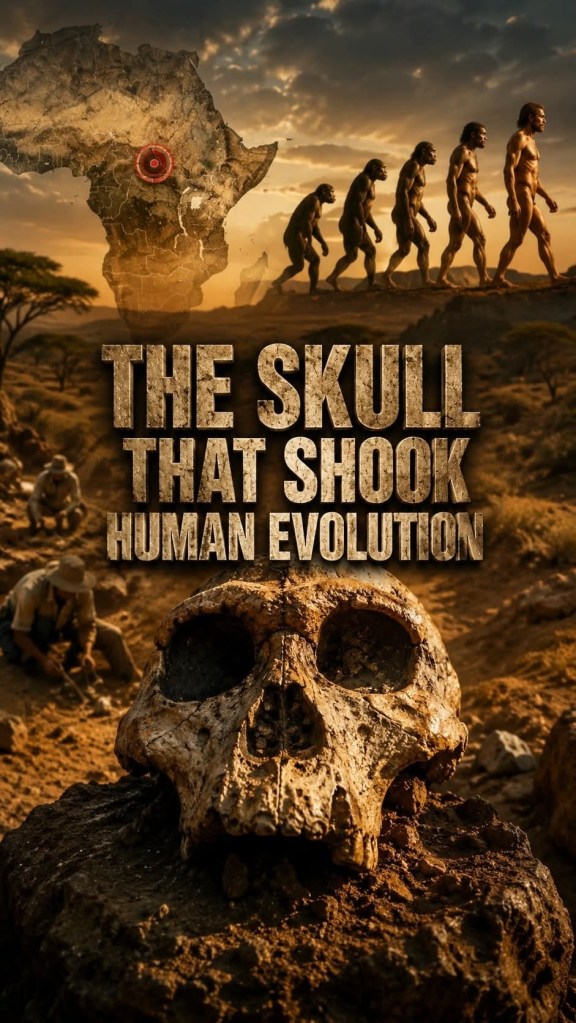
THEY THOUGHT THEY KNEW WHERE HUMANITY BEGAN… THEN TOUMAÏ APPEARED.
🔥 THEY THOUGHT THEY KNEW WHERE HUMANITY BEGAN… THEN TOUMAÏ APPEARED.
For generations, we were given a simple picture of human evolution.
Africa was the birthplace of humanity.
But when the story was told, attention often centered on the great fossil discoveries of East Africa.
Then, in 2001, something happened that made scientists rethink the map.
A skull was discovered in Chad.
Not Kenya.
Not Tanzania.
Not Ethiopia.
Chad.
Scientists called it Toumaï—Sahelanthropus tchadensis.
And this skull could be around 6–7 million years old.
Now stop for a moment.
If Toumaï really belonged somewhere near the beginning of the human evolutionary branch, then our ancient story may have been much more geographically complicated than the popular version suggests.
But here’s where things get REALLY interesting.
Toumaï had a small braincase.
Yet researchers found anatomical features that they interpreted as evidence that it may have been capable of walking upright.
Think about what that means.
Walking on two legs didn’t necessarily begin with a large human-like brain.
So maybe the story isn’t:
🧠 Bigger brain → walking upright → human.
Maybe evolution was experimenting with different traits independently.
And then there’s the controversial part.
Some scientists say Toumaï is one of the earliest known hominins.
Others aren’t convinced.
They argue that the skull could represent an ancient ape close to the evolutionary split between the ancestors of humans and chimpanzees.
And this is where social media gets the story wrong.
People love saying:
“Toumaï proves humans came from Chad!”
No.
That’s not what the evidence proves.
Toumaï is NOT proven to be our direct ancestor.
But dismissing it as “just another fossil” would also be a mistake.
Because it has forced scientists to confront a much bigger question:
What did the earliest members of our evolutionary lineage actually look like?
And then came another fascinating piece of evidence.
Bones associated with Sahelanthropus have been interpreted as suggesting bipedal locomotion while retaining adaptations useful for climbing.
In other words…
Our distant relatives may not have been choosing between:
TREES or GROUND.
They may have been doing BOTH.
Walking upright below.
Climbing above.
Moving through a changing African environment.
Surviving however evolution allowed them to survive.
And that should make us rethink the way we imagine human evolution.
Because evolution wasn’t a straight staircase where one species simply transformed into the next.
It was a chaotic tree.
Thousands—or perhaps millions—of branches.
Some disappeared.
Some survived.
And eventually, one tiny branch produced us.
But here’s the question I really want to put on the table:
How much of Africa’s evolutionary history have we actually discovered?
Think about the size of Africa.
Now think about how few fossils we have compared with the number of organisms that lived here over millions of years.
Every fossil site we excavate is just another page.
We haven’t found the whole book.
And if one skull from Chad can force scientists to rethink the geography of early human evolution…
what happens when we discover the next one?
Maybe the next fossil will support what we currently believe.
Maybe it will completely destroy it.
That’s how science works.
The evidence doesn’t care about our textbooks.
It doesn’t care about our assumptions.
And it certainly doesn’t care about our pride.
So I’ll leave you with TWO questions:
🔥 Was Toumaï an early member of the human lineage—or an ancient ape that lived close to the human-chimpanzee split?
And more importantly…
🔥 Do you think Africa’s human-evolution story is still massively incomplete?
👇 DROP YOUR THEORY IN THE COMMENTS.
But please—don’t just say “yes” or “no.”
Tell us WHY.
Let’s see whether the evidence can survive the debate.