STOP CALLING SAMORY TOURÉ JUST A “WARRIOR.” YOU’RE MISSING THE ENTIRE STORY.
STOP CALLING SAMORY TOURÉ JUST A “WARRIOR.” YOU’RE MISSING THE ENTIRE STORY.
Let me say something that might upset both sides of the argument:
Samory Touré was NOT a saint. But he was also NOT some helpless African ruler waiting for Europe to conquer him.
And if that statement bothers you, good.
Because history is not supposed to make us comfortable.
Samory Touré rose in West Africa during the 19th century and built what became known as the Wassoulou Empire.
He conquered territory.
He built an administration.
He organized armies.
He acquired firearms.
He developed military logistics.
He negotiated with foreign powers.
And when France began aggressively expanding into West Africa, Samory looked at the situation and understood something very clearly:
If he surrendered, his empire would disappear.
So he fought.
And here’s where the story gets interesting.
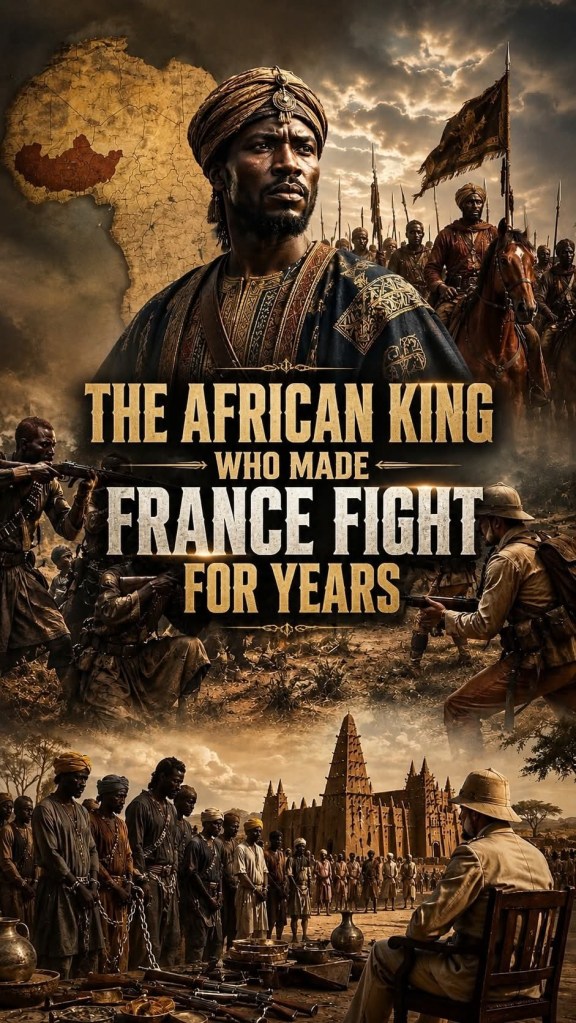
The French didn’t defeat Samory in one spectacular battle.
This was a long war of attrition.
Samory would lose territory, retreat, reorganize, rebuild his forces and fight again.
The French would capture one area, and Samory would establish himself somewhere else.
They pushed him eastward.
He rebuilt another political center.
They attacked again.
He negotiated when necessary.
He fought when necessary.
He used mobility because he understood that standing still against a technologically superior industrial army could mean destruction.
And this man kept the French busy for years.
But now let’s destroy another myth.
Samory Touré was not fighting simply because he wanted “African freedom.”
He was an empire-builder.
Before France became his greatest enemy, Samory had already fought and conquered other African communities.
His empire depended heavily on warfare, tribute and the capture and sale of people.
Some communities under his authority resisted him.
Some rebelled against his policies.
Some people remembered him not as a liberator, but as a conqueror.
So if someone tells you:
“Samory Touré was a perfect African hero,”
that’s mythology.
But if someone tells you:
“Samory Touré was nothing more than a slave trader,”
that’s also an incomplete history.
He was something far more complicated.
He was a conqueror AND a state-builder.
He was a Muslim ruler AND a military strategist.
He participated in the regional slave economy AND later became one of the strongest African opponents of French colonial expansion.
That’s the uncomfortable truth.
And here’s what I really want you to understand:
Africa was NOT politically empty before European colonialism.
There were kingdoms.
There were empires.
There were armies.
There were diplomatic alliances.
There were trade networks.
There were sophisticated political systems.
And African rulers were making strategic decisions long before European colonial borders were drawn across the continent.
Samory’s eventual defeat wasn’t proof that Africans couldn’t fight.
It demonstrated something much bigger:
You can be an extraordinary military strategist and still struggle against an industrial empire with vastly greater access to weapons, ammunition, transportation, finance and logistics.
Samory fought.
He adapted.
He negotiated.
He retreated.
He rebuilt.
And eventually, in 1898, the French captured him.
He was deported to Gabon.
He died there in 1900.
But here’s the question I want to leave you with:
Should Samory Touré be remembered as a hero?
Or should we judge him by the same standard we use for every empire-builder in history?
Because if we condemn European empires for conquering other peoples but romanticize every African conqueror simply because he fought Europeans…
aren’t we doing the exact same thing we’re criticizing?
History doesn’t need superheroes.
It needs the truth.
Samory Touré was neither saint nor simple villain.
He was a powerful African ruler who built an empire through conquest—and then fought desperately to prevent another empire from taking it away.
Now let’s debate.
Was Samory Touré an African freedom fighter, an African conqueror, or BOTH?
Drop your answer in the comments.
And don’t just say “hero” or “villain.”
Explain WHY.