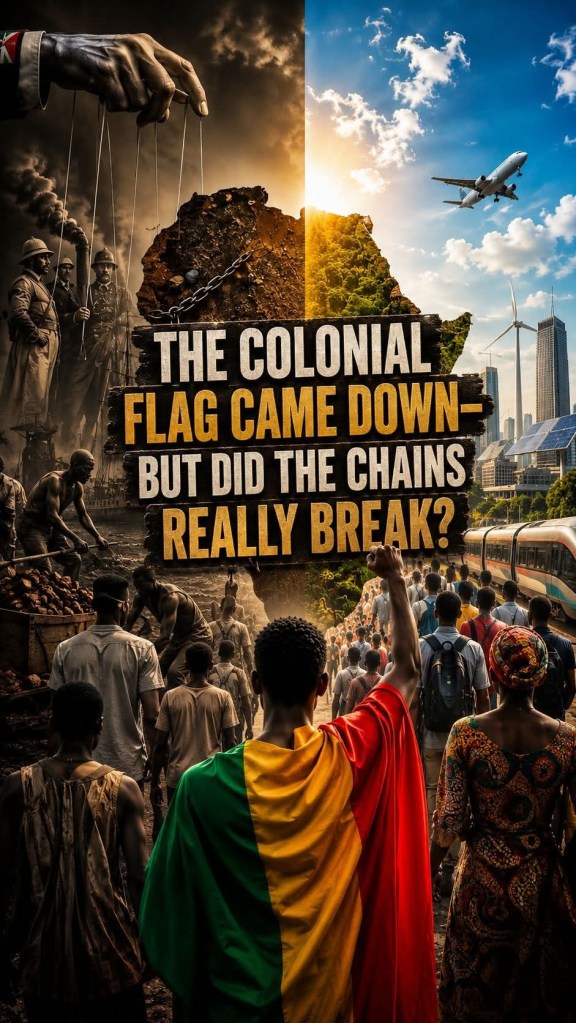
STOP SAYING AFRICA BECAME FREE THE DAY EUROPE LEFT. THAT STORY IS TOO COMFORTABLE.
STOP SAYING AFRICA BECAME FREE THE DAY EUROPE LEFT. THAT STORY IS TOO COMFORTABLE.
Yes, I said it.
The colonial flag came down.
African flags went up.
African presidents entered the presidential palaces.
And we were told:
“Congratulations. You are now independent.”
But independent from what?
And independent to do what?
Because here’s the uncomfortable part nobody wants to discuss.
Colonialism didn’t just occupy African land.
It reorganized African economies.
It drew political boundaries.
It created administrative systems.
It built economies heavily dependent on exporting raw materials.
And when independence arrived, African governments inherited much of that structure.
So let me ask the question that will probably make somebody angry:
If you inherit the house but somebody else still controls the bank, the machinery, the technology and the market where you sell your products… how much power do you actually have?
Don’t get emotional.
Think.
Ghana became independent in 1957.
Nigeria in 1960.
The Congo in 1960.
Kenya in 1963.
Zambia in 1964.
Africa celebrated.
And rightly so.
But political independence didn’t magically create economic independence.
The new states still had to deal with economies shaped during colonial rule.
Raw materials went out.
Finished products came back.
Foreign capital remained important.
Foreign technology remained important.
International markets determined the value of many commodities.
And powerful countries competed for influence across the continent.
Then came the Cold War.
Suddenly, Africa wasn’t just fighting poverty.
Africa became a battlefield of global geopolitical competition.
The Congo became one of the clearest examples.
Patrice Lumumba wanted a genuinely sovereign Congo.
But his country was immediately caught in political crisis, regional conflict and Cold War competition.
Lumumba was eventually assassinated.
And his death became a powerful symbol of the dangers surrounding African sovereignty during the Cold War.
Now before somebody jumps into the comments screaming:
“Everything is Europe’s fault!”
No.
Let’s have an adult conversation.
African leaders made decisions too.
Some built institutions.
Some destroyed them.
Some invested in education and infrastructure.
Others looted public resources.
Some defended national sovereignty.
Others became dictators.
Some military coups claimed to save their countries and ended up making things worse.
So no, Africa’s problems cannot honestly be blamed on one group of people forever.
But here’s another uncomfortable truth:
You cannot understand the postcolonial African state without understanding colonialism.
Both things can be true.
Colonialism left structural problems.
And postcolonial governments sometimes made those problems worse.
Now let’s talk about the part that REALLY makes people uncomfortable.
You can have political independence without economic independence.
You can have a flag without industrial power.
You can have a president without technological sovereignty.
You can have natural resources without controlling the entire value chain.
You can export cocoa while importing chocolate.
You can export crude oil while importing refined petroleum.
You can export minerals while importing expensive manufactured products containing those same minerals.
So when someone says:
“Africa is independent. Colonialism ended decades ago. Stop complaining.”
My response is simple:
Political independence is real.
But the struggle over economic power didn’t magically disappear.
And that’s exactly why the concept of neocolonialism became so controversial.
The question isn’t whether European soldiers are currently governing African countries.
They aren’t.
The question is:
Who has the power to influence the economic choices of supposedly sovereign states?
And that question doesn’t apply only to Europe.
It applies to America, China, Russia, multinational corporations, international financial institutions—and African elites themselves.
Because let’s stop pretending Africa is helpless.
Africa has enormous resources.
Africa has enormous markets.
Africa has one of the world’s youngest populations.
Africa has extraordinary agricultural potential.
Africa has energy resources.
Africa has strategic minerals.
Africa has intellectual talent.
So the question isn’t:
“Does Africa have wealth?”
The question is:
“Why does so much of that wealth fail to translate into power and prosperity for ordinary Africans?”
And THAT is where the real debate begins.
Maybe Africa doesn’t need another lecture about “development.”
Maybe Africa needs to ask who controls the value chains.
Who owns the factories?
Who processes the minerals?
Who controls the technology?
Who finances the infrastructure?
Who determines the terms of trade?
Who controls the data?
Who negotiates the contracts?
And perhaps most importantly:
Who benefits?
Because if Africa remains a supplier of raw materials while importing the expensive finished products made from those materials, then changing the flag was only one part of the liberation story.
And before anyone accuses me of blaming foreigners for everything, I’ll say this clearly:
African governments must take responsibility.
Corruption must be confronted.
Bad leadership must be challenged.
Institutions must be strengthened.
Industrialization must happen.
Education must produce knowledge—not just certificates.
And African countries must learn to negotiate with the rest of the world from a position of strength.
So here’s my question for you:
🔥 Was African independence the completion of decolonization—or merely the beginning?
And don’t give me a lazy answer.
If you believe Africa is completely independent, explain why.
If you believe Africa is still economically dependent, explain who or what is responsible.
And if you believe African leaders themselves are now the biggest obstacle, say it.
Let’s argue with history—not insults.
Because the colonial flag may have disappeared…
but the struggle over power never did.