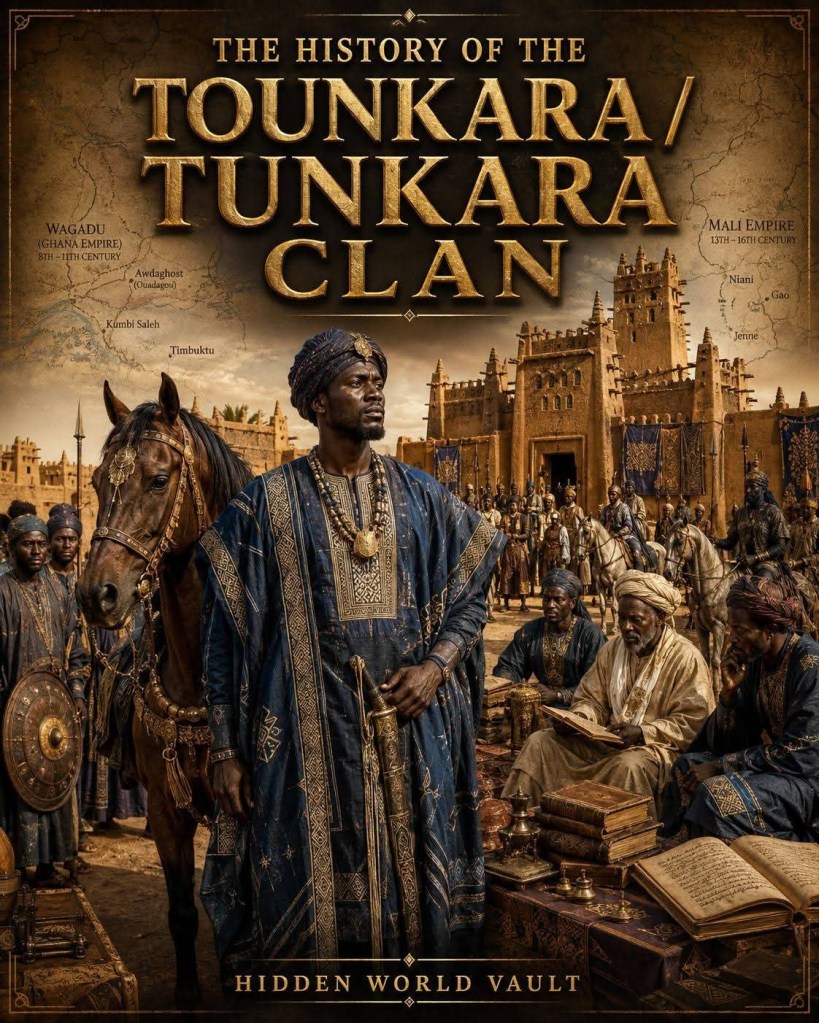
THE HISTORY OF THE TOUNKARA / TUNKARA CLAN
THE HISTORY OF THE TOUNKARA / TUNKARA CLAN
From the royal traditions of Wagadu to the Manding world
Across West Africa, the same ancestral name can appear under several spellings: Tounkara, Tunkara, Tonkara, Toungara, Tongara, Tangara, Tancara, Tunkar, Tunkare, Tunkarl and related forms.
The surname Tounkara/Tunkara is particularly significant because historical and genealogical sources connect it to the Soninke and Manding worlds and to the political traditions surrounding ancient Wagadu/Ghana.
So behind the spelling lies a much bigger question:
Was Tunkara originally simply a surname, or was it once a title associated with sovereignty and royalty?
- TUNKA: THE KEY TO UNDERSTANDING TOUNKARA
One of the most important words in this history is Tunka.
In Soninke historical traditions, Tunka refers to a king, ruler or sovereign. Academic historical work also records tunka as a Soninke term for ruler.
This is why the expression Tunkara has attracted so much attention.
In one Soninke tradition, the name is interpreted through:
Tunka + ra
with Tunka referring to the ruler and ra being interpreted within the tradition as family, household or belonging.
This produces the traditional interpretation of:
“the family of the ruler”
or
“those belonging to royalty.”
This interpretation should be treated as a traditional etymology, rather than an unquestionable linguistic fact.
And that distinction matters.
History becomes stronger, not weaker, when we distinguish what is documented from what is transmitted through tradition.
- THE TOUNKARA AND ANCIENT WAGADU
Soninke oral traditions place the origins of their civilization in Wagadu, commonly identified with the Ghana Empire.
Historical scholarship confirms that Soninke-speaking peoples played a central role in the ancient Ghanaian political formation, although the exact ethnic and dynastic structure of the early empire remains a subject of historical debate.
Soninke traditions associate the ruling houses of Wagadu particularly with Wagué and Cissé dynasties.
Some Soninke traditions also associate the royal title Tunka/Maghan with these rulers.
A nineteenth- and early twentieth-century French historical tradition recorded by Maurice Delafosse goes further, describing the Sissé-Tounkara as connected with the royal family of ancient Ghana and the descendants of Kaya Maghan.
This is one of the reasons the Tounkara name became associated with royal ancestry in Soninke historical memory.
- TOUNKARA WAS NOT ALWAYS JUST A FAMILY NAME
This is perhaps the most fascinating part.
Historical evidence indicates that Tunkara could function as a royal or honorific designation, rather than simply a modern inherited surname.
Research on West African history records Tunkara as a form of address associated with high-ranking officials and rulers.
One scholarly study notes that Tunkara was used as an honorific expression carrying an approximate meaning of “Your Highness” or “belonging to royalty.”
Another historical source records that the political power of Ghana was transmitted through the Sissé-Tounkara royal line.
That gives us an important historical distinction:
Tunka = ruler/title
Tunkara = an expression associated with royalty or belonging to the ruling establishment
Over generations, titles and political designations can become hereditary family names.
That process is not unique to West Africa.
- THE CISSÉ–TOUNKARA CONNECTION
The relationship between Cissé and Tounkara is one of the most important traditions surrounding the name.
Soninke traditions describe the Cissé as one of the major ruling families of Wagadu.
Some traditions interpret Tounkara as a designation connected to the royal Cissé lineage.
A Soninke historical tradition explicitly states that the Cissé and Tounkara dynasties were among the ruling dynasties associated with the Ghana Empire.
Another historical account describes the transmission of Ghana’s royal authority through the Sissé-Tounkara family.
But there is an important caution:
We should not automatically interpret every modern Cissé and every modern Tounkara as belonging to one identical biological lineage.
Centuries of migration, marriage, adoption, political affiliation and social incorporation transformed West African clan structures.
A surname can preserve memory without providing a complete genetic genealogy.
- THE DOUKOURÉ–TOUNKARA CONNECTION
According to Soninké oral tradition, the Doukouré and Tounkara lineages are historically connected to the royal and aristocratic traditions of Wagadu (the ancient Ghana Empire). One tradition holds that Doukouré families originated from the Tounkara royal lineage, with the name Doukouré emerging from a branch of the family associated with military leadership and victory in warfare.
In this interpretation, Tounkara represents the royal house, while Doukouré became associated with a distinguished military branch that developed its own authority and identity. Over generations, this branch became recognized as Doukouré, while retaining its deeper connection to the Tounkara tradition.
The tradition therefore presents the relationship not simply as two unrelated surnames, but as a story of royal lineage, military service, branching families and the transformation of clan names over time.
This account is primarily preserved through Soninké oral tradition and should be presented as a tradition requiring comparison with written historical and genealogical sources.
- THE TOUNKARA IN MÉMA
The story does not end with Wagadu.
Tounkara traditions extend into Méma, a historical region west of the Niger River.
This is especially significant in the history of the Mali Empire.
Historian Nehemia Levtzion notes that during Sundjata’s exile, he is traditionally said to have stayed at the court of the Tunkara ruler of Mema, who subsequently provided support to Sundjata in his struggle to liberate the Mandinka.
This is a remarkable connection.
It means that the Tunkara tradition was not confined to the ancient Ghanaian political world.
It continued into the political landscape from which the Mali Empire emerged.
- FROM WAGADU TO THE MANDING WORLD
The collapse and transformation of the Ghanaian political order did not mean the disappearance of its peoples.
Soninke populations migrated and established communities throughout the western Sahel.
Historical sources describe major Soninke migrations following the Almoravid conquest of Ghana in the late eleventh century, contributing to the formation and expansion of Soninke states elsewhere.
As populations moved, clans, titles, traditions and genealogies moved with them.
This helps explain why names associated with Wagadu can later appear in:
Mali
Mauritania
Senegal
The Gambia
Guinea
Burkina Faso
Côte d’Ivoire
Sierra Leone
Liberia
and beyond.
The name survived because the people survived, and because memory travelled with them.
- THE TOUNKARA AND THE MALI EMPIRE
The Tounkara also appear in Manding traditions surrounding the rise of Soundiata Keïta.
The historical traditions surrounding Mema and Wagadu describe Tunkara rulers as important political actors during the period of Soundiata.
The connection is particularly interesting because the rise of Mali did not erase the older political traditions of Wagadu.
Instead, many older families, titles and political institutions were incorporated into the expanding Manding world.
This is one reason why Mande history cannot be reduced to a single dynasty or a single ethnic group.
Wagadu, Mema, Sosso, Mali and later Manding states were connected through centuries of migration, warfare, diplomacy, marriage and political integration.
- THE MANY SPELLINGS OF THE NAME
Why do we encounter Tunkara, Tounkara, Tonkara, Toungara, Tongara, Tangara and other forms?
Because African surnames were not originally standardized according to modern European spelling systems.
A name could be recorded according to:
the pronunciation of the speaker;
the language of the scribe;
French orthographic conventions;
British colonial conventions;
Arabic transcription;
local dialect;
administrative spelling;
or simply the preference of the individual family.
This is why the same ancestral name can appear differently in historical documents.
For example, Tunkara and Tounkara should not automatically be treated as unrelated names simply because one contains “u” and the other “ou.”
At the same time, we must be careful:
similar spelling does not automatically prove common ancestry.
Genealogy requires more than phonetics.
- THE ANGLOPHONE AND FRANCOPHONE FORMS
In English-speaking West Africa, particularly in places such as The Gambia and Sierra Leone, the form Tunkara is common.
In Francophone West Africa, particularly Mali, Guinea and Senegal, Tounkara is widespread.
Other forms such as Tonkara, Toungara, Tongara, Tangara and Tancara occur in different regional and family contexts.
These variations demonstrate something fundamental about African history:
colonial borders divided people who had been connected for centuries.
The spelling on a modern identity document does not necessarily tell the complete story of the name.
- THE TOUNKARA AS A ROYAL MEMORY
Perhaps the most powerful interpretation of the Tounkara tradition is not simply that the name means “royal family.”
It is that the surname preserves a memory of political authority.
Imagine a title used around a royal court centuries ago.
Generations pass.
The empire disappears.
The court disappears.
The political institution disappears.
But the name survives.
A title becomes a family designation.
A royal designation becomes a surname.
A surname becomes a genealogical identity.
And eventually, centuries later, descendants still carry the word without necessarily knowing the political world in which it originated.
That is how history can survive inside a name.
- TOUNKARA AND THE SONINKE WORLD
The Soninke dimension of Tounkara history is particularly strong.
Soninke historical traditions explicitly connect Tounkara with the political history of Wagadu/Ghana.
The name therefore belongs to a wider historical environment involving:
Wagadu → Ghana → Mema → Sosso → Mali → Manding migrations
These should not be viewed as isolated chapters.
They represent overlapping political and cultural worlds.
- BUT WHAT ABOUT THE MANINKA AND MANDINKA?
This is where the story becomes even more interesting.
The Tounkara name is not exclusively encountered among people who identify themselves today as Soninke.
The name is also found within Mandinka and Malinke communities.
FamilySearch’s surname reference specifically describes Tounkara as a name of the Tunkara clan of the Mandinka and closely related Soninke peoples.
This reflects centuries of interaction between Soninke and Manding-speaking populations.
The medieval Sahel was not divided into the rigid ethnic categories we sometimes imagine today.
People migrated.
Languages changed.
Families married.
Rulers conquered territories.
Communities adopted new languages.
And clans entered new political systems.
- THE TOUNKARA QUESTION IN GUINEA
The movement of Manding peoples southward eventually brought various Tounkara families into areas that today form Guinea.
This is particularly important because modern Guinea contains communities with deep connections to:
Soninke
Malinke
Djalonké
Kouranko
Kono
and other Mande-speaking peoples.
Some Tounkara traditions also associate branches of the family with Kita, Beyla, Kankan and other regions.
However, these specific genealogical traditions require local oral histories and documentary evidence to establish each family’s precise lineage.
We should therefore distinguish:
the broad historical connection of Tounkara with the Soninke/Manding world
from
the precise genealogy of an individual Tounkara family.
- WHAT ABOUT THE “ROYAL TOTEM”?
Some oral traditions associate the Tounkara with the boa.
But this claim requires caution.
Totemic traditions vary from one community and lineage to another, and a symbolic animal associated with one branch cannot automatically be attributed to every person bearing the surname.
Therefore, the boa should be presented as an oral tradition associated with certain Tounkara narratives, not as an established universal fact.
That distinction protects the history from exaggeration.
- ORAL HISTORY VS WRITTEN HISTORY
This story demonstrates why Africa’s past cannot be reconstructed from only one type of evidence.
Oral tradition preserves genealogies, royal memories, migrations, praise names and family histories.
Written sources preserve administrative records, Arabic chronicles, colonial documents and later ethnographic studies.
Both have strengths.
Both have limitations.
A griot can preserve information transmitted across generations, but oral traditions can change.
A colonial administrator can leave a written record, but colonial observers could misunderstand local languages and institutions.
An academic historian can analyze both, but historians themselves can disagree.
Therefore:
Oral tradition must be investigated, not blindly accepted.
Written history must be investigated, not blindly accepted.
The strongest reconstruction comes from comparing multiple forms of evidence.
Scholars of Soninke history have specifically emphasized the importance of analyzing oral traditions as historical sources and understanding their social and political functions.
- WHAT WE CAN SAY WITH GREATER CONFIDENCE
The strongest evidence allows us to say that:
- Tunka is a documented Soninke term associated with rulers or chiefs.
- Tunkara is historically associated with Soninke and Mandinka communities.
- Historical traditions connect Tunkara with the political and royal traditions of ancient Wagadu/Ghana.
- Tunkara rulers were associated with Mema in traditions concerning the period of Soundiata.
- The name spread geographically as Soninke and Manding populations migrated and established new communities.
- The modern spelling variants should be studied within their linguistic and colonial contexts rather than automatically treated as completely separate surnames.
- WHAT REMAINS A MATTER OF TRADITION OR DEBATE?
Several popular claims deserve further investigation:
that every Tounkara descends directly from one ancient royal ancestor;
that every Tounkara is descended from the Cissé dynasty;
that the surname universally means “imperial family”;
that every Tounkara shares the same totem;
that every modern spelling variation represents the exact same lineage;
and that every modern Tounkara family can trace an uninterrupted genealogy to ancient Wagadu.
These are fascinating traditions.
But tradition is not the same thing as proof.
The responsible approach is to preserve the tradition while continuing to investigate it.
- THE BIGGER LESSON
The history of Tounkara teaches us something bigger than the history of one surname.
African surnames are often archives in miniature.
A name can contain memories of:
kings, migrations, wars, kingdoms, occupations, religious transformations, alliances, languages and ancient political institutions.
A person may carry a surname today without realizing that its earliest recorded meaning belonged to a completely different political world more than a thousand years ago.
That is why African genealogy deserves serious scholarship.
Not ridicule.
Not ethnic competition.
Not fabricated certainty.
Research.
- THE FINAL QUESTION
So when someone asks:
“Where did the Tounkara come from?”
the answer cannot simply be:
“Mali.”
Nor can it simply be:
“Guinea.”
Nor:
“The Manding.”
Nor:
“The Soninke.”
The deeper historical answer leads us toward the ancient Wagadu/Ghana world, the Soninke political tradition, the royal concept of Tunka, the historical region of Mema, the rise of Mali, and centuries of Manding migration and cultural interaction.
The surname travelled.
The spelling changed.
Kingdoms disappeared.
Borders moved.
Languages evolved.
But the name survived.
TOUNKARA. TUNKARA. TONKARA. TOUNGARA. TONGARA. TANGARA. TANCARA.
Different spellings.
One extraordinary historical question:
How much of West Africa’s forgotten past is still hiding inside the names we carry today?
SOURCES & REFERENCES
Written / scholarly sources consulted:
● Patrick Hanks, Dictionary of American Family Names, as reproduced in FamilySearch’s Tounkara surname reference.
● Maurice Delafosse, Haut-Sénégal-Niger, historical and ethnographic work concerning Soninke traditions and the Sissé-Tounkara royal line.
● Nehemia Levtzion, Ancient Ghana and Mali, on Mema, Tunkara rulers and the traditions surrounding Sundjata.
● Michael A. Gomez, African Dominion: A New History of Empire in Early and Medieval West Africa, including discussion of Tunka and Tunkara as royal/honorific terminology.
● Afriques scholarly research on Soninke/Mande terminology and the historical use of Tunkara.
● Monique Chastanet’s discussion of Mamadou Diawara’s research on Soninke oral traditions and their historical function.
Oral / traditional sources:
● Soninke and Manding griot traditions, family genealogies, praise traditions and oral histories concerning Wagadu, the Wagué and Cissé dynasties, Tounka/Tunkara rulers, Mema and the later Manding world. These traditions have been recorded and discussed in several historical and ethnographic works, but individual genealogical claims should be independently verified where possible.
History is not merely written in books.
Sometimes it survives in a surname.
HiddenWorldVault #Tounkara #Tunkara #SoninkeHistory #MandingHistory #Wagadu #GhanaEmpire #MaliEmpire #Africa