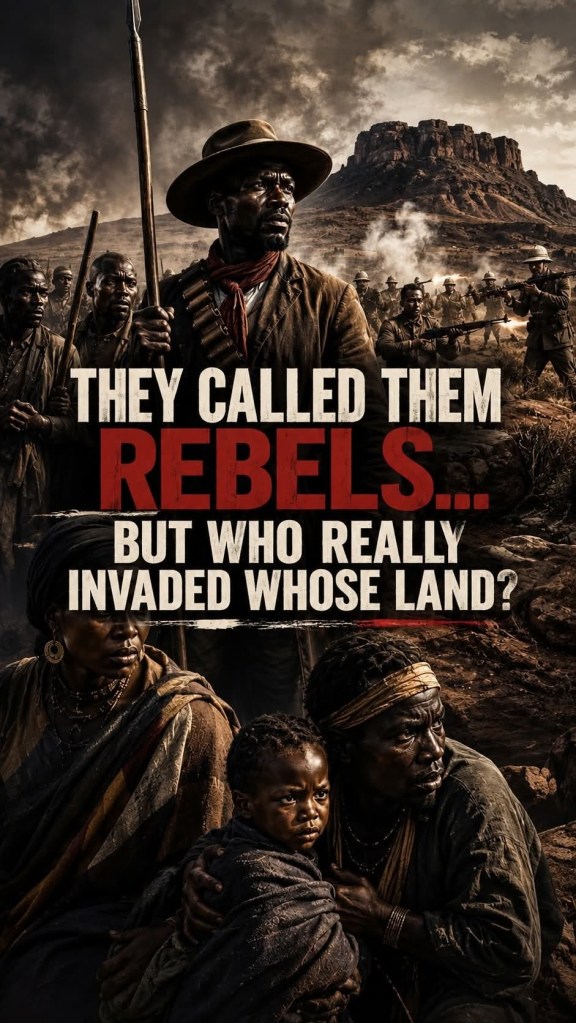
GERMANY CALLED IT A COLONIAL WAR. HISTORY CALLS IT GENOCIDE. SO WHY ARE WE STILL AFRAID TO TALK ABOUT IT?
GERMANY CALLED IT A COLONIAL WAR. HISTORY CALLS IT GENOCIDE. SO WHY ARE WE STILL AFRAID TO TALK ABOUT IT?
Let me say something that might make some people uncomfortable.
When Africans fought to defend their land, Europeans called them rebels.
When Europeans massacred Africans and took their land, they called it colonialism.
So tell me…
Who exactly were the real aggressors?
Let’s talk about the Herero and Nama people of Namibia.
Because this is one African story that exposes the ugly truth many people still don’t want to confront.
In 1884, Germany took control of what is now Namibia.
They didn’t discover empty land.
They arrived where people were already living.
The Herero had their land.
They had cattle.
They had leaders.
They had a society.
The Nama had their own communities, leaders, and territories.
Then Germany arrived and decided, essentially:
“This belongs to us now.”
Land was taken.
Cattle were lost.
Africans were pushed into debt.
Settlers expanded.
Racism became part of the colonial system.
And when the Herero finally fought back in 1904, history conveniently labeled it an uprising.
But let me ask you:
If foreigners entered your country, took your land, controlled your resources, and treated you like an inferior human being, and you fought back… would you call yourself a rebel?
Or would you call yourself a freedom fighter?
The Herero fought.
And Germany responded with overwhelming force.
Then came the Battle of Waterberg.
Thousands of Herero men, women, and children fled.
But fleeing wasn’t enough.
They were pushed toward the Omaheke Desert.
A desert.
Think about the cruelty of that.
Families fleeing with children.
No reliable water.
Little food.
People dying from thirst.
People dying from hunger.
People dying simply because they had been born on land that European colonialists wanted to control.
And then General Lothar von Trotha issued an extermination order.
Let that sink in.
An extermination order.
This wasn’t simply about defeating an army anymore.
This was about destroying a people.
And when the Nama saw what was happening to the Herero, they understood the message.
“Today it is them. Tomorrow it could be us.”
So they fought too.
Hendrik Witbooi fought.
Jakob Morenga fought.
Simon Kooper fought.
The Nama used guerrilla warfare because they understood something:
You don’t defeat a powerful invading army by standing in front of its artillery and politely asking for justice.
You resist with what you have.
And when Germany captured survivors?
They didn’t simply send them home.
They put them in concentration camps.
Yes.
CONCENTRATION CAMPS.
In colonial Africa.
Years before Nazi Germany became infamous for the Holocaust.
People were imprisoned.
Forced to work.
Starved.
Exposed to disease.
And thousands died.
Shark Island became one of the symbols of that horror.
Now here comes the controversial question.
Why does the world expect Africans to “move on” from colonial crimes while the world insists that other historical atrocities must never be forgotten?
Why are some genocides taught across the world…
While others are treated like a footnote?
Is the value of remembering a genocide determined by who the victims were?
Let’s be honest.
If this had happened to millions of Europeans on European soil, would the story be discussed differently?
Would every schoolchild know the names?
Would there be movies?
Museums?
International memorial days?
Or would people still be saying:
“That happened a long time ago. Move on.”
Because somehow, when Africans demand historical justice, people suddenly become experts in forgiveness.
They say:
“Don’t blame the present generation.”
“Why are you still talking about the past?”
“Slavery and colonialism happened a long time ago.”
Really?
Then let me ask you another question:
If the past doesn’t matter, why are former colonial powers still benefiting from wealth, land systems, and global structures built during the colonial era?
You cannot tell people to forget history while living with the consequences of history.
The descendants of the Herero and Nama are not asking us to travel back in time.
They are asking the world to acknowledge what happened.
And Germany eventually recognized the genocide.
But recognition raises another difficult question:
Is saying “sorry” enough?
Can an apology replace stolen land?
Can money repair generations of economic destruction?
Can governments negotiate reconciliation without fully satisfying the descendants of the people who suffered?
And before someone says:
“Africa also had wars before Europeans arrived.”
Of course, it did.
Africa had wars.
Europe had wars.
Asia had wars.
Human beings have fought wars throughout history.
But let’s stop using that argument to excuse colonial genocide.
A war between African societies is not the same thing as a foreign empire arriving, taking control of another people’s homeland, and implementing policies that lead to the destruction of entire communities.
Let’s not confuse history simply because the truth makes us uncomfortable.
And here’s another uncomfortable question:
Why are African children sometimes taught more about the history of European kings than African resistance heroes?
Why do we know the names of foreign conquerors but struggle to name our own freedom fighters?
Samuel Maharero.
Hendrik Witbooi.
Jakob Morenga.
Simon Kooper.
These names should not be forgotten.
Because the Herero and Nama were not simply victims waiting to die.
THEY FOUGHT BACK.
They resisted.
They refused to surrender their land without a fight.
They challenged an empire.
And yes, they were militarily defeated.
But the Germans could kill thousands of people.
They could take land.
They could destroy communities.
But they could not completely erase the truth.
And that truth is finally being spoken louder today.
So I want an honest debate.
No emotional manipulation.
No hiding behind political correctness.
No pretending history doesn’t matter.
HERE ARE MY QUESTIONS:
- Should former colonial powers pay reparations for genocide and colonial crimes—or is an apology enough?
- If stolen land cannot be returned, what does real justice actually look like?
- Why do you think some genocides receive global attention while African genocides remain largely unknown?
- Is telling African descendants to “move on” an honest call for reconciliation—or simply a way to avoid accountability?
- And the biggest question of all:
If the Herero and Nama had won, would history call them heroes—or would Europe still call them rebels?
I want to hear your honest opinion.
But remember:
History does not become less brutal simply because the victims were African.
And forgetting African history is one of the easiest ways to repeat the same injustice under a different name.
LET THE DEBATE BEGIN. 👇🔥