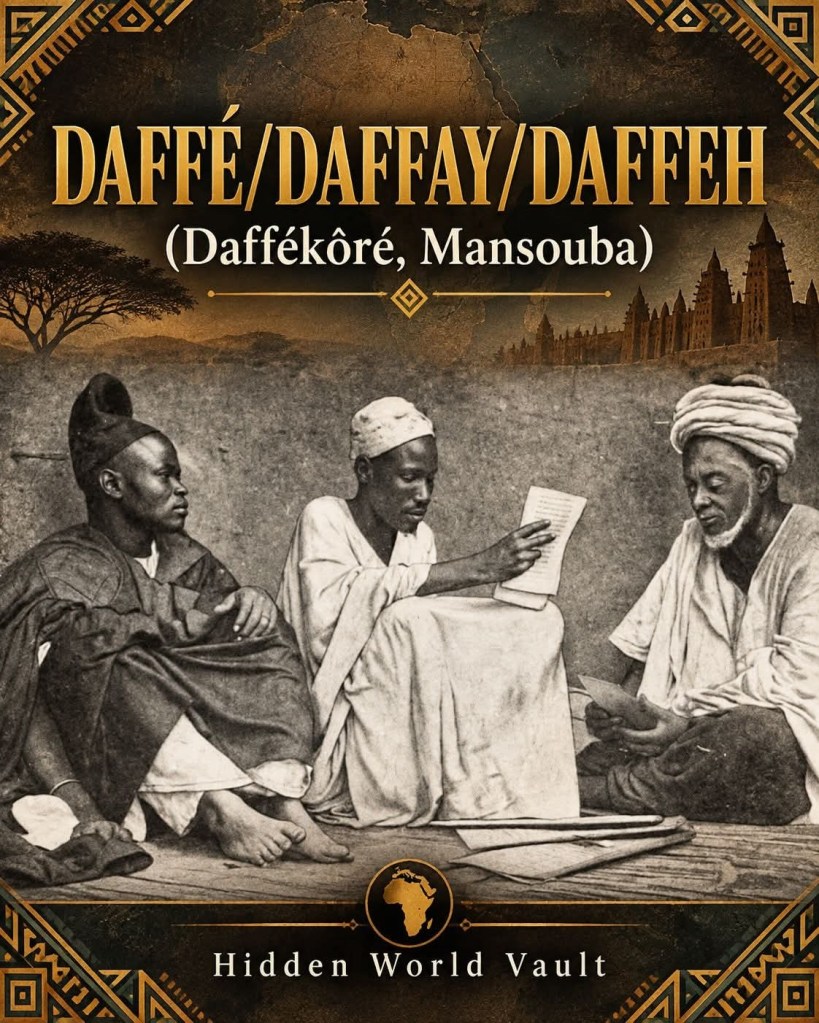
THE HISTORY OF THE DAFFÉ SURNAME
THE HISTORY OF THE DAFFÉ SURNAME
From the Ancient Wagadou Traditions to Mali, Guinea, Senegal, The Gambia and Sierra Leone.
Every West African surname carries a story.
For the Daffé family, oral traditions connect their history to the ancient movements of peoples across the Western Sahel, Soninké and the wider Manding world.
According to the traditions presented in the sources, the ancestors of the Daffé lived in the region of Gao before the rise of Wagadou, traditionally associated with the ancient Ghana Empire.
- FROM GAO TO WAGADOU
The tradition says that the ancestors of the Daffé moved south along the Niger River, eventually reaching Boidiè during the period associated with the Wagué rulers of Wagadou.
They later moved north and settled in Goumbou, during the period traditionally associated with the Cissé rulers of Koumbi.
From there, they are said to have moved to Diafounou, during the period associated with the Sacko.
Following the decline of Wagadou, the Daffé moved toward western Mandé, settling in the Wangara country, particularly around Baniakadougou in the Bafing region.
Tradition places them alongside families such as the Diané, Cissé, Bérété, Watara and Bella.
- THE KINGDOM OF MARA
According to this tradition, the Daffé later left the Bafing after the territory came under the control of the Keita, who were associated with the Kingdoms of Mara.
They moved toward the Tambaoura Mountains.
The Daffé are then said to have joined a coalition known as the Mouttira, described in the tradition as rebels who opposed the Kayta rulers of Mara.
After the Kayta were driven out, the Diané, Bérété and Cissé families are said to have successively occupied the throne.
Later, with the support of the Watara and Bella, the Daffé themselves took control of Mara.
Their rule, however, did not last. The kingdom was eventually destroyed by the powerful Kingdom of Karta.
- WESTWARD MIGRATION
Following the destruction of Mara, the Daffé, together with branches of the Cissé and Diané, are said to have moved westward toward territories that are today part of Tambacounda and Casamance in Senegal.
According to the tradition, some Daffé later supported the Kanté of the Sosso Kingdom in conflicts involving Karta and Mandé.
After the defeat of Soumaoro Kanté, the tradition says that Daffé warriors were pursued by the forces of Tirmakan Tarawele.
Some eventually sought refuge in Fouta-Toro, where the name is said to have taken the form Daff, while other branches moved toward Fouta-Djallon.
- THE DAFFÉ FAMILY ACROSS WEST AFRICA
Over generations, Daffé families spread across different parts of West Africa.
● GUINEA
Daffé families are found in parts of:
Upper Guinea: Siguiri, Kankan, Kouroussa and surrounding areas.
They are also found in parts of Middle Guinea and Lower Guinea, through migration, trade, settlement and intermarriage.
● SENEGAL & THE GAMBIA
The form Daffeh is found in Manding-speaking areas, including Casamance and parts of The Gambia.
Some families are also associated with local Islamic and scholarly traditions.
● MALI
Daffé families are associated by tradition with Soninké areas, and areas such as Kita, Kangaba and the wider Manding region.
● SIERRA LEONE
In Sierra Leone, the surname is found in the form Daffay.
According to family traditions, some Daffay families arrived through migration, trade and other forms of movement across the Guinea–Sierra Leone frontier.
They can be found among communities including the Mandingo, Koranko, Soso and Yalunka, reflecting the complex history of migration, intermarriage, cultural exchange and assimilation in northern and eastern Sierra Leone.
Traditional family locations mentioned include:
Kono, Karina, Manjoro, Waridala, Kambia, Falaba and Mongo.
- THE DJAMOU OF THE DAFFÉ
One important part of Manding identity is the djamou/jammu, a traditional praise name or ancestral designation connected with family identity and oral history.
The Daffé are traditionally associated with the djamou:
DAFFÈKÔRÈ
MANSOUBA
These names form part of the oral heritage through which family histories and ancestral memories are passed from one generation to another.
- MORE THAN A SURNAME
The Daffé story is not simply the story of a name.
It is a story of migration, kingdoms, warfare, religion, trade, cultural exchange and adaptation across West Africa.
Over centuries, families moved across political borders that did not exist in their present form. A branch could change its language, adopt a new local identity, intermarry with another community, or develop a different spelling of its surname while still preserving memories of an older lineage.
■ A NOTE ON HISTORY
Much of the Daffé genealogy and migration history presented here comes from oral traditions and family historical memory. Oral traditions are important sources for understanding how communities remember their past, but individual genealogical claims should ideally be compared with written records, linguistics, archaeology and other historical evidence.
The purpose is not to dismiss oral history, but to preserve it while continuing to investigate it.
The Daffé story is another chapter in the great history of West African migrations, the Soninké and the wider Manding world.
SOURCES
- Oralité, Bulletin du Collectif des Historiens du Sahel-Soudan, No. 4, November 2015.
- Rois et Peuples de l’Empire du Ghana, Kindle Edition, 2018.
- Youba Bathily, Après l’Empire du Ghana. Entre les Empires du Ghana et du Mali, Éditions Mieruba, 2019.
- Khalil Djafounouka Kaba