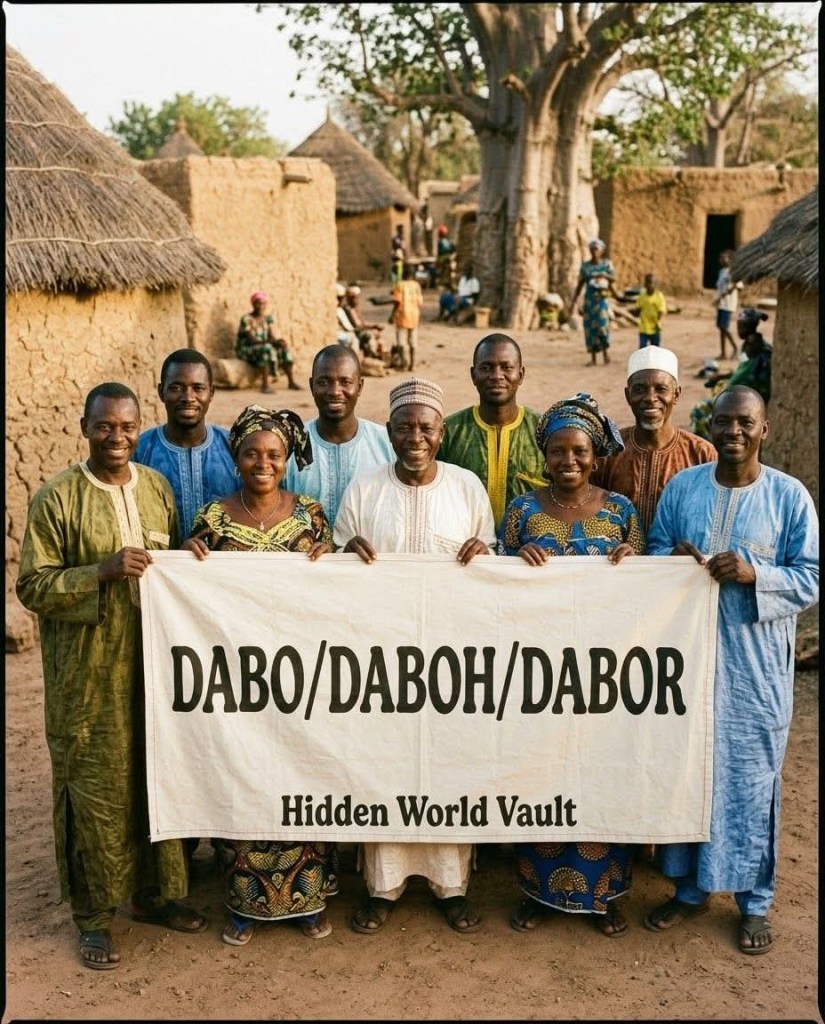
WHO ARE THE DABO?
WHO ARE THE DABO?
The Forgotten History Behind the Dabo, Daboh & Dabor Surname
The name Dabo is relatively uncommon compared with many better-known West African surnames. Yet behind this seemingly simple name lies a fascinating history involving Soninké ancestry, Manding traditions, migration, land, political change and the movement of families across West Africa.
But the Dabo also have another important name preserved in tradition:
Sankadjan, or simply Sanka.
So, who are the Dabo? Where did they come from? What does the name mean? And how did Dabo families become established in different parts of West Africa?
Let us open the vault.
- THE DABO IN THE MANDING WORLD
According to traditions concerning the lineage, the Dabo are associated with the wider Manding and Soninké historical world, with important historical connections to areas of present-day Guinea and Mali, as well as communities elsewhere in West Africa.
The lineage has traditionally been regarded in some communities as belonging to respected and prosperous families.
Their dignified or traditional name is said to be Sankadjan, also shortened to Sanka.
However, it is important to remember that a surname does not always correspond neatly to a modern ethnic identity.
West African families migrated, intermarried, changed languages and became incorporated into different communities over many centuries.
Therefore, the history of a surname can be much older and geographically wider than the identity attached to it today.
- THE EARLY SETTLEMENTS OF THE DABO
According to the traditions surrounding the Dabo lineage in Guinea, their early settlement followed a particular route.
Their first settlement was in Tatidou, in the Kouroussa area.
From Tatidou, the lineage is said to have moved toward Dabola.
Eventually, they established themselves at Kouroukoro, which today is regarded in tradition as their stronghold in Guinea.
In Sierra Leone, the Dabo are also found in places such as:
Manjoro
Waridala
Karina
Kono
This tradition is important because it gives us a geographical framework for understanding the movement and settlement of the Dabo in present-day Guinea.
At the same time, these settlement traditions should be compared with genealogies, oral histories and documentary sources before treating every detail as historically established.
- WHAT DOES “DABO” MEAN?
One tradition gives the name Dabo an unusual interpretation: “the one who is not his” or “those who do not belong to him.”
This explanation is connected to an ancestral story in which the Dabo are said to have relationships with Camara and Konté, while some traditions also associate them with the Sissoko.
Such explanations should primarily be understood as genealogical and oral traditions, rather than automatically treating them as linguistically proven facts.
That distinction matters.
In African historical research, a traditional explanation of a surname can preserve an important ancestral memory even when the literal linguistic meaning remains uncertain.
- THE DABO AND FATAO
One particularly interesting tradition comes from the region of Kayes in present-day Mali, especially the village of Fatao.
There, the Dabo have traditionally been associated with the management or stewardship of land.
The name Fatao itself has also been explained traditionally through Soninké in connection with agreement, understanding or accord.
This is significant because land was not simply an economic resource in traditional West African societies.
Land could represent:
ancestry
authority
political legitimacy
social responsibility
community identity
Consequently, a family’s association with land management could reflect an important position within the local social structure.
- THE FIFTEENTH-CENTURY MOVEMENTS
Another part of the Dabo story takes us toward the fifteenth century, a period of considerable political and religious transformation across the western Sahel and the wider Niger region.
According to the historical account attributed to A. Arcin, political disturbances in the Inner Niger Delta contributed to movements of various Malinké and Sarakollé maraboutic families from centres such as Djenné and Timbuktu toward western regions.
The Dabo are traditionally placed within this broader history of migration and settlement.
Some accounts associate their movement with Badora and Niokholo, where Dabo families are said to have established themselves in areas possessing considerable natural resources.
However, the precise relationship between these movements and particular Dabo genealogies requires further investigation.
- THE DABO AND NIOKHOLO
The Niokholo region became another important area in traditions concerning the Dabo.
The lineage is also associated in different accounts with:
Niokholo
Niokoula
Ouli
Dentilia
Fatao
Socé communities
Soso communities of Mellacorée (Morea)
This distribution is historically interesting because it demonstrates how family names could cross linguistic and political boundaries.
A family could move into another community, adopt a new language or become culturally integrated into another society while still preserving memories of its ancestral lineage.
- DABO, DABOH AND DABOR
Today, the surname may appear in different written forms, including:
Dabo — Daboh — Dabor
Such variations should be investigated carefully rather than automatically assuming that they represent either completely different families or unquestionably identical lineages.
Across West Africa, names were traditionally transmitted largely through speech.
Later, colonial administrators, missionaries, Islamic scholars and modern governments recorded these names according to different writing systems, spellings and local pronunciations.
This produced many variations in African surnames.
The spelling may change.
The ancestral memory may remain.
- THE DABO IN GUINEA TODAY
The Guinean traditions are particularly important because they preserve a geographical memory of the Dabo lineage.
According to this tradition, the movement from Tatidou → Dabola → Kouroukoro represents an important part of the Dabo settlement history in Guinea.
Kouroukoro is remembered as the present stronghold of the Dabo in Guinea, while Dabo families are also found in Manjoro, Waridala and Karina.
These traditions should be treated as valuable local oral history and compared with other evidence.
They may preserve memories of migration and settlement that are not always visible in written colonial records.
- ORAL HISTORY VS. WRITTEN HISTORY
The Dabo story demonstrates why African history should be investigated through multiple kinds of evidence.
Oral traditions can preserve:
genealogies
migration memories
family relationships
ancestral names
land traditions
praise names
stories of political authority
settlement histories
Written sources provide another layer through historical documents, ethnographic accounts, manuscripts and administrative records.
Neither category should be accepted blindly.
Oral tradition must be critically examined. Written records must also be critically examined.
The strongest historical reconstruction comes from comparing different sources rather than choosing only the version that confirms what we already believe.
- THE WRITTEN RECORD
One important written reference associated with this particular historical account is:
A. Arcin, Les Tribus Mandé de la Guinée française.
Arcin’s work is valuable for understanding how Mandé communities and traditions were recorded during the colonial period.
At the same time, colonial-era ethnographic works must be read critically. Their terminology, classifications and interpretations reflect the intellectual environment of their time.
They should therefore be compared with oral traditions, modern historical scholarship, linguistic research and other documentary evidence.
- THE BIGGER LESSON
The story of the Dabo/Sankadjan/Sanka is ultimately bigger than simply asking what the surname means.
It raises much larger questions:
How did Dabo families move across West Africa?
How did the name Dabo become established in different regions?
What is the relationship between Dabo, Sankadjan and Sanka?
How did Soninké and Manding communities interact?
How did migration and intermarriage reshape identities?
And perhaps most importantly:
How much of our ancestral history is still hidden inside the names we carry today?
The Dabo story reminds us that modern borders: Guinea, Mali, Senegal, The Gambia, Guinea-Bissau, Sierra Leone and beyond, are relatively recent compared with the centuries of movement that shaped the peoples living within them.
A surname may look ordinary today.
But behind it may be a story of migration, land, family alliances, political authority, religion, settlement and forgotten journeys.
And perhaps the name Sankadjan, or Sanka, preserves another layer of that ancestral memory.
This is why we continue opening the vault.
SOURCES & REFERENCE NOTES
Written source
- A. Arcin, Les Tribus Mandé de la Guinée française.
Oral traditions
- Soninké and Manding oral traditions concerning the Dabo/Sankadjan lineage and its ancestral relationships.
- Local genealogical traditions concerning Dabo families in the Kayes/Fatao region of Mali.
- Guinean oral traditions concerning the Dabo settlement sequence from Tatidou in the Kouroussa area, through Dabola, to Kouroukoro.
- Local traditions concerning Dabo communities in Manjoro, Waridala and Karina.
■ IMPORTANT HISTORICAL NOTE
The genealogical explanations, surname meanings and migration traditions presented here should be understood as oral traditions and historical interpretations unless independently supported by documentary or linguistic evidence.
They are valuable because they preserve how communities remember and explain their own past, but they should not automatically be presented as proven historical facts.
THE QUESTION FOR YOU 👇🏿
If you are Dabo, Daboh, Dabor, Sankadjan or Sanka, what story did your parents or grandparents tell you about the origin of your family?
Did your family come from Kouroukoro, Tatidou, Dabola, Manjoro, Waridala, Karina, Fatao, Niokholo or somewhere else?
Tell us in the comments.
Your family’s memory could contain a piece of history that has never been written down.
HiddenWorldVault #DaboHistory #Dabo #Daboh #Dabor #Sankadjan #Sanka #MandingHistory #SoninkeHistory #MandeHistory #GuineaHistory #MaliHistory #WestAfricanHistory #AfricanHistory #AfricanGenealogy #OralHistory