THE MAP WILL BE RETURNED. WHO WILL RETURN THE SYSTEM THAT KNEW HOW TO MAKE AND FABRICATE THINGS, THE AFRICA’S REAL WOUND AND THE ONE THING NO REPATRIATION AGREEMENT HAS YET RETURNED
THE MAP WILL BE RETURNED. WHO WILL RETURN THE SYSTEM THAT KNEW HOW TO MAKE AND FABRICATE THINGS, THE AFRICA’S REAL WOUND AND THE ONE THING NO REPATRIATION AGREEMENT HAS YET RETURNED
EXCERPT…
“The Ife bronze head is in a museum in Berlin. The Igbo-Ukwu bronze bowl is in a museum in London. The Nok terracotta is in a museum in Paris. But those are not the real theft. The real theft is the knowledge that made those things. The artist who cast that bronze head carried inside them a complete civilisational operating system, a philosophy, a mathematics, a material science, a spiritual technology, and a transmission chain that could produce the next generation of artists. The bronze you can photograph. What was inside the artist you cannot return. And that is what Africa cannot recover from.”
INTRODUCTION
The Ife terracotta heads are dated to between 1200 and 1400 AD. The Igbo-Ukwu bronzes are dated to the ninth century. The Nok terracottas of central Nigeria are dated to between 900 BC and 200 AD. The Great Zimbabwe stone enclosure was built to precision tolerances that modern engineers approach with respect. Ancient Nubian pyramids outnumber Egyptian ones. The astronomical precision of the Dogon people’s knowledge about the Sirius star system, documented by Marcel Griaule in 1931, included facts about a companion star invisible to the naked eye that Western astronomy did not confirm until 1970. All of this is documented. All of it is real. And all of it is evidence of the same thing: Africa was not a place without advanced civilisation waiting for European contact to begin development. Africa was a place where advanced civilisation had already been running for three thousand years before the first Portuguese ship appeared off the Senegambian coast. The question we are asking is the most important question in African intellectual history: what was taken that made all of that impossible to continue, and why has Africa spent five centuries unable to get it back?
The Name of the Thing That Was Stolen
There is a word for it now. Scholars call it epistemicide. It is a compound of the Greek word episteme, meaning knowledge, and the Latin suffix cide, meaning killing. It means the deliberate, systematic murder of a knowledge system. Not the theft of individual artifacts. Not the extraction of individual resources. The killing of the entire architecture through which a civilisation produces, transmits, validates, and applies knowledge across generations. What Europe did to Africa between 1444, when the first Portuguese slave ship returned to Lisbon, and 1960, when the last major wave of formal independence began, was not merely political colonisation and economic extraction. It was epistemicide. The deliberate, methodical destruction of the knowledge systems that had produced everything from the Ife bronze casting tradition to the Ifa binary mathematics to the Yoruba pharmacological science to the Egyptian architectural precision to the Nok terracotta technology. Every one of those achievements was produced by a knowledge system, a transmission chain of trained human beings who carried specific technical, spiritual, and philosophical knowledge from one generation to the next through structured initiation, apprenticeship, and practice. Epistemicide killed the transmission chains. The bronze heads survived. The knowledge that made them did not.
What an Advanced Civilisational Operating System Actually Contains
To understand what was destroyed you must first understand what a functioning advanced civilisation actually is, because the popular imagination reduces civilisation to its visible products, the bronze heads, the stone buildings, the astronomical records, and misses the invisible architecture that produced them.
A functioning advanced civilisation is a self-sustaining knowledge ecosystem with six interdependent components operating simultaneously. The first is a theory of the universe, a cosmological framework that explains how reality is structured and how human beings fit within it. The Yoruba had this in the Ifa corpus. The Egyptians had this in the Hermetic tradition. The Dogon had this in their extraordinary astronomical knowledge system. The theory of the universe is not decoration. It is the foundation on which everything else is built, because it determines what questions you think worth asking, what phenomena you think worth investigating, and what methods of investigation you consider valid.
The second is a knowledge transmission system, a structured way of passing the accumulated knowledge from one generation to the next without loss. This is what the babalawo initiation system did for Ifa knowledge. What the bronze-casting guilds of Benin and Ife did for metallurgical knowledge. What the Nok terracotta tradition did for ceramic science. What the Egyptian priestly schools did for architectural and astronomical knowledge. Every one of these transmission systems was a university. It was more rigorous than any modern university in one specific way: it required the student to demonstrate actual mastery before they were trusted with the next level. You did not pass Ifa initiation by passing an examination. You passed it by demonstrating that you had internalised the knowledge so completely that it had become part of how you thought, not just what you knew.
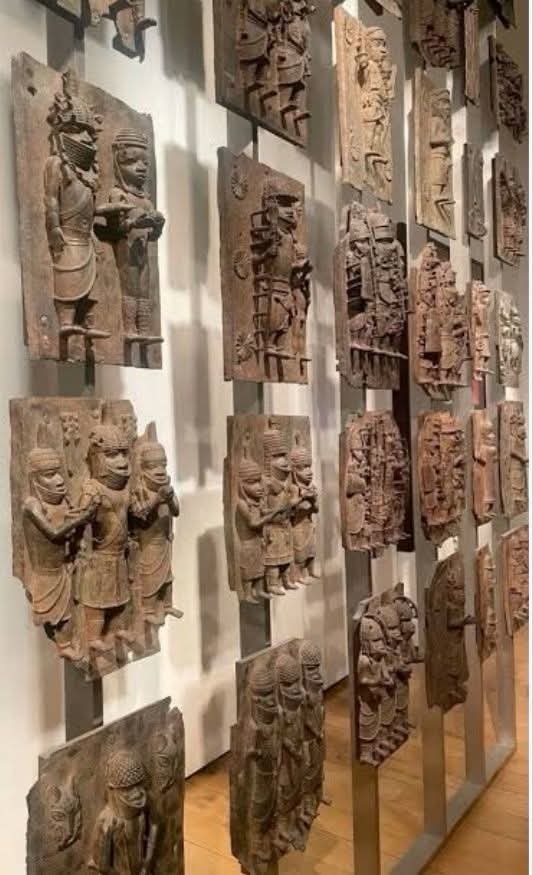
The third is a material science, a systematic understanding of how the physical world’s materials behave and how they can be transformed into useful objects. The Igbo-Ukwu bronzes were cast using the lost-wax technique at a level of precision that modern metallurgical historians describe as extraordinary. The Benin bronzes required an understanding of copper-tin alloy ratios, furnace temperature management, and mold construction that represented centuries of accumulated empirical knowledge refined through practice and transmitted through guild apprenticeship. The Ife terracotta tradition required mastery of clay selection, firing temperature, and sculptural technique that produced the most naturalistic human portraiture in sub-Saharan Africa before European contact. None of this happened by accident. All of it was the product of transmission chains of technical knowledge operating across generations.
The fourth is a governance philosophy, a framework for organising collective human life that reflects the cosmological understanding of the first component. The Igbo republican system, the Yoruba council-based monarchy, the Benin palace bureaucracy, the Egyptian theological state, the Zulu military-administrative system, each of these governance structures was the political expression of a specific philosophical understanding of how human beings should organise collective life. They were not random arrangements. They were deliberate applications of knowledge about human nature, collective decision-making, and the relationship between authority and accountability.
The fifth is a spiritual technology, a systematic understanding of the relationship between human consciousness, the natural world, and the spiritual dimension, and the practices through which that relationship can be productively engaged. The Ifa divination system, the Ofe transmission chain, the Egyptian mystery school tradition, the Dogon astronomical ritual calendar, all of these were spiritual technologies in the precise sense: systematic, transmissible, empirically refined practices for engaging with dimensions of reality that material science alone does not address.
The sixth is an economic philosophy, a framework for organising the production and distribution of material resources that reflects the cosmological and governance frameworks of the other components. The Yoruba Aje tradition, instituted by Osangangan Obamakin as documented in this series, was a philosophy of trade and commerce grounded in spiritual principles. The Aiyetoro communal economy, which produced the highest per capita income in Africa, was an economic system derived directly from a theological framework. The Benin Kingdom’s management of the palm oil and bronze trade was a sophisticated political economy that maintained Benin’s sovereignty against European commercial pressure for over four centuries.
These six components constitute a civilisational operating system. When all six are running simultaneously and reinforcing each other, the system produces Ife bronze heads. When the transmission chains are broken, it stops.
How the Transmission Chains Were Broken: Five Instruments of Epistemicide
The slave trade came first and it came for the most valuable asset in any knowledge system: the trained human being. The twelve to fifteen million people transported across the Atlantic were not randomly selected. The Aro slave network in eastern Nigeria specifically targeted educated, skilled, and socially significant individuals because those were the people who commanded the highest prices from European buyers who needed skilled labour for plantation agriculture and artisanal production. The Benin warriors taken in conflict were the people who carried military and governance knowledge. The healers taken from Yoruba communities were the people who carried pharmacological and spiritual knowledge. The slave trade was not merely a labour extraction system. It was a targeted extraction of the most knowledge-intensive members of African communities, leaving behind populations systematically depleted of their most capable knowledge-holders.
The missionary school system was the second instrument, and it was the most comprehensively effective. The colonial mission school did not simply offer an alternative education. It offered an alternative identity. The child who entered a mission school entered as an Igbo child, a Yoruba child, a Zulu child, with a complete civilisational identity rooted in a specific knowledge system. That child left as a Christian African whose entire framework for understanding the world had been restructured around European epistemology. The indigenous knowledge system was not merely set aside. It was actively stigmatised. The Ifa board was described as an instrument of the devil. The babalawo was described as a fraud or a servant of dark forces. The traditional healer was described as a practitioner of superstition. The child who had been taught to understand the world through the Ifa cosmological framework was taught in the mission school that everything they had been taught was wrong, backward, and spiritually dangerous.
As Frantz Fanon documented in his 1961 study of the psychology of colonisation, the most devastating consequence of this process was not the replacement of one knowledge system with another. It was the creation of a psychological state in which the colonised person genuinely believed that their own knowledge system was inferior. The person who believes their knowledge system is inferior does not transmit it to their children. The transmission chain breaks not through external force but through internal surrender. That psychological break is the most difficult wound to heal because you cannot repatriate it. You cannot pass a UN resolution returning it. It lives inside the minds of African people themselves, and it reproduces itself through every generation that internalises the colonial educational framework without questioning its foundational assumption that European epistemology is the universal standard against which all other knowledge systems should be measured.
The colonial legal system was the third instrument. Across British, French, Portuguese, and Belgian colonial territories, traditional practices were systematically criminalised through ordinances against native medicine, witchcraft, and traditional religious practice that made public operation of the most advanced levels of indigenous knowledge systems legally dangerous. The babalawo who performed Ofe-related ceremonies publicly risked colonial prosecution. The traditional healer who practiced outside European medical frameworks risked criminal sanction. The result was that the most advanced knowledge went underground, and as documented throughout this series, knowledge that goes underground in one generation frequently does not surface intact in the next.
The destruction of material infrastructure was the fourth instrument. The colonial administration’s systematic destruction of indigenous political and economic structures removed the institutional support systems that knowledge transmission required. The Benin palace bronzes were not merely aesthetic objects. They were the institutional records, the teaching tools, and the ritual instruments of a knowledge system whose operation required those objects to function. Taking them was not art collection. It was dismantling the library and the laboratory simultaneously. The Nuer shrines documented by the British colonial administration were not merely religious sites. They were the physical infrastructure through which an entire community’s relationship with its knowledge system was maintained. Their destruction, documented in the epistemicide academic literature, was followed immediately by the collapse of Nuer anti-colonial resistance, precisely because the knowledge infrastructure that organised that resistance had been physically dismantled.
The language suppression policy was the fifth instrument, and the most quietly devastating. Every major African indigenous knowledge system was encoded in a specific African language because language is not merely a communication medium. It is a knowledge storage system. The phonological structure of the Yoruba language, with its tonal differentiation and its specific vowel qualities, is the medium through which the Ofo Ase incantation system operates. The Ifa corpus cannot be transmitted in English without fundamental loss because the specific tonal patterns that activate the knowledge encoded in the ese Ifa verses are not reproducible in a non-tonal language. When colonial education required African children to conduct all formal learning in English, French, or Portuguese, it did not merely change the language of instruction. It made the transmission of indigenous knowledge systems structurally impossible within the formal educational framework. The child who could only read and write in English could not access the written manuscripts of Arabic-Yoruba scholarly tradition. Could not properly transmit the Ifa corpus. Could not preserve the exact phonological precision that the Ofo Ase required. Language suppression was the most technically precise instrument of epistemicide because it severed the connection between the knowledge and the medium through which the knowledge operated.
Why Africa Cannot Simply Restart
Here is the specific mechanism of the wound that our question is pointing at, the one that explains why returning the Benin bronzes, correcting the map, and granting political independence have all been insufficient to restore African civilisational momentum. A knowledge system is not like a machine that you can turn off and turn on again. It is like a living organism that requires continuous feeding, continuous transmission, and continuous practice to remain alive. When you interrupt the transmission chain of a knowledge system for three or four generations, you do not simply pause it. You kill the living carriers of the knowledge while the static records, the bronze heads, the terracottas, the odu verses written down in the nineteenth century, remain as fossils of what the living system once produced.
The Ife bronze caster of the thirteenth century was the product of a transmission chain stretching back several centuries. Their technical knowledge was not something they had learned from a manual. It was embodied knowledge, internalised through years of supervised practice under masters who had themselves internalised it through years of supervised practice. When that transmission chain was broken, what was lost was not the knowledge abstractly, in the way that a library loses a book when it burns. What was lost was the embodied, practised, refined version of the knowledge that only lives in human beings who have been properly trained. You cannot reconstitute embodied knowledge from static records any more than you can reconstitute a living tree from a photograph of it.
Africa’s development crisis is not primarily a financial crisis, though the financial dimension is real. It is not primarily a governance crisis, though governance failures are genuine. It is fundamentally a knowledge crisis. African nations are attempting to develop using epistemological frameworks that were designed by and for European civilisational contexts, applying economic theories developed for European market structures, governance models derived from European political philosophy, and scientific methodologies built on European cosmological assumptions, to societies whose indigenous knowledge systems had developed entirely different and in many respects more sophisticated approaches to exactly the same developmental challenges.
The result is the specific development failure pattern that every serious African development scholar has documented: external solutions that do not stick because they do not connect to indigenous knowledge frameworks, institutions that function on paper but fail in practice because they are built on epistemological foundations that the societies they govern do not share, and a persistent sense of civilisational disorientation in which African people are attempting to develop using tools whose foundational assumptions contradict the deepest knowledge of their own civilisational tradition.
The Thing That Must Be Returned Before Anything Else
Return the Benin bronzes. Absolutely. Return the Ife heads. Return the Igbo-Ukwu bowls. Return the Nok terracottas. Return the Egyptian artifacts in European collections. Return all of it. But understand clearly and completely what you are returning when you return a bronze head. You are returning a product. You are not returning the system that produced the product. And it is the system that matters. A museum with the Benin bronzes on display but without a functioning Benin bronze-casting guild producing new work in the living tradition is a cemetery with better lighting. The artifact without the living knowledge system that produced it is a gravestone, not a civilisation.
What must be returned before anything else is the confidence to treat African knowledge systems as valid, rigorous, and worthy of the same institutional investment, the same research funding, the same pedagogical centrality, and the same intellectual respect that European knowledge systems receive as the automatic default of every African university, every African government ministry, and every African development programme. That confidence cannot be legislated. It cannot be repatriated. It cannot be granted by a UN resolution. It must be rebuilt from inside African intellectual and educational life, institution by institution, curriculum by curriculum, generation by generation, by African scholars who have understood clearly enough what was taken to know specifically what must be rebuilt.
The Ife bronze caster’s art will return when a child in Ile-Ife grows up inside an educational system that treats Ifa mathematics as seriously as it treats Euclidean geometry, that presents the Igbo-Ukwu bronzes as evidence of African metallurgical genius rather than as curiosities of African primitivism, that teaches the Ofo Ase as a legitimate epistemological framework rather than as superstition to be overcome. The terracotta heads of the Nok culture represent not primitive artistic expression but the earliest evidence of continuous human artistic sophistication in sub-Saharan Africa. Treating them that way, not just in museums but in classrooms, not just in heritage tourism but in research universities, is what the return of Africa’s civilisational confidence actually requires.
Walter Rodney wrote in 1972 that Europe underdeveloped Africa. He was precise but incomplete. Europe did not merely underdevelop Africa economically. It epistemicided Africa intellectually. And the recovery from epistemicide requires not just economic development but epistemological decolonisation, the restoration of Africa’s confidence in its own ways of knowing as the necessary foundation for any development worth the name.
The map is a tool. What was stolen was the knowledge of how to read the territory the map was drawn from. Return that, and Africa will draw its own maps.
Ire ooo
Alex Sewo
References
Rodney, Walter. How Europe Underdeveloped Africa. Bogle L’Ouverture Publications, London, 1972.
Fanon, Frantz. The Wretched of the Earth. Présence Africaine, Paris, 1961.
Fanon, Frantz. Black Skin, White Masks. Editions du Seuil, Paris, 1952.
Wiredu, Kwasi. Cultural Universals and Particulars: An African Perspective. Indiana University Press, Bloomington, 1996.
Ngugi wa Thiong’o. Decolonising the Mind: The Politics of Language in African Literature. James Currey, London, 1986.
Abimbola, Wande. Ifa: An Exposition of Ifa Literary Corpus. Oxford University Press Nigeria, Ibadan, 1976.
Shaw, Thurstan. Igbo-Ukwu: An Account of Archaeological Discoveries in Eastern Nigeria. Faber and Faber, London, 1970.
Griaule, Marcel. Conversations with Ogotemmeli: An Introduction to Dogon Religious Ideas. Oxford University Press for the International African Institute, London, 1965.
Ake, Claude. Democracy and Development in Africa. Brookings Institution Press, Washington D.C., 1996.
De Sousa Santos, Boaventura. Epistemologies of the South: Justice Against Epistemicide. Paradigm Publishers, Boulder, 2014.