THE ORIGIN OF THE NAME DRAMÉ/DARAMY/DARAMEH
THE ORIGIN OF THE NAME DRAMÉ/DARAMY/DARAMEH
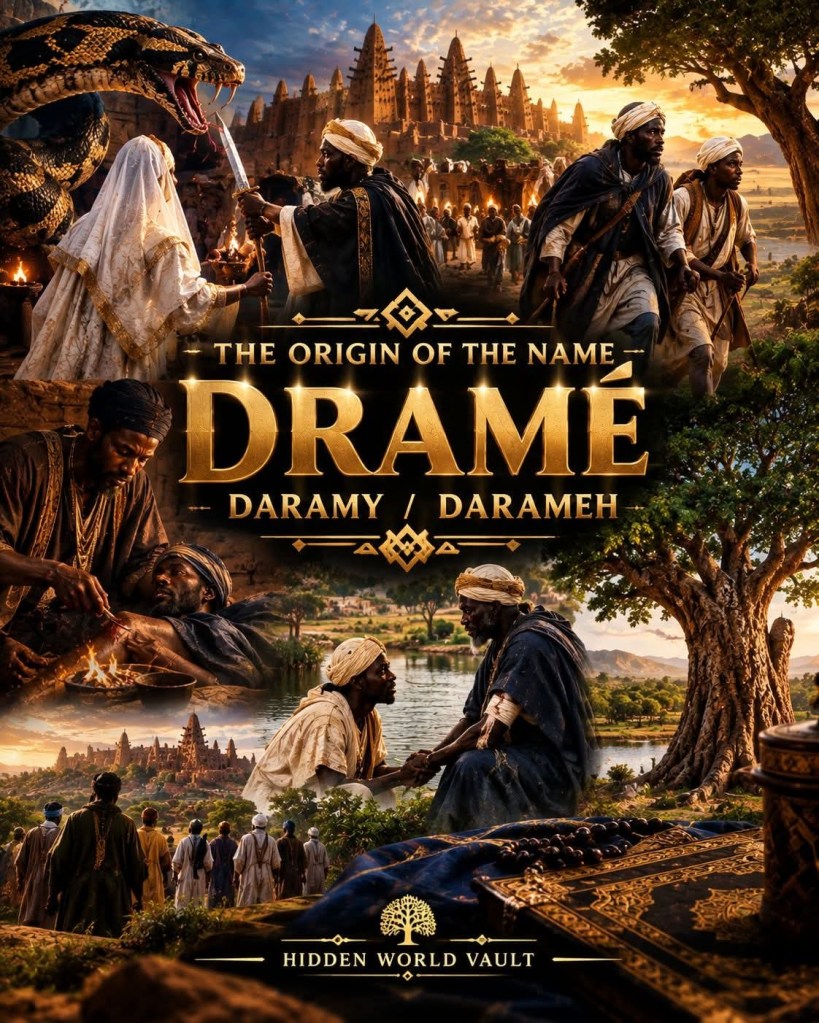
According to Soninké oral tradition, the origin of the Dramé name is connected to the legendary story of Fata Maga Niakaté and his elder brother Mana Maga during the early history of Wagadu (Ghana).
The python Bida, believed to protect the prosperity of the community, demanded the annual sacrifice of a young virgin. When Sia Niakaté, Fata Maga’s cousin and fiancée, was chosen, Fata Maga secretly hid beneath her bridal veil and killed Bida with his sword.
He then fled with his elder brother, Mana Maga, who helped him escape instead of capturing him.
After two days without food, Fata Maga became exhausted. Mana Maga went hunting but found nothing. To save his brother, he secretly cut a piece of flesh from his own calf, cooked it, and gave it to him.
They eventually stopped beside a pool, where Mana Maga’s wound prevented him from continuing. When Fata Maga discovered that his brother had sacrificed his own flesh to save him, he was deeply moved.
To honor this sacrifice, Fata Maga adopted the name Dramé, traditionally associated with the Daramanyitte (Sébéstier) tree beneath which his brother had made the sacrifice.
The place where they settled was called Diara, traditionally interpreted in Soninké as “to heal.”
Thus, according to this tradition, the name Dramé carries a story of courage, sacrifice, brotherhood, gratitude, and ancestral memory.
■ THE DRAMÉ JAMMU KARÉ
Within Soninké and wider Mandé oral traditions, a Jammu Karé is a praise name, ancestral designation, or traditional praise expression associated with a particular family or lineage.
The Dramé family is associated with several Jammu Karé, including:
● Dramé-Kandji
● Dramé-Saama
● Dramé-Fadiga
● Dramé-Demba
● Dramé-Dibasi
● Dramé-Wakkane
● Dramé-Fenyini
● Dramé-Niaxate
● Dramé-Koyinera
● Dramé-Korima
● Dramé-Xaayi
These Jammu Karé form part of the oral identity and praise tradition associated with Dramé lineages.
They should not necessarily be interpreted as separate surnames or as proof that every person bearing one of these names belongs to exactly the same genealogical branch. In Mandé societies, praise names and family traditions can vary according to lineage, locality, genealogy, historical events, and oral transmission.
The Jammu Karé therefore provide another layer through which the history and identity of the Dramé name can be explored.
■ A STORY OF SACRIFICE AND MEMORY
The traditional story of Dramé is ultimately a story about brotherhood and sacrifice.
Mana Maga gave part of his own body to save his younger brother.
Fata Maga responded by preserving the memory of that sacrifice through a name.
In this tradition, the name Dramé is therefore more than a family name. It carries a remembered story of loyalty, self-sacrifice, gratitude, survival, and ancestral honor.
DRAMÉ
A name.
A lineage.
A Jammu.
A memory.
Note: This account is presented as Soninké oral tradition concerning the origin and Jammu Karé associated with the Dramé name. Oral traditions may vary between families and regions and should be examined alongside genealogical, linguistic, written, and other historical evidence.