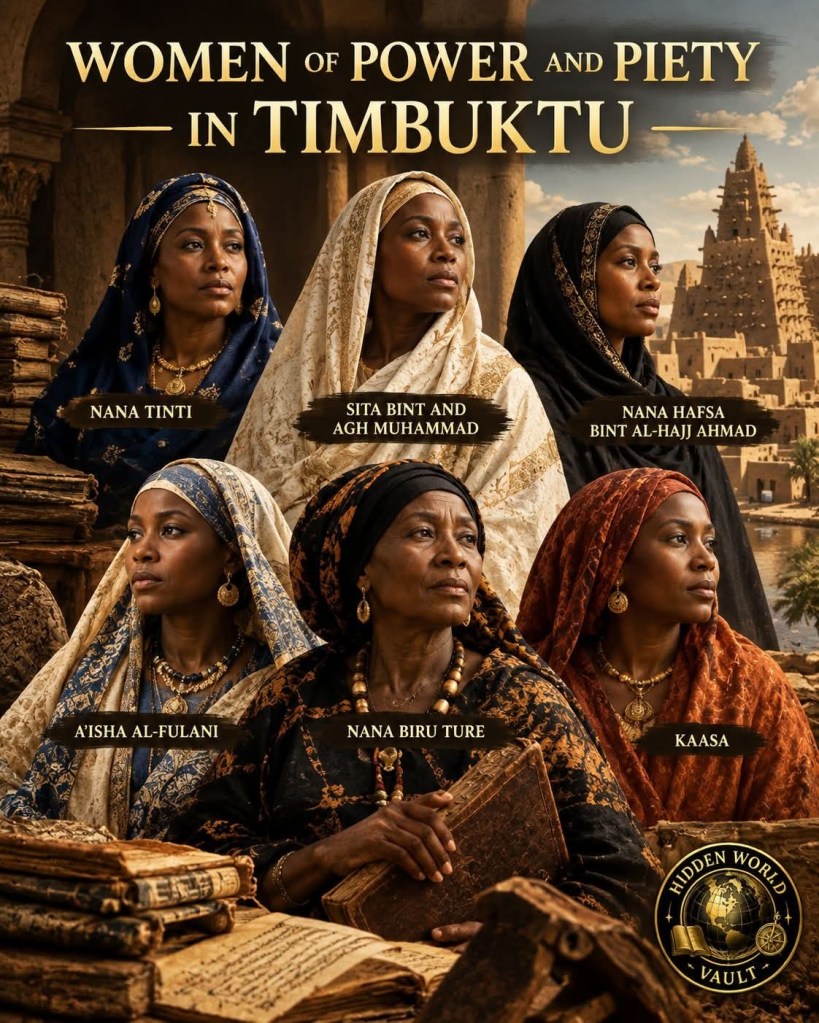
WOMEN OF POWER AND PIETY IN TIMBUKTU
WOMEN OF POWER AND PIETY IN TIMBUKTU 👑
The Tarikh ‘s-Sudan reveals that women played vital roles in the intellectual and spiritual life of Timbuktu. They were not just mothers and wives; they were scholars, saints, and advisors. Their stories remind us that African women have always been central to the preservation of knowledge and faith.
- NANA TINTI – THE WOMAN WHOSE PRAYERS WERE ANSWERED
Consider Nana Tinti, daughter of Qadi al-Hajj. When Kaasa, the mother of Askiya Muhammad, sought her help, Nana Tinti prayed for her son’s success. Her supplication was answered, and Askiya Muhammad honored her family forever.
The Tarikh ‘s-Sudan records:
“Once when Askiya Muhammad was being afflicted with severity from the tyrant, his mother Kaasa went to her close friend, Nana Tinti the daughter of Qadi ‘l-Hajj in Tinbuktu. She sought for her son a supplication from Nana Tinti that Allah ta`ala would help him against Sonni Ali. She said, ‘If Allah would accept this supplication, my son would bring gladness to the hearts of your children and your nearest kin, if Allah wills.’ When Askiya Muhammad took control of the government, he kept his promise to their family.”
— Tarikh ‘s-Sudan, Chapter XII
This shows that women’s prayers were considered powerful and effective. Nana Tinti was not just a passive observer, she was a spiritual force whose supplication changed the course of history.
- SITA BINT AND AGH MUHAMMAD – THE STEADFAST MOTHER
Then there is Sita bint And Agh Muhammad, the mother of the famous jurist Mahmud. She was imprisoned by Sonni Ali but remained steadfast. Her son became one of the greatest scholars of Timbuktu.
The Tarikh ‘s-Sudan tells us:
“He had the mother of the jurist Mahmud, Sita bint And Agh Muhammad imprisoned.”
— Tarikh ‘s-Sudan, Chapter XII
Despite her imprisonment, her son Mahmud ibn Umar Aqit became the chief judge of Timbuktu and dean of Sankore’ University. His justice was so renowned that the author says he had “no equal in his time.” Sita’s steadfastness in the face of persecution is a testament to the resilience of African women.
- THE FIVE BLESSED DAUGHTERS OF IMAM AND-AGH MUHAMMAD
The blessed daughters of Imam And-Agh Muhammad, all five of them, gave birth to great scholars and saints. The Tarikh records:
“The blessed Imam, And-Agh Muhammad had five blessed daughters. Each one of them gave birth to men of profound baraka. Two of the daughters have been discussed earlier. As for the third, she was the mother of the shaykh of shaykhs, the imam of the Sankore’ university/mosque – the jurist Muhammad ibn Muhammad Kara. The fourth daughter was the mother of bearer of the Book of Allah ta`ala, Muhammad ibn Yumdhu Ghurben. The fifth daughter was the mother of Muhammad Matina ibn Asikala the brother of Atakurye.”
— Tarikh ‘s-Sudan, Chapter IX
These women were the mothers of scholars, saints, and imams. Their baraka flowed through their children and blessed the entire community. One of them was the mother of Muhammad ibn Muhammad Kara, the shaykh of shaykhs and imam of Sankore’—one of the most important scholarly figures in Timbuktu’s history.
- NANA HAFSA BINT AL-HAJJ AHMAD – THE SCHOLAR WHO REFUSED
Women also played a role in preserving and transmitting knowledge. Nana Hafsa bint al-Hajj Ahmad ibn Umar was a scholar in her own right. When her son was appointed to lead prayers, she refused, showing that women had a say in religious matters.
The Tarikh ‘s-Sudan records:
“Then his nephew, the ascetic jurist Muhammad ‘l-Amin ibn Qadi Muhammad was appointed to pray with the people in the mosque. But his mother Nana Hafsa bint al-Hajj Ahmad ibn Umar refused. Thus, the Sankore’ mosque/university remained for days without the people praying the congregational prayers in it.”
— Tarikh ‘s-Sudan, Chapter XI
Her refusal was not out of opposition to her son, but because she understood the weight of the responsibility and the importance of proper qualifications. Her voice was respected, and the community waited until the matter was resolved properly.
- A’ISHA AL-FULANI – FROM CAPTIVE TO MOTHER OF SCHOLARS
The Tarikh also mentions A’isha al-Fulani, a woman from the Fulani tribe who was married by the ascetic imam Abdullah al-Balbali. She was among the women dispatched by Sonni Ali after his incursion against the Fulani of the Sanqara clan.
The Tarikh ‘s-Sudan records:
“Among them who did this was the grandfather of my grandmother, the mother of my father, the excellent sayyid, the ascetic imam Abdullah ‘l-Balbali. He married the women that was dispatched to him and her name was A`isha ‘l-Fulani. From her Nana Biru Ture was born and she was the mother of my father.”
— Tarikh ‘s-Sudan, Chapter XII
From A’isha al-Fulani, Nana Biru Ture was born, the grandmother of the author himself, al-Qadi Abd’r-Rahman as-Sa’di. This shows how women, even those who came from difficult circumstances, became the mothers of scholars and the preservers of lineages.
- NANA BIRU TURE – THE GRANDMOTHER OF THE AUTHOR
Nana Biru Ture was the grandmother of the author, al-Qadi Abd’r-Rahman as-Sa’di. She was the daughter of A’isha al-Fulani and Imam Abdullah al-Balbali, and she married into the family of the author.
The Tarikh ‘s-Sudan mentions her in Chapter XI:
“He came to Tinbuktu and kept company with the jurist the Imam Qadi Kaatib Musa when he returned from Fez. Along with him were his two brothers: the father of Abd ‘r-Rahman, who was known as Alfa Tunka; the father of Musa Kara and the father of Nana Biru Ture.”
— Tarikh ‘s-Sudan, Chapter XI
Nana Biru Ture was part of a scholarly lineage that spanned generations. Her son was the father of the author, and her legacy lives on in the Tarikh ‘s-Sudan itself.
- KAASA – THE MOTHER WHO SOUGHT HELP
Kaasa, the mother of Askiya Muhammad, was a woman of great faith and determination. When her son was being persecuted by Sonni Ali, she did not sit idly by; she sought help from Nana Tinti, a woman known for her piety and powerful prayers.
The Tarikh ‘s-Sudan records:
“Once when Askiya Muhammad was being afflicted with severity from the tyrant, his mother Kaasa went to her close friend, Nana Tinti the daughter of Qadi ‘l-Hajj in Tinbuktu.”
— Tarikh ‘s-Sudan, Chapter XII
Kaasa’s actions show that women were not passive in times of crisis. They took initiative, formed alliances, and sought spiritual solutions to political problems. Her son became one of the greatest rulers of Songhay, and her faith played a role in his success.
- CONCLUSION
These women were not passive observers. They were active participants in the intellectual and spiritual life of their community. They were mothers of scholars, advisors to rulers, and keepers of spiritual power. Their stories remind us that African women have always been central to the preservation of knowledge and faith.
The Tarikh ‘s-Sudan preserves their names and their legacies. It is a reminder that behind every great scholar, there was often a great woman, a mother, a wife, a daughter, or a friend, whose prayers, patience, and piety made it all possible.
REFERENCES:
● as-Sa’di, al-Qadi Abd’r-Rahman. Tarikh ‘s-Sudan: The History of the Land of the Blacks. Translated by Abu Alfa Umar Muhammad Shareef bin Farid. Maiurno, Sennar, Sudan: SANKORE’ Institute of Islamic ● African Studies, 1410/1990.
● Chapter IX: Biography of the Scholars, the Righteous and Judges of Tinbuktu
● Chapter XI: Mentioning the Chronological Order of the Imams of the Jingerber Mosque and the Sankore’ Mosque
● Chapter XII: Mentioning the Infamous Tyrant Sonni Ali