WHO REALLY CONTROLS AFRICA’S WEALTH?
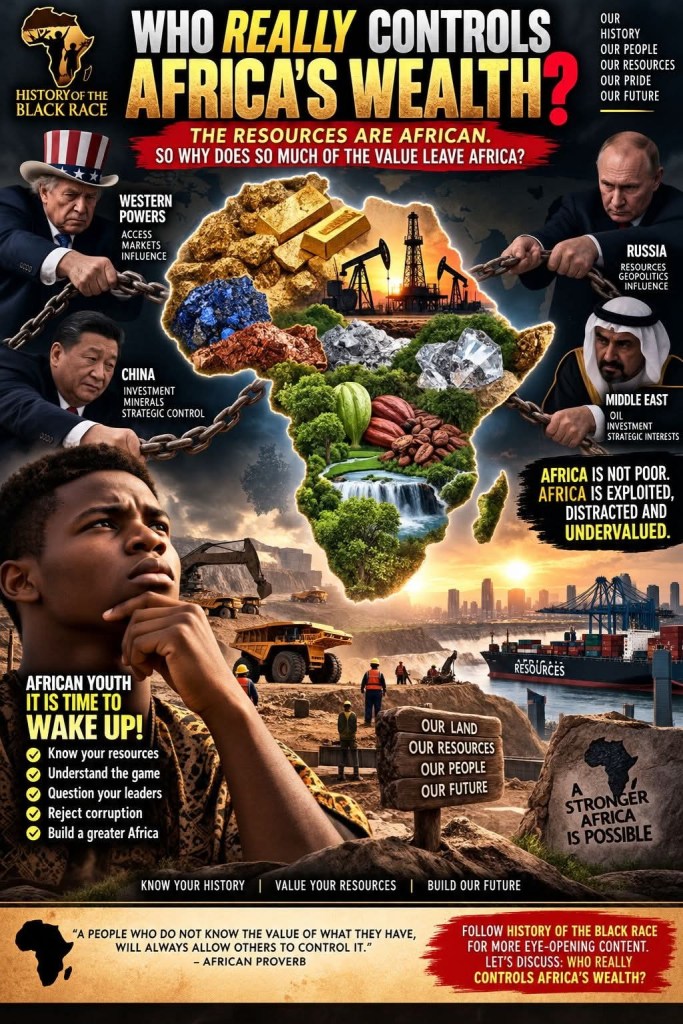
🌍 WHO REALLY CONTROLS AFRICA’S WEALTH?
The resources are African. So why does so much of the value leave Africa?
Africa is often described as a continent rich in natural resources but poor in economic power.
But perhaps we should ask a more uncomfortable question:
If Africa possesses so much wealth, why have so many Africans remained poor?
Look beneath the surface.
Africa possesses enormous deposits of gold, copper, cobalt, lithium, uranium, platinum, bauxite, oil, natural gas, diamonds and other strategic resources.
These are not ordinary commodities.
They are the raw materials that power modern civilization.
They are needed for smartphones, computers, vehicles, electricity networks, construction, advanced manufacturing, renewable-energy technologies and many other industries.
Yet there is a contradiction.
Africa often exports the raw material and then imports the finished product at a much higher price.
That means the greatest value is frequently created somewhere else.
And this is where the real question begins:
WHO REALLY CONTROLS AFRICA’S WEALTH?
Is it the African farmer who produces the crop?
Is it the miner who extracts the mineral?
Is it the African government that grants the concession?
Or is it the company that owns the technology, processing facilities, financing, transportation networks and international market access?
The answer is complicated.
And that complexity is exactly what Africans need to understand.
⛏️ THE RESOURCE IS NOT THE SAME AS THE WEALTH
Imagine an African country discovers a huge deposit of lithium.
The mineral belongs to that country.
But extracting it requires expensive machinery.
Processing it requires advanced technology.
Transporting it requires infrastructure.
Turning it into batteries requires sophisticated manufacturing.
Selling the final product requires access to global markets.
If a foreign company possesses most of those capabilities, the country may possess the mineral while another part of the world captures much of the economic value.
So the question should not simply be:
“Who owns the resource?”
It should be:
“Who controls the entire chain from the ground to the finished product?”
That is where economic power lives.
🌍 AFRICA’S BIGGEST CHALLENGE
For decades, many African economies have depended heavily on exporting commodities.
This creates vulnerability.
When the international price of a commodity falls, government revenue can fall.
When foreign demand changes, economies can suffer.
When a country depends heavily on imported machinery, technology and manufactured goods, its ability to negotiate from a position of strength becomes limited.
This does not mean that foreign investment is automatically bad.
Africa needs investment.
Africa needs technology.
Africa needs international partnerships.
But there is a difference between partnership and dependency.
A genuine partnership should help create African capacity.
It should develop skills.
It should create industries.
It should strengthen infrastructure.
It should generate jobs.
And, most importantly, it should allow Africans to capture an increasing share of the value created from their own resources.
⚠️ THE NEW SCRAMBLE FOR AFRICA?
The competition for Africa’s resources has not disappeared.
It has evolved.
Today, African resources attract attention from Western governments and companies, China, Russia, Gulf states, India and multinational corporations.
Everyone has interests.
Critical minerals have become especially important because the global economy is becoming increasingly dependent on technologies requiring them.
This means Africa is entering a new geopolitical moment.
But Africans must understand something:
Foreign interest in Africa is not necessarily the problem.
The problem is entering negotiations from weakness.
If African countries compete against one another for foreign investors by offering increasingly favorable terms, they can weaken their own bargaining position.
But if African countries cooperate, process their resources locally, develop their industries and strengthen their institutions, the equation changes.
Suddenly, Africa is no longer simply a supplier.
Africa becomes a producer.
🇨🇩 🇿🇲 🇿🇼 🇬🇳 🇳🇦 AND BEYOND
Look at countries such as the Democratic Republic of the Congo, Zambia, Zimbabwe, Guinea and Namibia.
Their mineral resources have enormous strategic importance.
Then look at Nigeria’s energy resources and massive consumer market.
Look at South Africa’s industrial base and mineral wealth.
Look at Ghana’s gold and other resources.
Look at Tanzania’s minerals and strategic Indian Ocean position.
Look at Mali’s gold and geopolitical significance.
These countries are different.
Their governments are different.
Their economies are different.
Their challenges are different.
But they share something important:
Their natural resources have value far beyond their borders.
And whenever something possesses enormous economic value, powerful interests will seek access to it.
That is not a conspiracy theory.
That is geopolitics.
🧠 AFRICANS MUST LEARN THE GAME
The solution is not to hate foreigners.
The solution is not to reject every foreign company.
The solution is not to isolate Africa from the world.
The solution is to become knowledgeable enough to negotiate with the world.
African governments must understand the true value of their resources.
African citizens must understand the contracts their governments sign.
African universities must produce engineers, scientists, economists, lawyers and entrepreneurs capable of building industries.
African businesses must move beyond simply trading raw materials.
And African youth must stop seeing natural resources merely as something buried underground.
Resources become power when knowledge, technology, capital and institutions are added to them.
🔥 THE QUESTION AFRICA MUST ANSWER
Imagine an Africa where cocoa is processed into chocolate within Africa.
Where crude oil is transformed into refined petroleum and petrochemicals within Africa.
Where copper becomes electrical equipment.
Where lithium becomes batteries.
Where cobalt becomes part of African manufacturing chains.
Where agricultural products are processed before leaving the continent.
Where African companies own factories.
Where African universities produce the technology.
Where African governments negotiate contracts with confidence.
Where African countries trade more with one another.
That Africa would look very different.
It would not necessarily need to confront the rest of the world.
It would simply have something much more powerful:
BARGAINING POWER.
🌅 THE REAL BATTLE IS OVER VALUE
Perhaps the greatest struggle facing Africa is not whether foreigners are coming for African resources.
They already are.
The greater question is:
Will Africa continue exporting what it has and importing what it needs?
Or will Africa finally build the capacity to transform its own resources into wealth?
Because the future of Africa will not be determined simply by how many tonnes of minerals are beneath African soil.
It will be determined by who possesses the knowledge to transform those minerals into economic power.
And that responsibility ultimately belongs to Africans.
Our land.
Our resources.
Our people.
Our future.
The world will continue to pursue its interests.
Africa must learn to pursue hers.
🔥 NOW LET’S TALK
If Africa owns the resources, but foreigners own much of the technology, capital, processing capacity and global market access, can we truly say that Africa controls its wealth?
What do you think?
Is Africa being exploited—or has Africa simply failed to build enough capacity to control the value of what it possesses?
Drop your honest opinion in the comments.
 Hi welcome to my website