A WOMAN AS CAPABLE AS A MAN:
A WOMAN AS CAPABLE AS A MAN:
The Unyielding Empire of Queen Amina of Zazzau.
When we discuss the great military strategists of the global medieval era, names like Alexander the Great or Napoleon dominate the pages of history textbooks.
Yet, in the 16th century, right here in West Africa, a fierce warrior monarch built an empire through 34 years of uninterrupted military brilliance.
Her name was Queen Amina of Zazzau (modern-day Zaria).
Born around 1533 to King Nikatau and Queen Bakwa Turunku, Amina did not just inherit a throne; she built an armor-clad empire.
While her mother founded the city of Zazzau and her younger sister, Zariya, gave the modern city its name, Amina took to the battlefield.
She understudied the Zazzau military from a young age, mastering weaponry, cavalry tactics, and combat leadership.
When her brother, Karama, died around 1576, Amina ascended the throne as the Sarauniya (Queen).
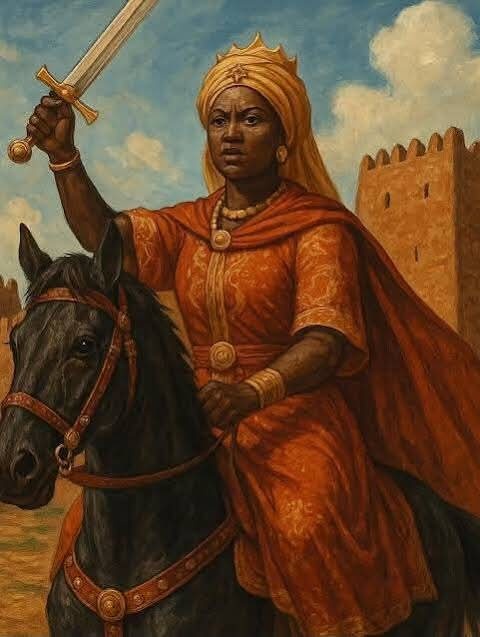
Within just a few months of taking power, she did something unheard of for a female ruler of her time: she led her very first military charge.
Commanding a staggering force of 20,000 infantrymen and 1,000 armored cavalry, Queen Amina launched massive expansionist campaigns. She successfully expanded the borders of the Hausa people to their largest limits in history.
According to records like the Kano Chronicle, she marched her armies south to the Nupe kingdom, dominated Kano and Katsina, and reduced surrounding territories to tribute-paying vassals.
Amina wasn’t just a brutal conqueror; she was an economic mastermind and a defense innovator:
The Trans-Saharan Trade Monopoly:
By conquering key regional hubs, she transformed Zazzau into the ultimate commercial powerhouse of West Africa, dictating the flow of gold, horses, salt, and fabrics.
Military Innovation:
Recognizing the skill of Hausa metalworkers, she introduced protective iron helmets and chain-mail armor to her frontline cavalry.
The “Ganuwar Amina” (Amina’s Walls): Wherever her military set up camp or conquered a city, she built massive earthen fortification walls to protect her territories.
Remarkable remnants of these ancient defensive walls still stand across Northern Nigeria today as living proof of her engineering legacy.
The Monarch Who Refused to Marry:
One of the most fascinating aspects of Amina’s legacy was her absolute refusal to take a husband.
In 16th-century West Africa, a woman’s authority was almost always tied to or compromised by marriage.
Amina knew that a husband would try to claim her throne or strip her of her military command.
To protect her total independence and retain her crown, she declared that she would never marry.
While the written court chronicles focus heavily on her economics and battles, rich oral traditions and folklore record a dark, legendary cost to her independence.
Legend has it that she would take a temporary husband or lover from the ranks of the vanquished enemy in the towns she conquered.
To ensure that no man could ever tell tales of being with the Queen, attempt to leverage her sexually, or claim political power over her, that brief bridegroom would be executed at dawn before her army marched on.
For Amina, absolute sovereignty required absolute sacrifice.
She died in battle around 1610 in Altagara (near Bida), having reigned for over three decades without ever backing down from a conflict.
In her homeland, she is forever immortalized in traditional Hausa praise songs as “Amina, yar Bakwa ta san rana”—meaning Amina, daughter of Nikatau, a woman as capable as a man.
We must stop relying on external narratives to define African leadership.
Long before colonial interference, Queen Amina proved that our history is paved with unmatched power, tactical brilliance, and fierce independence.
 Hi welcome to my website