THIAW: THE TEKROURAN NAME THAT CARRIED WOLOF, TOUCOULEUR, AND SERER DESTINIES INTO THE LAYÈNE LINEAGE
THIAW: THE TEKROURAN NAME THAT CARRIED WOLOF, TOUCOULEUR, AND SERER DESTINIES INTO THE LAYÈNE LINEAGE
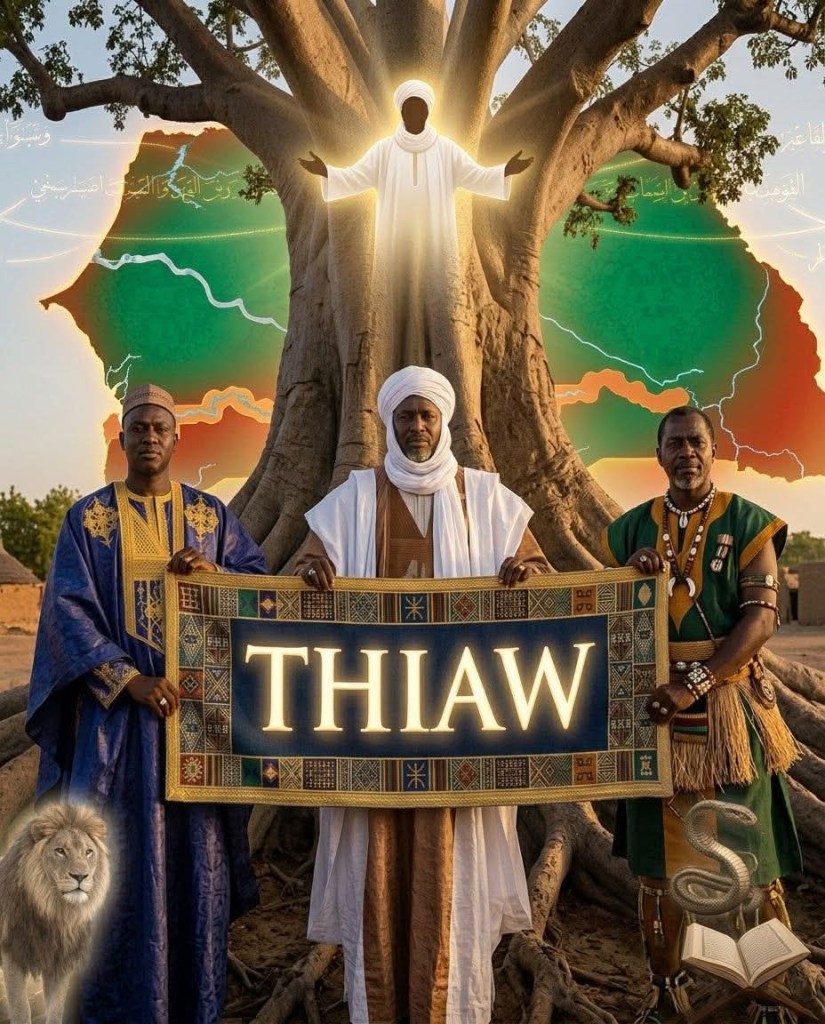
Some names are simply names. Others are archives. They carry the memory of kingdoms, migrations, alliances, and spiritual journeys. The patronym Thiaw belongs to this second category. It is often described as a Wolof surname, but that description is far too narrow. In the deeper history of Senegambia, Thiaw is a Tekrouran name, a lineage marker that crosses the worlds of the Wolof, the Toucouleur, and the Serer. It is a name that refuses to be imprisoned inside a single ethnic border.
The ancient space of Tekrour was not a simple territory. It was a meeting point. Wolof, Toucouleur, and Serer communities lived there, traded there, married there, and built shared political and spiritual traditions. The name Thiaw is one of the living traces of that world. Among the Wolof Lebou, the Thiaw are originally from Baol, and their remembered ancestor is Teigne Maafane THIAW. That name alone carries weight. It evokes royalty, memory, and the deep roots of a family line in the history of Senegambia.
But the Thiaw presence does not stop in Baol. It is found among Toucouleur communities, especially in the province of Dimat. It is borne by Wolofs of the Lebou country, Walo, Baol, and Cayor. Certain Serer Cangin tribes and Serer of Sine also carry this patronym. This wide distribution is not an accident. It is the signature of a Tekrouran heritage that circulated across regions, kingdoms, and ethnic boundaries long before modern labels hardened into fixed identities.
The most powerful testimony to this heritage is the patrilineage of Seydina Limamou Laye Al Mahdi, the venerated founder of the Layène brotherhood. His lineage is not merely a family tree. It is a historical document. It shows how a Tekrouran patronym moved through generations and became part of one of the most important spiritual movements in Senegal.
The line begins with Tèigne Ma Fân THIAW, who was the father of Samba Galgal THIAW. Samba Galgal THIAW was the father of Diokel THIAW. Diokel THIAW was the father of Wâke THIAW. Wâke THIAW was the father of Tannar THIAW. Tannar THIAW was the father of N’Dobân THIAW. N’Dobân THIAW was the father of M’Boor THIAW.
M’Boor THIAW, with his spouse Codou NDOYE Khagane Ba, fathered Daali THIAW, Ma THIAW, Tannar THIAW, and Yabey THIAW. Daali Codou Ndoye THIAW Khagane Ba then fathered Demba Daali THIAW. Demba Daali THIAW, with his spouse Djiguène DIAGNE, fathered Medoune Djiguène Diagne THIAW. Medoune Djiguène Diagne THIAW fathered the twins Seyni THIAW and Allassane THIAW. Allassane THIAW, with his spouse Coumba Ndoye, fathered the venerated founder of the Layène brotherhood, Seydina Limamou Laye Al Mahdi.
This genealogy is far more than a list of names. It is a bridge. It connects Baol to Dimat, Walo to Cayor, the Lebou world to the Serer world, Toucouleur history to Layène spirituality. It reminds us that Senegambian history was never built in isolated ethnic boxes. Wolof, Toucouleur, and Serer identities overlapped, influenced one another, and produced shared heroes, shared lineages, and shared memory.
To know the Thiaw is to know a crossroads. To speak the name is to summon centuries of coexistence. To transmit it is to refuse historical amnesia. It is to remember the Tekrour, to honour the ancestors, and to keep alive a memory that colonial borders and modern labels have too often tried to erase.
REFERENCE
● Oumar Ndiaye Leyti, Le Djoloff et ses Bourba, for Wolof royal and Tekrouran context; oral genealogical tradition of the Thiaw family and the Layène community. Genealogies of this kind should also be cross-checked with other family traditions and historical sources.
 Hi welcome to my website