THE ARMY THREW A 77-YEAR-OLD WOMAN FROM A SECOND-FLOOR WINDOW — HER SON LATER CARRIED HER COFFIN TO THE MILITARY HEADQUARTERS
THE ARMY THREW A 77-YEAR-OLD WOMAN FROM A SECOND-FLOOR WINDOW — HER SON LATER CARRIED HER COFFIN TO THE MILITARY HEADQUARTERS
By 1977, Fela Kuti had stopped behaving like an ordinary Nigerian musician.
His Lagos compound was called the Kalakuta Republic.
It was home.
It was a recording studio.
It had a free clinic.
It housed members of his band, his family and his growing community.
And Fela had declared it independent from the Nigerian state.
But there was another reason the military government knew exactly who lived there.
Fela had released Zombie.
The song mocked Nigerian soldiers as men who simply followed orders.
It became a massive hit.
And the tension between Fela and the military government was reaching its breaking point.
Then, on 18 February 1977, soldiers came.
Not a handful.
Not a small police patrol.
About 1,000 soldiers surrounded Kalakuta Republic.
They forced their way inside.
Residents were beaten and assaulted.
Fela was severely beaten.
The buildings were set on fire.
His recording studio was destroyed.
His instruments were destroyed.
His master tapes were destroyed.
Even the completed soundtrack of his film The Black President, whose filming had just been completed, was lost in the fire.
And then the soldiers found someone who was not Fela.
His mother.
Funmilayo Ransome-Kuti.
She was 77 years old.
This was the same woman who had spent decades challenging colonial authority and mobilising thousands of women in Abeokuta.
Now she was trapped inside her son’s burning compound.
What happened next became one of the darkest chapters in the history of Nigeria’s military era.
Funmilayo was taken to a second-floor window and fell from the building.
Fela and his family maintained that soldiers threw her out.
Accounts attributed to soldiers gave a different explanation, saying she was lowered from the window to escape the fire.
But whatever explanation was given…
she did not recover.
She was hospitalized.
Her health deteriorated.
And on 13 April 1978, almost fourteen months after the attack…
Funmilayo Ransome-Kuti died from the injuries she had suffered.
But the government still had one more answer.
An inquiry was established.
People expected someone to be held responsible for what had happened at Kalakuta.
Instead, the investigation produced a conclusion that would become legendary in Fela’s music.
The destruction had been blamed on…
an unknown soldier.
One soldier.
Unknown.
From an attack involving roughly a thousand troops.
Fela never accepted that explanation.
And he turned the absurdity of the finding into music.
He recorded Unknown Soldier.
But that was not his most dramatic response.
Because Fela had not forgotten his mother.
He waited.
Then, in September 1979, he did something almost unimaginable.
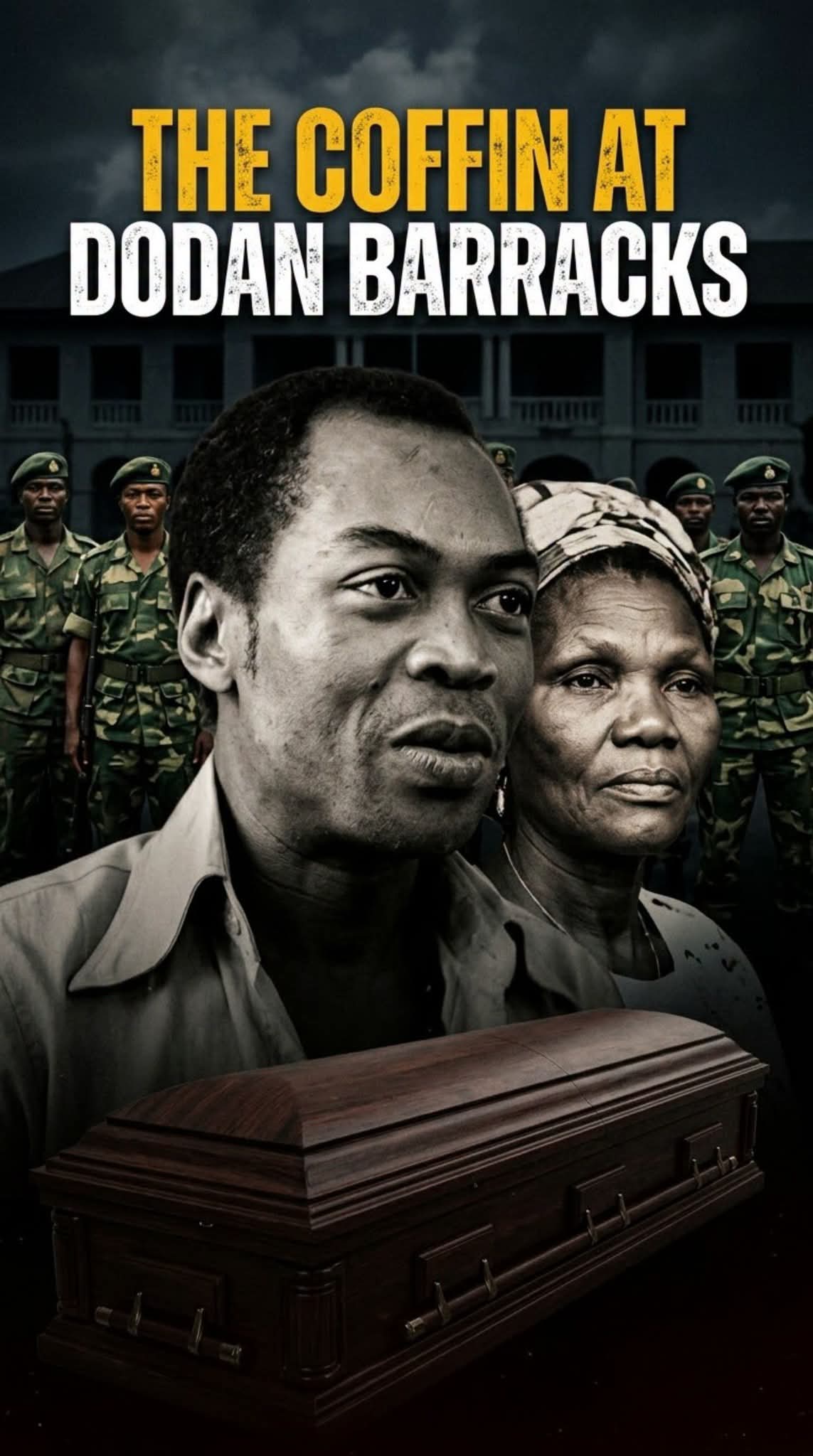
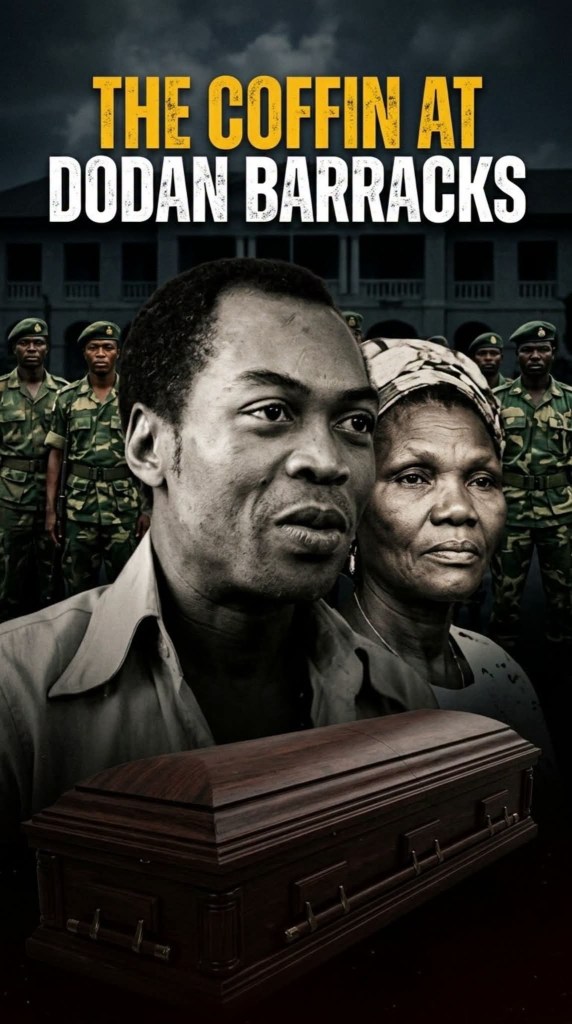
He took a coffin.
And he carried it to Dodan Barracks, the headquarters of Nigeria’s military government.
The coffin represented his dead mother.
The man he held responsible was the military government headed by General Olusegun Obasanjo.
Fela and his supporters reached the gates.
They were not allowed inside.
So they left the coffin there.
At the doorstep of military power.
And Fela turned the entire episode into another song:
Coffin for Head of State.
Think about the symbolism.
A woman who had once organised thousands of ordinary women against a traditional ruler…
Had now died after an encounter with the modern military state.
Her son responded by taking her coffin to the very headquarters from which that state ruled Nigeria.
The government could destroy Kalakuta.
It could burn the studio.
It could destroy the master tapes.
It could beat the residents.
It could even produce an inquiry that named no one.
But Fela found something the military could not easily confiscate.
A song.
Then another.
And another.
And suddenly, the story of Kalakuta was no longer trapped inside the walls of a burned compound.
It was being heard across Nigeria.
Funmilayo had once fought power with organised women.
Her son would fight it with music.
And the strange thing about history is this:
The woman who once forced a king to answer to his people eventually became a symbol of what happened when the military refused to answer to anyone.
Her story did not end in Abeokuta.
It ended at Kalakuta.
And her son’s answer…
was a coffin at the gates of power.
What do you think was more powerful — Funmilayo’s women’s movement, or Fela’s music?
Share your thoughts below. 👇
Follow for more hidden stories from Nigeria’s past.
 Hi welcome to my website