
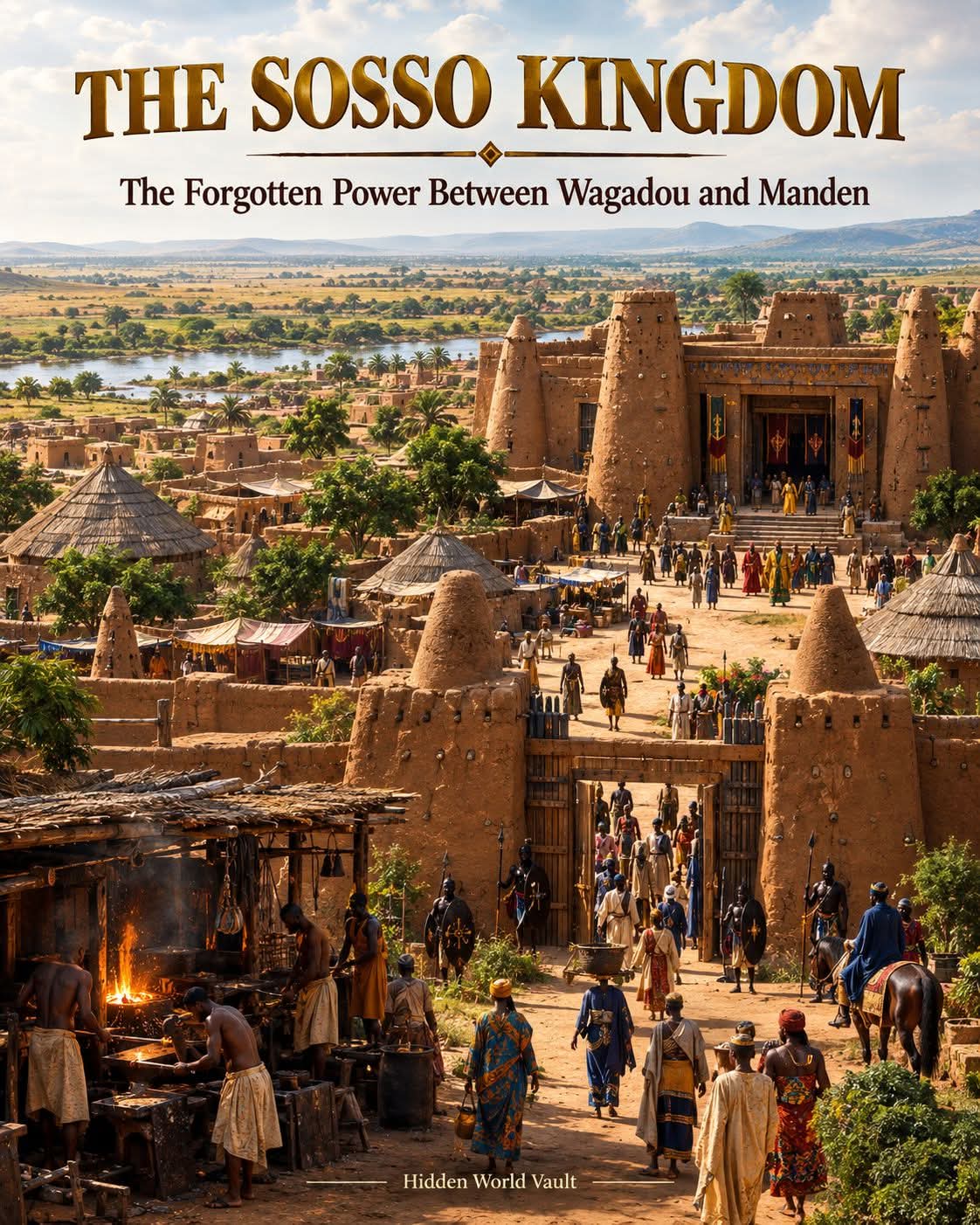
THE SOSSO KINGDOM
THE SOSSO KINGDOM
The Forgotten Power Between Ghana and Mali
When people hear the name Sosso, many immediately think of Soumaoro Kanté, Sundiata Keita and the Battle of Kirina.
But the history of Sosso is much bigger than one battle.
Before Mali became one of the great empires of West Africa, another powerful state had emerged in the western Sudan. It grew during the weakening of Ghana/Wagadou, developed a strong political and military base, expanded into neighbouring territories, and eventually came into direct conflict with the Manden.
That power was Sosso, also written Soso.
Its most famous ruler was Soumaoro Kanté, whose name has survived in both written sources and Mande oral traditions.
So what exactly was the Sosso Kingdom?
Where was it?
When did it rise?
Who were its rulers and people?
Why did it become powerful?
And how did it eventually fall?
Let’s examine the story through six simple questions:
WHAT? WHERE? WHEN? WHO? WHY? AND HOW?
- WHAT WAS THE SOSSO KINGDOM?
The Sosso Kingdom was a major medieval state in West Africa that emerged during the political changes following the weakening of Ghana/Wagadou.
It is also associated with Kaniaga, although historians have debated exactly how the names Sosso and Kaniaga should be related.
Sosso was not a modern nation-state with fixed borders. Its political authority was centred on a royal power and extended through subordinate territories, tributary communities, military strength, trade and alliances.
The state became particularly powerful during the 12th and early 13th centuries.
By the beginning of the 13th century, Sosso had become one of the strongest political powers in the region.
Its final great period of expansion came under Soumaoro Kanté.
But there is an important distinction that should be made from the beginning:
“The medieval Sosso Kingdom should not simply be treated as identical to the later Soussou/Sosoé people of coastal Guinea.”
There may be historical connections between these traditions and populations, but they developed across different periods and through complex movements of people, political changes and cultural interaction.
- WHERE WAS SOSSO?
The principal area associated with the medieval Sosso Kingdom was in present-day Mali, rather than on the Guinean coast.
Historical and oral traditions place its centre around the Kaniaga–Bélédougou region, northeast of modern Bamako.
The wider area stood between the former Ghanaian heartland and the Manden.
A settlement called Sosso is traditionally identified in the region around present-day Boron, and local traditions associate the place with the ancient kingdom.
Maurice Delafosse’s early twentieth-century reconstruction also placed the political centre of Sosso in this general region and connected the kingdom with Kaniaga.
The exact geography, however, has been debated.
Some interpretations have attempted to locate ancient Sosso farther west, even toward Fouta Djallon. That interpretation has not become the dominant historical reconstruction.
The safest geographical description is therefore:
“The principal centre of the medieval Sosso Kingdom is generally placed in the Kaniaga/Bélédougou region of present-day Mali, south of the former Ghanaian heartland and north of the Manden.”
This distinction matters.
The medieval Sosso Kingdom should not be placed directly on the modern Guinean coast simply because later Soso/Soussou communities became concentrated there.
- WHEN DID SOSSO RISE?
The rise of Sosso belongs to the period when Ghana/Wagadou was losing its political dominance.
The 11th and 12th centuries were a period of major change across the western Sudan.
The Almoravid expansion affected the political and commercial environment, while new centres of power and gold production developed farther south.
As Ghana’s authority weakened, territories that had previously been under its influence gained greater independence.
One of these emerging powers was Kaniaga/Sosso.
Traditional reconstructions place the development of the Sosso state toward the late 11th century, followed by major expansion during the 12th century.
By the early 13th century, Sosso had become a major regional power.
Its final period of expansion came under Soumaoro Kanté.
That period ended with the defeat of Sosso at Kirina, traditionally dated to 1235.
- WHO WERE THE PEOPLE OF SOSSO?
This is one of the most complicated questions surrounding the kingdom.
We should not take modern concepts of ethnicity and simply project them backward onto medieval West Africa.
The historical evidence strongly associates the medieval Sosso state with Soninke populations of the Kaniaga region.
At the same time, Sosso’s expansion brought it into contact with neighbouring peoples, including Mande-speaking communities of the Manden.
David Conrad describes Soso as a southern Soninke state and notes that much of the information about it has survived through later Mande oral traditions, while Arabic historical sources also preserve information concerning the kingdom.
This gives us an important distinction.
● Medieval SOSSO
A medieval political formation centred in the western Sudan.
● Later SOUSSOU/SOSOÉ
A later population whose history became strongly associated with Upper Guinea and especially Maritime Guinea.
The later Soussou developed through migration, settlement, political alliances and interaction with populations including the Baga, Landouma, Nalou, Dialonké and Fulɓe.
The relationship between these different histories is important, but it should not be reduced to a simple statement that one is automatically identical to the other.
- WHO RULED SOSSO?
The royal history of Sosso contains several traditions.
One influential reconstruction, particularly associated with Maurice Delafosse, describes a Diarisso dynasty ruling Kaniaga before the rise of the Kanté rulers.
According to this reconstruction, the Diarisso dynasty ruled from roughly the late 11th century until around 1180.
Delafosse then described the rise of Diara Kanté and, later, his son Soumaoro Kanté.
But this genealogy requires caution.
The relationship between the Diarisso rulers, Diara Kanté and Soumaoro is not independently established with the same degree of certainty as the existence of the wider political formation.
This is one of the places where historical research must distinguish between:
oral tradition,
colonial-era reconstruction,
and
modern historical criticism.
The existence and importance of Sosso are one question.
The precise genealogy of every ruler is another.
- SOUMAORO KANTÉ
Whatever uncertainties remain around his genealogy, Soumaoro Kanté became the defining ruler of the final great phase of Sosso power.
He is traditionally placed in power around the beginning of the 13th century, with his reign ending around 1235.
Under Soumaoro, Sosso reached the height of its military and political strength.
Traditions associate him with the expansion of Sosso into territories formerly connected with Ghana and with campaigns against the Manden states to the south.
This is the ruler who would eventually become the great antagonist of Sundiata Keita in the Mande epic tradition.
But there is more than one memory of Soumaoro.
In the best-known Mande traditions, he is portrayed as a dangerous and powerful enemy of the Manden.
Other traditions associated with Soumaoro’s descendants and supporters preserve a different image and challenge the negative portrayal.
This is why Soumaoro needs to be studied in two ways:
Soumaoro the historical ruler
and
Soumaoro the legendary figure preserved through oral tradition.
The two overlap, but they are not necessarily identical.
- WHY DID SOSSO BECOME POWERFUL?
Sosso did not become powerful by accident.
Several conditions worked in its favour.
● THE DECLINE OF GHANA
As Ghana’s authority weakened, political space opened for new states.
Sosso was one of the powers that benefited from this changing environment.
● ITS GEOGRAPHICAL POSITION
Sosso occupied an important position between the former Ghanaian sphere, the Manden and the southern savanna.
This placed it close to agricultural areas, trade routes and wider networks of exchange.
● MILITARY POWER
Military organization was central to the growth of the kingdom.
Traditions particularly associate Soumaoro and the Kanté name with blacksmiths, or numu, and with mastery of iron and weapons.
In many West African societies, blacksmiths were not simply craftsmen. They possessed specialized technical and ritual knowledge connected with iron, fire and weapon production.
● TRADE AND WEALTH
The changing gold economy of the western Sudan also mattered.
Gold-producing areas farther south, including the Bure goldfields, became increasingly important.
Agriculture, livestock, trade and tribute provided resources that could support political authority and military forces.
● POLITICAL FRAGMENTATION
The region was divided among numerous political communities.
A strong kingdom could therefore expand by conquering, subordinating or incorporating neighbouring territories.
Together, these conditions helped Sosso become a major regional power.
- WHAT DID THE SOSSO KINGDOM LOOK LIKE?
To understand Sosso, we have to forget the idea of a medieval country looking like a modern country on a map.
There were no modern national borders.
Sosso’s authority changed according to military strength and political relationships.
At the centre stood the royal authority.
Around it were communities that could be:
● directly controlled;
● tributary;
● allied;
● conquered;
● economically connected;
● or only temporarily subject to Sosso authority.
The kingdom therefore looked more like a network of territories and communities connected to a powerful royal centre than a modern state with fixed national boundaries.
When the rulers were strong, Sosso expanded.
When rival powers became stronger, that influence could shrink.
At its height, the Sosso political sphere extended beyond its immediate homeland into territories formerly connected with Ghana and toward the Manden.
- WHERE WAS THE CAPITAL?
Traditions identify Sosso as the capital.
The settlement traditionally connected with the ancient capital lies in the Bélédougou/Koulikoro region of present-day Mali.
This is important because the name Sosso appears in several historical contexts.
The medieval capital should therefore not be confused with later Soso/Soussou settlements in Guinea.
David Conrad notes the existence of a village called Soso in the region associated with the ancient kingdom.
At the same time, archaeological evidence has not yet provided enough information to reconstruct the medieval capital in the detail we would like.
We therefore know the traditional location, but much about the physical appearance and organization of the capital remains uncertain.
- SOSSO AND GHANA/WAGADOU
The rise of Sosso cannot be separated from the decline of Ghana/Wagadou.
For centuries, Ghana had been one of the major powers of the western Sudan.
But by the 11th and 12th centuries, its political position had weakened.
The Almoravid expansion contributed to a changing political environment, while new powers and economic centres developed farther south.
Formerly subordinate territories became increasingly independent.
Sosso was one of the powers that emerged from this changing political landscape.
By the beginning of the 13th century, it had become strong enough to challenge and absorb territories associated with the former Ghanaian political order.
The sequence can therefore be understood as:
Ghana weakened.
Regional states gained independence.
Sosso expanded.
Sosso became a major power.
Manden resisted.
Mali Empire emerged.
Sosso therefore stands between two major chapters of West African history:
WAGADOU to SOSSO to MALI EMPIRE
- SOSSO AND THE MANDEN
Eventually, Sosso expansion brought it directly into conflict with the Manden.
The Manden was not yet the vast Mali Empire that it would later become.
It consisted of different communities and political centres.
As Sosso power expanded southward, it threatened the independence of the Manden states.
Resistance followed.
Mande oral tradition remembers Sundiata Keita as the leader who eventually united forces against Soumaoro.
The conflict was therefore larger than a personal quarrel between two famous rulers.
It was a struggle over political control:
Sosso expansion on one side.
Manden resistance on the other.
The outcome would change the political history of West Africa.
- KIRINA — THE TURNING POINT
The decisive confrontation came at Kirina, traditionally dated to 1235.
Sundiata Keita and his allies confronted the Sosso forces of Soumaoro Kanté.
Sosso was defeated.
Once its central military power was broken, the kingdom could no longer maintain the same level of control over its territories.
Sundiata then consolidated the Manden and established the political foundations of the Mali Empire.
Kirina therefore represents one of the major turning points in medieval West African history.
BEFORE KIRINA
Sosso was the dominant power challenging the Manden.
AFTER KIRINA
Mali became the rising power.
The political centre of gravity had shifted.
- WHAT HAPPENED TO SOSSO AFTER KIRINA?
The defeat of a kingdom did not mean that every person associated with Sosso suddenly disappeared.
Some communities remained in the region and were incorporated into the expanding Mali political order.
Others are remembered in traditions as having moved westward and southward.
Later traditions connect Soso/Soussou migrations with:
● Senegambia;
● Fouta Djallon;
● Upper Guinea;
● the Guinean coast;
● and other parts of the western Sudan.
But these movements should not be imagined as one single migration immediately following Kirina.
West African populations moved over long periods through warfare, trade, marriage, political change, settlement and assimilation.
This is especially important when discussing later Soussou history.
There may be historical connections between the medieval Sosso world and later Soso/Soussou populations, but the story is more complicated than saying that an entire medieval kingdom simply moved from Mali to Guinea.
- SOSSO, SOUSSOU AND THE GUINEAN COAST
The later history of Soso/Soussou populations brings us much farther west.
Traditions recorded by Mahawa Bangoura describe several routes through which groups identified as Soussou moved from the interior toward Upper Guinea, Fouta Djallon and the coast.
Jean Suret-Canale also recorded traditions concerning ancient movements toward the Guinean coast, including routes associated with the Cogon valley.
These traditions preserve memories of migration and interaction.
They also help explain the later concentration of Soussou-speaking populations in places such as:
Conakry, Coyah, Dubréka, Kindia and Forécariah.
But the coastal region already had its own older populations, including the Baga, Nalou and Landouma.
The later Soso/Soussou world was therefore shaped by interaction between different populations rather than by a single migration story.
- THE KANTÉ NAME AND THE POWER OF IRON
The history of Sosso is closely connected in oral tradition with ironworking and blacksmiths.
Across many West African societies, blacksmiths — often associated with the numu — possessed specialized knowledge of:
● iron;
● fire;
● weapons;
● agricultural tools;
● metallurgy;
● and ritual practices.
The Kanté name became strongly associated with these traditions.
But one point must remain clear:
Not every Kanté was necessarily a blacksmith, and not every Kanté can be assumed to descend from Soumaoro Kanté.
Surnames and clan names can spread through migration, marriage, political relationships, adoption and other social processes.
The association between Kanté, iron and political power is therefore an important historical tradition, but it should not be turned into a simple genealogical formula.
- HOW DID THE SOSSO STATE WORK?
We cannot reconstruct every institution of the Sosso Kingdom in detail.
But the available historical and traditional material points to a state built around several sources of power.
THE KING
Royal authority stood at the centre.
THE ARMY
Military strength allowed the rulers to expand and defend their political authority.
TRIBUTE
Subordinate communities could provide wealth, labour, soldiers or other resources.
TRADE
Control of strategic areas connected the kingdom to wider commercial networks.
AGRICULTURE
Food production supported communities, towns and armies.
SPECIALISTS
Blacksmiths and other skilled groups were important to both the economy and military system.
This was a medieval West African political system.
Its strength rested on royal authority, kinship, warfare, tribute, trade, agriculture and alliances.
- WHY DOES SOSSO MATTER?
Sosso is sometimes reduced to one sentence:
“Soumaoro Kanté was defeated by Sundiata at Kirina.”
That is only the final chapter of the story.
Sosso was one of the major powers that emerged from the political transformation of the western Sudan after Ghana’s decline.
It became powerful enough to dominate large areas, challenge the Manden and shape the political conditions from which Mali emerged.
In that sense, Sosso helps us understand the transition between two major imperial periods.
GHANA/WAGADOU
↓
KANIAGA/SOSSO
↓
SOUMAORO KANTÉ
↓
MANDEN RESISTANCE
↓
KIRINA
↓
MALI EMPIRE
Understanding Sosso makes the rise of Mali easier to understand.
- THE FOUR THINGS WE MUST NOT CONFUSE
When studying this history, keep four things separate.
- SOSSO — THE MEDIEVAL KINGDOM
The medieval political state associated primarily with Kaniaga and the Bélédougou region of present-day Mali.
- KANIAGA — THE HISTORICAL POLITICAL REGION
A historical name closely associated with the Sosso state, although the exact relationship between Kaniaga and Sosso remains debated.
- SOUMAORO KANTÉ — THE GREAT SOSSO RULER
The 13th-century ruler associated with the height of Sosso power and its confrontation with Sundiata.
- SOUSSOU/SOSOÉ — THE LATER GUINEAN POPULATION
A later historical population whose development became strongly connected with Upper Guinea and Maritime Guinea.
These names belong to a connected historical conversation, but they should not simply be collapsed into one identity.
CONCLUSION
The history of Sosso is the history of a power that stood at a critical crossroads in West African history.
It emerged as Ghana/Wagadou weakened.
It established its centre in the Kaniaga–Bélédougou region of present-day Mali.
It developed into a major political and military power.
Under Soumaoro Kanté, it reached the height of its influence and challenged the Manden.
Then came Kirina, traditionally dated to 1235.
Sosso was defeated.
Mali rose.
But the story did not simply disappear with the fall of the kingdom.
People remained. Communities changed. Migrations continued. Names survived. Oral traditions preserved memories of rulers, warriors, blacksmiths, migrations and political struggles.
Over the centuries, Soso/Soussou communities became part of the complex history of Upper Guinea and the Guinean coast.
That is why Sosso should not be remembered only as the kingdom that lost to Sundiata.
It was a major political power in its own right.
It stood between the histories of Ghana and Mali, and understanding its rise and fall gives us a fuller picture of how political power shifted across medieval West Africa.
A kingdom can fall without its people, names and memories disappearing.
That is the deeper story of Sosso.
SOURCES & REFERENCES
Arabic and Medieval Historical Traditions
● Ibn Khaldun, Kitāb al-ʿIbar — an important written source for medieval western Sudanese history and traditions concerning Ghana, Sosso and Mali.
Historical Scholarship
● Maurice Delafosse, Haut-Sénégal-Niger: L’histoire (1912) — an influential reconstruction of Kaniaga/Sosso, the Diarisso traditions, Diara Kanté and Soumaoro Kanté.
● Nehemia Levtzion, works on ancient Ghana, Mali and medieval West African history.
● David C. Conrad, Empires of Medieval West Africa: Ghana, Mali, and Songhay — discusses Soso, its geographical setting, relationship with Ghana and importance in the rise of Mali.
● Jean Suret-Canale, works on the history of Guinea and traditions concerning population movements toward the Guinean coast.
Mande Oral Tradition
● Wa Kamissoko — Mande oral traditions concerning Sundiata, Soumaoro and the political history of the Manden.
● Youssouf Tata Cissé — research on Mande oral traditions and historical memory.
Soumaoro Kanté Traditions
● Drissa Diakité — research and discussions concerning Soumaoro Kanté and traditions surrounding him.
● Fousseyni Kanté and traditions associated with the Association Soumaoro Kanté, Roi du Sosso — alternative perspectives on Soumaoro and his historical legacy.
Guinean Historical Traditions
● Mahawa Bangoura (1972) — traditions concerning Soussou migration routes and relationships between Soussou, Dialonké and other populations of Upper Guinea.
● André Arcin, Histoire de la Guinée française — historical material concerning coastal Guinea, Rio-Nunez and the political geography of the region.
SOURCE NOTE
The history of Sosso comes from several kinds of evidence: Arabic historical writing, later historical scholarship, archaeology and oral traditions recorded many centuries after the events themselves.
These sources do not always agree.
The broad existence and importance of a medieval Soso political formation are better established than every detail of its royal genealogy, borders, migrations or the precise relationship between medieval Sosso and later Soussou communities.
We preserve the traditions.
We examine the written record.
We identify what is debated.
And we do not confuse tradition with proven fact.
 Hi welcome to my website