TIMBUKTU AND SANKORE: THE OXFORD OF AFRICA
TIMBUKTU AND SANKORE: THE OXFORD OF AFRICA
- INTRODUCTION: TIMBUKTU, A CITY OF KNOWLEDGE
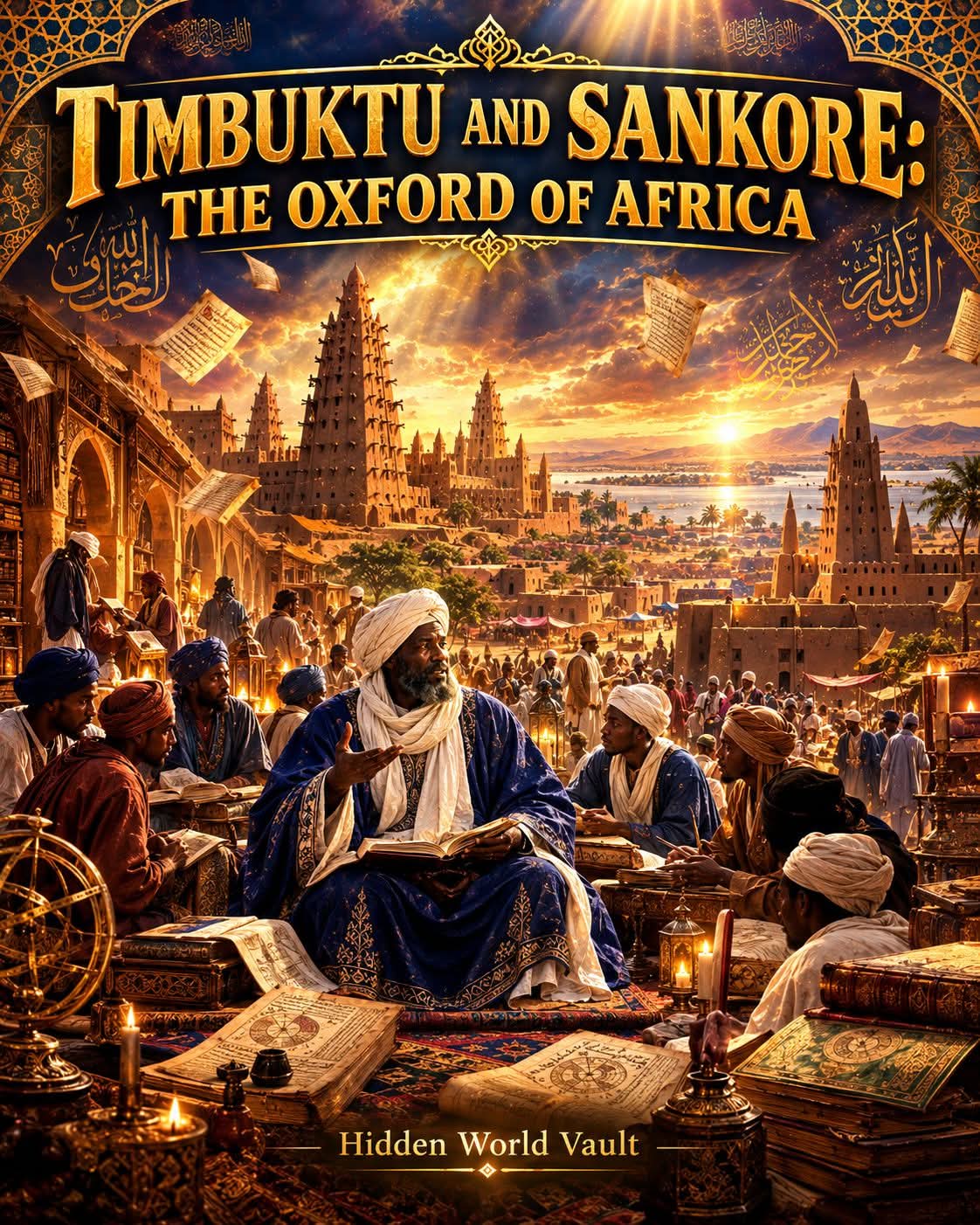
Timbuktu was more than a city. It became a symbol of knowledge, faith, scholarship, and intellectual exchange in West Africa.
At the heart of this tradition stood Sankore’ University and the Jingerber Mosque. Scholars from different parts of Africa and beyond travelled to Timbuktu to study, teach, exchange ideas, and preserve knowledge.
Timbuktu has often been described as the Oxford of Africa, a comparison that reflects its historic importance as a center of learning.
- THE SCHOLARS OF SANKORE’
In Tarikh ‘s-Sudan, we encounter accounts of the respected scholars of Sankore’. One passage quotes Modibo Muhammad al-Kaburi:
«“I have been blessed to keep company with the righteous men of the Sankore’ University, whom none had equaled in righteousness except the Companions of the Messenger of Allah, may Allah bless him and grant him peace and may Allah be pleased with them.”
— Tarikh ‘s-Sudan, Chapter IX»
This statement reveals the high regard in which the scholars of Sankore’ were held. Modibo Muhammad al-Kaburi compared the righteous scholars of the university with the Companions of the Prophet Muhammad (peace be upon him).
Such a comparison reflects the spiritual and scholarly respect associated with Timbuktu’s intellectual tradition.
- SANKORE’: MORE THAN A MOSQUE
Sankore’ was not simply a place of prayer. It functioned as an important institution of advanced learning, where students and scholars studied different branches of Islamic knowledge and other intellectual disciplines.
3.1. Areas of Study
The curriculum included:
- Jurisprudence (Fiqh): Islamic law, particularly within the Maliki tradition.
- Grammar (Nahw): The structure and rules of the Arabic language.
- Rhetoric (Balagha): The art of effective and eloquent speech and writing.
- Qur’anic Exegesis (Tafsir): The interpretation of the Qur’an.
- Prophetic Traditions (Hadith): The sayings and actions of the Prophet Muhammad (peace be upon him).
- History (Tarikh): The study of past events and civilizations.
- Sciences: Including astronomy, mathematics, medicine, and other fields of knowledge.
The scholars of Timbuktu produced and preserved manuscripts covering subjects such as law, theology, astronomy, and medicine. Many of these manuscripts have survived, providing evidence of the city’s long intellectual tradition.
- THE GREAT MINDS OF SANKORE’
Several respected scholars became associated with Timbuktu’s scholarly history.
4.1. Qadi Mahmud ibn Umar Aqit
Qadi Mahmud ibn Umar Aqit (d. 1548) served as the chief judge of Timbuktu and is described as the dean of Sankore’ University.
Tarikh ‘s-Sudan praises him in the following words:
«“The chief judge of Tinbuktu, the praiseworthy, the splendid, the foremost scholar, the most righteous, the professor, the jurist and Imam of Takruur.”
— Tarikh ‘s-Sudan, Chapter IX»
The text also describes his reputation for justice, stating that he had no equal in his time.
4.2. Ahmad Baba
Ahmad Baba (d. 1626) is remembered as one of Timbuktu’s most celebrated scholars. Tarikh ‘s-Sudan describes him as:
«“The jurist, the learned scholar, the unique of his age, the matchless one of his time, proficient in every variety of sciences… He was earnest and strenuous from the beginning of his affair in the service of knowledge until he outstripped all of his contemporaries and surpassed them exceedingly.”
— Tarikh ‘s-Sudan, Chapter IX»
According to the text, Ahmad Baba wrote more than 40 works and became widely known across Africa and the Middle East.
Following the Moroccan invasion, he was taken captive to Marrakech, but he continued his scholarly work, writing and teaching.
4.3. Muhammad Baghyuyu
Another important scholar was Muhammad Baghyuyu, a jurist and theologian who was appointed to the judiciary after the death of Qadi al-Abbas Kibi.
His sons, Muhammad and Ahmad, also became prominent scholars, continuing the family’s intellectual tradition.
- THE JINGERBER MOSQUE: THE GREAT MOSQUE OF TIMBUKTU
The Jingerber Mosque was another major institution in Timbuktu’s religious and community life. According to Tarikh ‘s-Sudan, it was constructed under Mansa Musa, the ruler of Mali.
The text states:
«“It was the Sultan al-Hajj Mansa Musa, the ruler of Mali, who first had it and its minaret constructed where it held five rows.”
— Tarikh ‘s-Sudan, Chapter XI»
The mosque served purposes beyond worship. It was a central part of community life, and a graveyard stood next to it. The text explains that burying the dead in the courtyards of mosques was a custom in parts of the western Sudan.
5.1. The Imams of Jingerber
The first imams of the Jingerber Mosque were Sudanese jurists. The last of them mentioned in the account was Kaatib Musa, who reportedly served for 40 years without anyone being appointed to act in his place—even for a single prayer.
Kaatib Musa attributed his health to three habits:
«“I never sleep out in the open during all the four seasons; I never go to sleep without first rubbing my entire body with oils and then after day break taking a hot bath; and I never leave for the subh prayer except after first eating breakfast.”
— Tarikh ‘s-Sudan, Chapter XI»
- THE SIDI YAHYA MOSQUE: ANOTHER CENTER OF LEARNING
The Sidi Yahya Mosque was also associated with scholarship in Timbuktu.
It was named after Sidi Yahya al-Tadalisi, described as a Qutb and wali of Allah who lived during the period of the Sankore’ scholars.
The mosque served as a place where scholars gathered to study and teach.
Timbuktu’s scholars were not isolated from the wider Islamic world. They corresponded with scholars in places such as Fez, Cairo, and Mecca. They also travelled on pilgrimage and returned with books, ideas, and knowledge.
This placed Timbuktu within a broader intellectual network that connected West Africa to other parts of the Islamic world.
- THE CURRICULUM AND TEACHING METHODS
Tarikh ‘s-Sudan provides insight into the texts studied by scholars in Timbuktu.
7.1. Important Texts
Among the works mentioned are:
- Al-Muwatta by Imam Malik.
- Al-Mudawwana al-Kubra by Sahnun.
- Al-Mukhtasar by Khalil ibn Ishaq.
- Kitab al-Shifa by Qadi ‘Iyad.
- The Sahih collections of al-Bukhari and Muslim.
- Al-Tahdheeb by al-Buradi‘i.
7.2. Teaching Methods
Teaching involved memorization, repetition, commentary, debate, and discussion.
Students studied texts, committed them to memory, and examined their meanings through explanation and scholarly exchange. The scholars of Sankore’ were recognized in the text for their mastery of important works and their ability to explain them.
- THE LEGACY OF SANKORE’
The history of Sankore’ challenges the outdated idea that Africa lacked intellectual institutions or written traditions.
Timbuktu was home to scholars who studied law, theology, history, language, astronomy, medicine, and other subjects. Its scholars produced manuscripts, maintained relationships with intellectual communities beyond West Africa, and contributed to a wider tradition of Islamic learning.
The surviving manuscripts are an important part of this legacy.
8.1. The Importance of Tarikh ‘s-Sudan
Tarikh ‘s-Sudan is itself a product of that intellectual tradition. It was written by al-Qadi Abd’r-Rahman as-Sa’di, a scholar of Timbuktu, who sought to preserve historical knowledge during a period when much had been lost following the Moroccan invasion of 1591.
In the introduction, he wrote:
«“When I perceived that this science and its study had become extinct and its wealth and the tremendous advantages it brings from comprehending human nature, their homelands, forefathers, social classes, chronicles and the causes of their decline; had weakened – I sought Allah’s assistance… in writing what I had memorized.”
— Tarikh ‘s-Sudan, Introduction»
His words demonstrate the importance he placed on preserving historical knowledge, collective memory, and an understanding of societies and their past.
The legacy of Sankore’ survives through the manuscripts that remain, the scholars whose names have been recorded, and historical works such as Tarikh ‘s-Sudan.
Timbuktu reminds us that the history of African civilization includes longstanding traditions of scholarship, intellectual exchange, written knowledge, and education.
- REFLECTION AND DISCUSSION
What would you study at Sankore’ University?
If you had the opportunity to attend Sankore’, which subject would you choose?
● Islamic jurisprudence
● History
● Astronomy
● Medicine
● Arabic grammar
● Another field of knowledge
- REFERENCES
10.1. Primary Source
as-Sa‘di, al-Qadi Abd’r-Rahman. Tarikh ‘s-Sudan: The History of the Land of the Blacks. Translated by Abu Alfa Umar Muhammad Shareef bin Farid. Maiurno, Sennar, Sudan: SANKORE’ Institute of Islamic-African Studies, 1410/1990.
10.2. Relevant Sections
- Introduction: The author’s purpose in writing Tarikh ‘s-Sudan.
- Chapter IX: Biographies of the scholars, righteous figures, and judges of Timbuktu, including Modibo Muhammad al-Kaburi, Qadi Mahmud ibn Umar Aqit, Ahmad Baba, and Muhammad Baghyuyu.
- Chapter XI: The chronological order of the imams of the Jingerber and Sankore’ mosques, including Kaatib Musa and accounts of the Jingerber and Sidi Yahya mosques.
10.3. Additional Sources Mentioned
- Ahmad Baba, Nayl ‘l-Ibtihaaj Bi Tatreez ‘d-Dibaaj.
- Ibn Battuta, Ar-Rihla.
 Hi welcome to my website