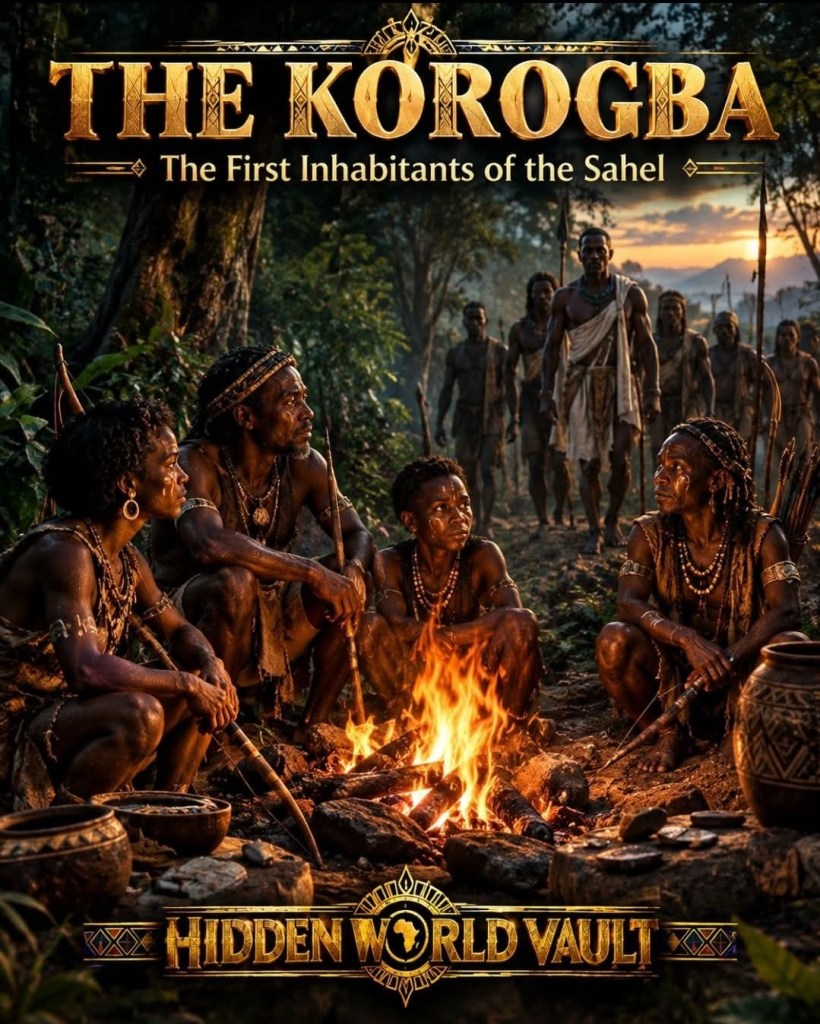
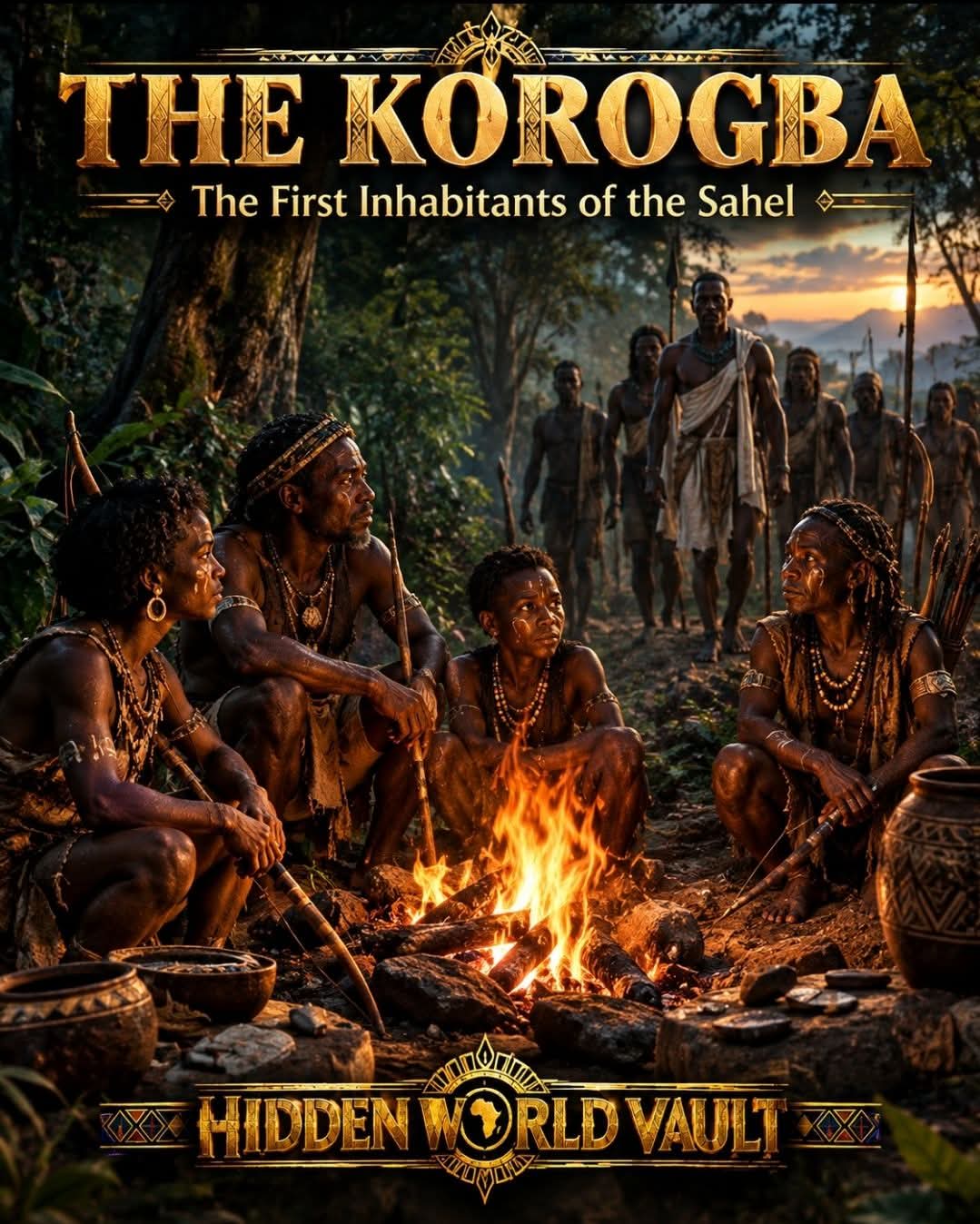
THE KOROGBA — THE FIRST INHABITANTS OF THE SAHEL
THE KOROGBA — THE FIRST INHABITANTS OF THE SAHEL
Ancient Small-Statured Populations and the Memory They Left Behind
INTRODUCTION
Before the Kakoro (the Mandé ancestors), and before the Soninké as we know them today, Mandé oral history speaks of populations remembered as the Korogba.
They are described as an ancient, small-statured population that lived across the Sahel, especially parts of the Upper Guinea region, Northwestern Côte d’Ivoire, and Southern Mali. They survived through agriculture, gathering, and hunting.
In the traditions discussed here, the Korogba represent an earlier population layer; people who were already living in the region before the arrival and expansion of Kakoro and Soninké populations.
Some of their descendants or surviving legacy are said to have been absorbed into later communities. Among the names associated with this memory are the Temne, Baga, Landouma, Talèm, Nalou, and Pygmy groups.
The story is therefore not simply about a forgotten people.
It is about what happened to the populations who were already there before later identities emerged.
And critically, it is also a story of war, defeat, and assimilation, a story that the oral traditions do not shy away from.
- WHO WERE THE KOROGBA?
The Korogba are described in the tradition as people of very small stature, sometimes referred to using older terms such as “Pygmies” or “Negrilles.”
Their remembered territory included parts of:
● Upper Guinea — present-day Guinea
● Northwestern Côte d’Ivoire
● Southern Mali
● The Valley of Mopti to Koulikoro in Mali
They are associated with both dense forest and wooded savannah environments.
Their traditional way of life included:
● Agriculture
● Gathering
● Hunting
But the descriptions go beyond subsistence.
The Korogba are also remembered as possessing knowledge of:
● Iron working and metallurgy
● Medicinal plants
● Archery
● Cultivation of taro and yam
That is important because the old descriptions can easily reduce such populations to the label “primitive.”
Hidden World Vault believes they were not “primitive.”
The tradition itself presents something more complicated.
It remembers people who possessed their own knowledge systems and ways of adapting to their environment.
- THE MEANING OF “KOROGBA” — THE WAR CAPTAIN
One of the most significant discoveries in this research is the linguistic meaning associated with the name “Korogba” in the languages of descendant populations.
● In Temne, O-kurugba is remembered as meaning: War Captain, General, Battle Commander.
● In Baga, O-courougba is remembered as: War Captain, Army General, Supreme Battle Commander.
● In Landouma, O-courougba is likewise remembered as: War Captain, Army General, Supreme Battle Commander.
This is a profound revelation.
The name “Korogba” was not merely an ethnic label. It was a title of military rank, a designation of war leadership.
The Korogba were not simply “small-statured people.”
They were war captains, commanders of armies, leaders of battles.
This changes everything about how we understand them.
They were:
● Organized — capable of military structure
● Led — by commanders with authority
● Formidable — worthy opponents to the Kakolo
● Respected — their title preserved in descendant languages
The fact that the term survives in Temne, Baga, and Landouma as “War Captain” preserves an important memory of the Korogba as military leaders.
- THE EARLIEST SETTLEMENTS
According to the historical memory presented in this tradition, the Korogba settled in small family groups in Batè before the 10th century.
They were not remembered as a single centralized kingdom or large political state.
Instead, the picture is one of small communities and family groups, living through agriculture, gathering, and hunting.
This detail matters.
When we speak of “the first inhabitants,” we should not automatically imagine a single people occupying a clearly defined modern territory.
The tradition describes an older population layer spread across different environments and later absorbed into other communities.
- THEIR KNOWLEDGE SYSTEMS
The Korogba tradition also preserves memories of practical knowledge.
They are remembered as having knowledge of:
● Metallurgy — iron working
● Medicinal plants — herbal medicine
● Archery — bow and arrow
● Agriculture — taro and yam cultivation
These details are significant because the history of early African populations is often told through political kingdoms and famous rulers.
But knowledge of plants, agriculture, metallurgy, and hunting is also history.
The people who possessed that knowledge deserve to be remembered as more than a footnote.
- THE ORIGINAL TERRITORY — THE VALLEY OF MOPTI TO KOULIKORO
The oral traditions specify the original territory of the Korogba:
The Korogba were the first inhabitants of the Valley of Mopti downwards to Koulikoro before the arrival of the Kakoro from Nubia.
This places the Korogba in the Niger River Valley, from Mopti, in present-day Mali, down to Koulikoro, near Bamako.
This was their homeland before the Kakoro arrived from Nubia.
- THE WAR WITH THE KAKOLO
One of the most important, and often overlooked parts of the Korogba story is the war with the Kakolo.
The oral traditions state clearly:
● There was a war between the Korogba and the Kakolo. The Kakolo defeated them and chased them away.
● This was not a minor skirmish.
● It was a decisive conflict that reshaped the population landscape of the region.
- THE FIRST WAR — WAGADOU
The first war took place in Wagadou, the region of the Ghana Empire.
The Kakolo were victorious and established dominance.
Most of the Korogba were chased away and dispersed to other regions.
Some of the remaining Korogba were assimilated among the Kakolo.
After the Kakolo defeated and chased them away from the land that would later become Wagadou, the majority migrated to the land that would be called Fouta Djallon, but some went and inhabited the land that would later become Mandé.
It was a heavily forested, game-rich land.
- THE SECOND WAR — THE FOREST OF WANDA
The second war took place in the forest of Wanda, the heavily forested land that would later become Mandé.
When the Kakolo journeyed southward into this land, they met Pygmies called the Kounins.
The Korogba populations were also there.
So the Kakolo encountered two populations:
- The Kounins — Pygmies
- The Korogba — the War Captains
The Kakolo who fought the war against the Korogba were 12 Donso, or hunters, from ancient Wagadou.
They were led by their great hunter king, MANSA KÎRÂN CAMARA.
He was the great hunter king who led the twelve Kakolo Donso into the forest of Wanda.
The twelve hunters began their conquest in the forest of Wanda.
The forty-three villages of the Korogba, including the Pygmies, resisted fiercely before eventually being defeated.
The Korogba and Kounins resisted fiercely.
This was not a simple conquest.
It was a hard-fought war against determined enemies who were already living in the forest.
The forty-three villages were eventually defeated by the Kakolo.
That was how the Korogba finally left Wanda and joined the ones who had left earlier for the land that would be called Fouta Djallon.
The Kakolo established control over Wanda.
- WHO SURVIVED?
The tradition does not describe the Korogba as simply disappearing.
Instead, it remembers their gradual absorption, change of name, as well as their dispersal after the wars.
Among the groups associated with this memory are:
● Temne — Sierra Leone; descendants of Korogba who migrated.
● Baga — Guinea; descendants of Korogba who migrated.
● Landouma — Guinea; descendants of Korogba who remained.
● Nalou — Guinea-Bissau; descendants of Korogba.
● Talèm — described as “Red Pygmies.”
● Nianthio — another name preserved in tradition.
● Kounins — Pygmies of the forest of Wanda.
These names are important because they suggest that the memory of the Korogba survived even after their distinct identity was weakened through war and assimilation.
- ASSIMILATION, NOT SIMPLE DISAPPEARANCE
One of the most important parts of this story is assimilation.
The tradition describes a gradual process involving:
● Intermarriage
● Cultural absorption
● Incorporation into later populations
● Loss or transformation of an earlier identity
This is different from simply saying:
“The Korogba disappeared.”
They may have disappeared as a clearly separate population in some areas, while elements of their ancestry, culture, or historical memory continued among later communities.
That is why the Temne, Baga, Landouma, and Nalou connections are important within this tradition.
The people may have changed their identity without completely disappearing from history.
- THE PROBLEM WITH THE WORD “PYGMY”
There is also a language issue that should not be ignored.
Older historical writings use terms such as “Pygmy” and “Negrille” when describing small-statured African populations.
The term “Pygmy” can be problematic, particularly when it is used to reduce an entire population to physical stature.
The Korogba should instead be approached as people with their own:
● History
● Knowledge
● Communities
● Agency
Their small stature is one feature in the descriptions.
It should not become their entire identity.
Likewise, describing them as a “primitive population” can obscure the knowledge systems attributed to them, and their role as war captains.
A better way to understand the tradition is to recognize that these were communities remembered as having developed their own ways of living, cultivating food, working with metals, using medicinal plants, hunting, and leading armies.
- THE MANDÉ ORAL TRADITION
The importance of the Korogba story comes largely from its preservation in the Mandé oral tradition.
The tradition remember them as an earlier population.
Their small stature is part of that memory.
Their knowledge of agriculture, metallurgy, medicinal plants, and archery is also preserved in the account.
Their title as War Captains is preserved in the languages of descendant populations.
And their eventual defeat, dispersal, and assimilation provides an explanation for why these populations are remembered as ancient inhabitants rather than as a large, clearly separate population today.
The oral tradition therefore preserves a historical memory of population layers.
- THE KOROGBA AND THE BAGA, TEMNE, LANDOUMA, AND NALOU
One of the most significant claims in this tradition is the connection between the Korogba and the Baga, Temne, Landouma, and Nalou.
The tradition presented here remembers:
● Temne — descendants of Korogba who migrated to Sierra Leone.
● Baga — descendants of Korogba who settled in Guinea.
● Landouma — descendants of Korogba who remained in Guinea.
● Nalou — descendants of Korogba who settled in Guinea-Bissau.
This creates an important question:
Did later Baga, Temne, Landouma, and Nalou populations incorporate earlier populations remembered as Korogba?
Within the traditional framework, the answer is yes.
But the historical significance of that claim needs to be examined through the evidence available for each period and population.
- THE BIGGER QUESTION
The Korogba story is ultimately about something larger than one ancient population.
It raises a question that runs through much of West African history:
● Who was already here before the better-known kingdoms, languages, and ethnic identities emerged?
● Before later Mandé expansions?
● Before the Soninké political traditions?
● Before the identities that dominate many modern historical narratives?
The Korogba tradition remembers an older population layer.
And if that memory preserves genuine historical information, then the history of West Africa cannot be understood only through the rise of later kingdoms.
It must also account for the people who were already living on the land.
- WHAT HIDDEN WORLD VAULT IS TESTING
The Korogba tradition therefore contributes several hypotheses to the larger investigation.
- EARLIER POPULATION LAYER
The Korogba may represent populations that inhabited the Niger Valley, from Mopti to Koulikoro, before later Mandé and Soninké expansions.
- SMALL-STATURED POPULATIONS
The traditions preserve memories of populations described as unusually small in stature.
- INDIGENOUS KNOWLEDGE SYSTEMS
The Korogba are remembered as possessing knowledge of agriculture, metallurgy, medicinal plants, and archery.
- WAR CAPTAINS
The name “Korogba” means “War Captain” in Temne, Baga, and Landouma, indicating military organization and leadership.
- POPULATION CONTINUITY THROUGH ASSIMILATION
Rather than disappearing completely, some Korogba populations may have been absorbed into later communities.
- WAR WITH THE KAKOLO
The tradition specifically remembers two wars: one in Wagadou and one in the forest of Wanda.
- MANSA KÎRÂN CAMARA
The Kakolo war leader who defeated the Korogba and Kounins with his 12 Donso.
- THE FORTY-THREE VILLAGES
The Korogba and Kounins resisted fiercely from 43 villages before being defeated.
- TEMNE–BAGA–LANDOUMA–NALOU CONNECTION
The tradition specifically connects these groups with Korogba ancestry.
- OLDER POPULATION LAYERS IN WEST AFRICA
The broader hypothesis is that modern ethnic identities may contain older population layers that are no longer visible from language or political identity alone.
- THE KOROGBA LEGACY
Within this historical framework, the Korogba represent:
● An ancient population — remembered as living in West Africa before later groups.
● An original territory — the Valley of Mopti to Koulikoro.
● Small-statured communities — associated with Upper Guinea and neighboring regions.
● Knowledge systems — agriculture, hunting, gathering, metallurgy, medicine, and archery.
● Military organization — War Captains remembered through the terms O-kurugba and O-courougba.
● War and defeat — defeated by the Kakolo in Wagadou and Wanda.
● Assimilation — those who remained were absorbed into Kakolo society.
● Dispersal — descendants associated with the Temne, Baga, Landouma, and Nalou.
● Historical memory — preserved through Mandé and Soninké traditions.
● Their story is therefore not simply one of disappearance.
● It is a story of continuity through transformation.
CONCLUSION
The Korogba occupy an unusual place in West African historical memory.
They are remembered as an early population, small in stature but knowledgeable in agriculture, hunting, metallurgy, medicinal plants, and archery.
They were War Captains, military leaders whose title survives in the languages of their descendants.
Their communities are said to have existed in the Valley of Mopti to Koulikoro before the Kakoro arrived from Nubia.
Over time, the tradition remembers them being defeated by the Kakolo in two wars; first in Wagadou, then in the forest of Wanda, with most chased away and the remainder absorbed into Kakolo society.
The Temne, Baga, Landouma, and Nalou are remembered as having descended from these Korogba populations.
So the Korogba story is not simply:
“An ancient people disappeared.”
It is:
An older population was defeated, dispersed, and absorbed. Identities changed. And the memory survived.
And that leaves us with a question worth investigating:
How many of West Africa’s present-day populations carry memories, or perhaps ancestral layers, of peoples whose names disappeared long before the histories we know today were written down?
They were the Korogba.
They were the first inhabitants of the Sahel.
They were War Captains.
They were defeated by the Kakolo.
They were absorbed into later populations.
And their story deserves to be investigated rather than forgotten.
REFERENCES
● Mandé Oral Tradition
● Soninké Oral Tradition
● Temne Linguistic Tradition
● Baga Linguistic Tradition
● Landouma Linguistic Tradition
● Winters, C. (1986). The Migration Routes of the Proto-Mande. The Mankind Quarterly, 27(1), 77–96.
Korogba