
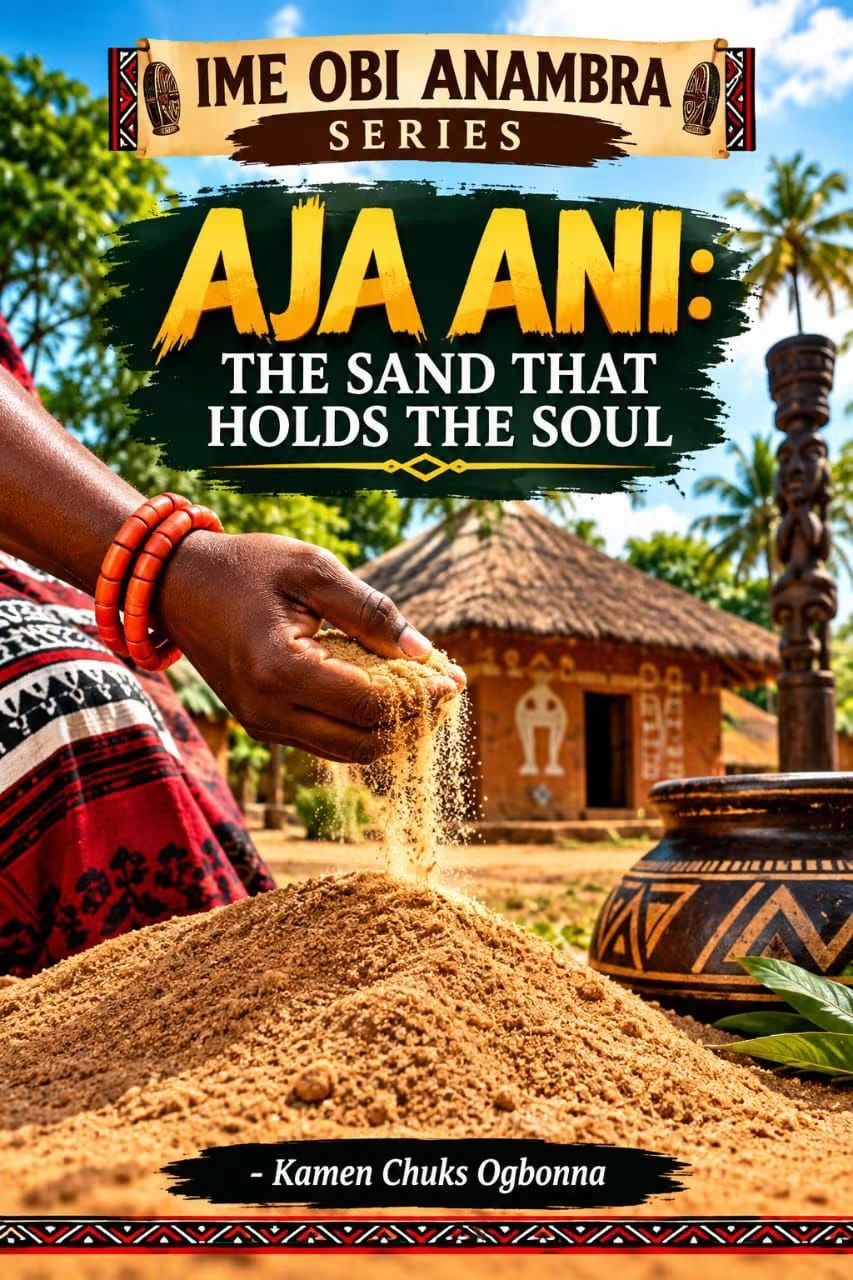
AJA ANI: THE SAND THAT HOLDS THE SOUL
IME OBI ANAMBRA SERIES
AJA ANI: THE SAND THAT HOLDS THE SOUL
In its simplest interpretation, Aja is sand while Ani is the earth. Aja Ani is the sand of the earth. But in the ancient Igbo worldview, this sand is not ordinary. It is the very flesh of Ala, the Earth Mother.
Our ancestors did not see Ani as mere soil. She is a living deity that owns all land, holds the ancestors in her womb, and feeds the living on her back.
When you hold Aja Ani in your palm, you are not holding dust. You are holding Ala herself. That is why the Igbo say Ala bu nne (the earth is mother).
This belief gave Aja Ani three great powers.
The first is truth. In ancient igbo society, law was not written in books, it was held in sand. When there was a dispute over land or a case of theft, elders brought Aja Ani (sand) from the land in question and asked the parties to swear upon it. No one dared lie. Ani cannot be bribed and she never forgets. When two villages made peace, both sides would taste the sand from their boundary. Once you have placed sand from the earth on the tongue in oathtaking, you cannot betray it. The sand becomes witness.
The second is protection. Aja Ani was used as a seal. A Dibia or an elder would pour a circle of sand round a compound, a farm or a newborn child, and no evil force would cross it. A handful of sand from the sacred groove wrapped in cloth and placed on property was an invitation for Ala to stand guard.
Travellers leaving home carried a small knot of Aja Ani from their father’s compound. Wherever they went, their mother followed them. In a strange land, they could pour it on the ground and call home.
The third is identity. Every Igbo child has his umbilical cord buried in Aja Ani. His placenta rests in that soil. So he is not just from that land, he is that land. That is why to exile a man was to say his feet had been cut from his earth. He becomes rootless.
In ancient times land could not be sold outright because you cannot sell your mother. You only begged Ala to let you farm.
The philosophy behind this is profound. It teaches equality, because we all come from sand and to sand we shall return, king and slave alike. It teaches humility, because no matter how high you climb, you remain dust. And it teaches wealth, because everything we eat and own comes from Aja Ani.
For the modern Igbo man, Aja Ani still speaks. Many of our youth in Port Harcourt, Lagos and abroad no longer know their Aja Ani, the sand where their navel was buried, and so they float without root. The reckless sale of ancestral land and the pollution of our soil is, in the old language, a betrayal of our own flesh. And in an age when justice can be bought, Aja Ani reminds us of a truth that cannot be bribed.
Yet, Ala still watches with clear eyes.


What a profound and beautifully written reflection on the relationship between people, land, ancestry, and identity. 🌍🙏
I was especially moved by the idea that “you are not just from that land, you are that land.” It transforms soil from something we simply possess into something we belong to—and perhaps that distinction carries an important lesson for all of us.
LikeLiked by 2 people