MAJOR GENERAL ILLIYA BISALLA: THE SOLDIER CAUGHT IN NIGERIA’S 1976 COUP CRISIS
MAJOR GENERAL ILLIYA BISALLA: THE SOLDIER CAUGHT IN NIGERIA’S 1976 COUP CRISIS
Major General Illiya D. Bisalla was one of the most senior officers in the Nigerian Army when the country entered one of the darkest episodes in its post-Civil War military history.
A Sandhurst-trained officer, former commander of the 1st Infantry Division and former Commandant of the Nigerian Defence Academy, Bisalla had risen through the ranks to become Federal Commissioner for Defence under General Murtala Mohammed.
Less than a year after reaching that position, however, he was dead.
On 13 February 1976, Lieutenant Colonel Buka Suka Dimka and other officers launched an unsuccessful coup attempt in Lagos. General Murtala Mohammed was assassinated during the attempt, and Bisalla was subsequently arrested and accused of involvement in the conspiracy.
Less than a month later, Bisalla was executed by firing squad.
But the historical record surrounding his downfall is more complicated than simply saying that a senior general was exposed as a coup plotter.
A SOLDIER TRAINED FOR COMMAND
Bisalla belonged to the generation of Nigerian officers whose careers developed during the country’s transition from colonial rule to independence and then through the political crises of the 1960s.
He trained at the Royal Military Academy Sandhurst in Britain, where he was a course mate of another prominent Nigerian soldier, Major General Hassan Usman Katsina.
His career progressed steadily through the Nigerian Army.
From September 1969 to December 1973, he served as General Officer Commanding (GOC) 1st Infantry Division. The division had played an important role during the Nigerian Civil War, and Bisalla belonged to the generation of commanders who continued to occupy senior positions in the post-war Army.
He subsequently became Commandant of the Nigerian Defence Academy in Kaduna, placing him at the head of the institution responsible for training many of Nigeria’s future military officers.
By the middle of the 1970s, Bisalla had become one of the most senior officers in the country.
FROM MILITARY COMMAND TO GOVERNMENT
The political situation changed dramatically in July 1975.
General Yakubu Gowon, who had ruled Nigeria since the 1966 counter-coup, was overthrown by a group of senior military officers. General Murtala Ramat Mohammed emerged as Head of State, with Lieutenant General Olusegun Obasanjo as his deputy.
Bisalla became part of the new administration.
He was appointed Commissioner for Defence in 1975, a position roughly equivalent to what would later be known as Minister of Defence.
He had therefore moved from commanding troops and training officers to occupying one of the most influential defence positions in the Federal Military Government.
But the new administration was itself operating in a tense political environment.
Murtala Mohammed had embarked on a programme of rapid reforms, including changes within the military and government. His administration also faced opposition from officers who disagreed with the direction of the new regime.
Then came February 1976.
THE COUP THAT CHANGED EVERYTHING
On the morning of 13 February 1976, Lieutenant Colonel Buka Suka Dimka and a group of military personnel launched an attempted coup.
Dimka’s men attacked key locations in Lagos and assassinated Murtala Mohammed.
The coup attempt failed to take control of the government. Brigadier Olusegun Obasanjo, then Chief of Staff, Supreme Military Headquarters, assumed leadership of the Federal Military Government.
Dimka escaped Lagos and remained at large for several weeks before he was eventually captured.
But the investigation into the coup had already begun.
And among those implicated was the Federal Commissioner for Defence himself.
WHY WAS BISALLA ACCUSED?
The government’s investigation connected Bisalla to the conspiracy.
Historical accounts say that evidence implicating him came partly from statements attributed to Dimka during interrogation.
The Federal Military Government alleged that Bisalla had provided operational instructions to Dimka.
But there was a serious complication.
Accounts of the investigation indicate that Dimka did not consistently identify Bisalla as the source of the operational orders. One historical account records that Dimka instead pointed to Major Ibrahim Rabo as the officer who provided the orders. The evidence against Bisalla has consequently remained controversial in later historical writing.
This distinction is important.
Bisalla was not acquitted. He was tried by a Special Military Tribunal and convicted.
But a conviction by a military tribunal and the question of what the historical evidence ultimately proves are not necessarily the same thing.
THE ABISOYE TRIBUNAL
The government established a special military tribunal headed by Major General E. O. Abisoye to investigate and try those accused of involvement in the February coup.
Bisalla was tried and convicted of offences connected with the conspiracy, including conspiracy and concealment of treason, according to historical accounts of the proceedings.
The proceedings were conducted in the atmosphere of an authoritarian military government following the assassination of its Head of State.
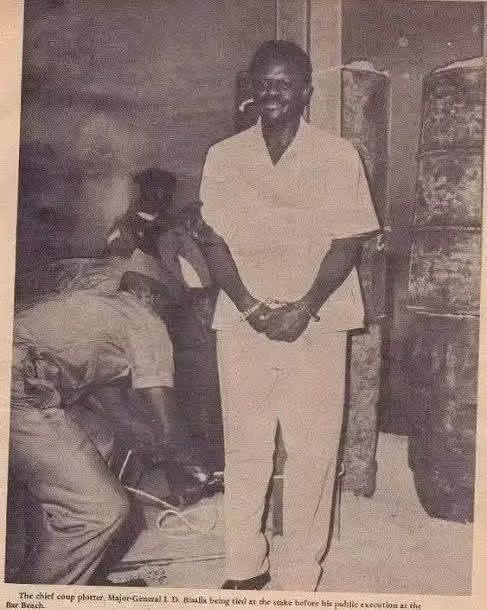
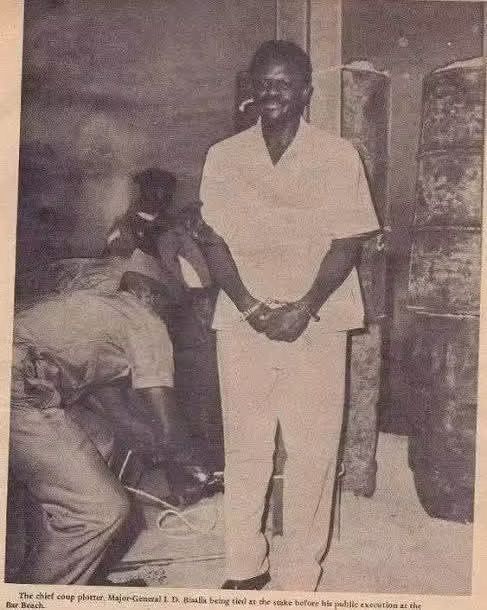
Amnesty International later described the trials as summary trials and recorded that Major General I. D. Bisalla was among those publicly executed after being convicted in connection with the February coup attempt.
Contemporary reporting also recorded that dozens of people were arrested after the failed coup, while others were released or received different sentences.
The punishments were therefore not uniform.
Some suspects were acquitted or discharged for lack of evidence, some received prison terms and others were sentenced to death.
THE FIRING SQUAD
On 11 March 1976, Major General Illiya Bisalla was executed by firing squad in Lagos.
He was among the first group of people punished for their alleged involvement in the coup.
Contemporary international reporting recorded the execution of 30 people, including the former Defence Commissioner.
The execution brought a sudden end to the career of a senior Nigerian military officer who only months earlier had occupied one of the most powerful defence positions in the country.
Bisalla was not, however, the only prominent figure whose fate was sealed by the coup.
Lieutenant Colonel Dimka, the officer identified as the leader of the attempted coup, was captured later and tried separately.
On 15 May 1976, Dimka and six other convicted persons, including former Benue-Plateau State military governor Joseph Gomwalk, were executed.
WHAT REMAINS UNCERTAIN?
The most enduring question surrounding Bisalla is whether the evidence against him adequately established the level of involvement attributed to him.
The official position of the military government was that he was guilty.
That is the historical fact of the tribunal’s verdict.
But subsequent accounts have pointed to inconsistencies surrounding the evidence, particularly the statements attributed to Dimka and the alleged source of operational instructions. For this reason, Bisalla’s role continues to be treated cautiously by some historians and writers on Nigeria’s military coup history.
It would therefore be misleading to state as an established fact that Bisalla personally orchestrated the coup or ordered Murtala Mohammed’s assassination.
The more defensible conclusion is that he was implicated, tried, convicted and executed by the military government for his alleged involvement in the conspiracy, while the precise extent of his involvement remains contested in historical accounts.
A CAREER ENDED IN A MONTH
Bisalla’s story illustrates the extraordinary volatility of Nigeria’s military politics in the 1970s.
He had commanded one of the country’s major Army formations.
He had led the Nigerian Defence Academy.
He had become Federal Commissioner for Defence.
Then, within months, he went from being one of the most senior figures in the military establishment to a condemned prisoner.
His execution was part of the Federal Military Government’s response to the assassination of Murtala Mohammed and the failed attempt to seize power.
The event also demonstrated how quickly political alliances and military careers could change during Nigeria’s era of successive coups and counter-coups.
THE LEGACY OF ILLIYA BISALLA
More than five decades later, Bisalla’s name remains attached to one of the most disputed episodes in Nigeria’s military history.
His professional record shows a senior officer who rose through the Nigerian Army, served as a divisional commander, headed the Nigerian Defence Academy and eventually became Federal Commissioner for Defence.
His final chapter was very different.
The February 1976 coup attempt ended with the assassination of Murtala Mohammed, the arrest of numerous suspects and the execution of several officers and civilians.
Bisalla was among those executed on 11 March.
Whether the tribunal’s verdict tells the entire story of his involvement remains a question that historical accounts continue to debate.
What is not in dispute is the extraordinary speed of his downfall.
In 1975, Illiya Bisalla stood at the summit of Nigeria’s military establishment. By March 1976, he was dead.
His story remains one of the most striking chapters in the turbulent history of Nigeria’s military era.
Sources
- Amnesty International, Amnesty International Report 1975–1976 — contemporary human-rights documentation of the arrests, trials and executions following the February 1976 coup attempt.
- National Library of Nigeria, Nigeria Year Book — historical account of the Abisoye Tribunal and the military government’s response to the coup.
- The New York Times, “Nigeria Executes 30 for Coup Role; Ex-Defense Minister Among Them,” 13 March 1976 — contemporary reporting on Bisalla’s execution.
- *Max Siollun, Oil, Politics and Violence: Nigeria’s Military Coup Culture (1966–1976) — scholarly historical account of Nigeria’s military coups and the political context surrounding the 1976 crisis.
- Vanguard, “Gbajabiamila, let’s talk Bisalla,” 13 July 2019 — biographical information on Bisalla’s military career.
- TheCable, historical reporting on Nigeria’s 1976 coup crisis and military politics.