
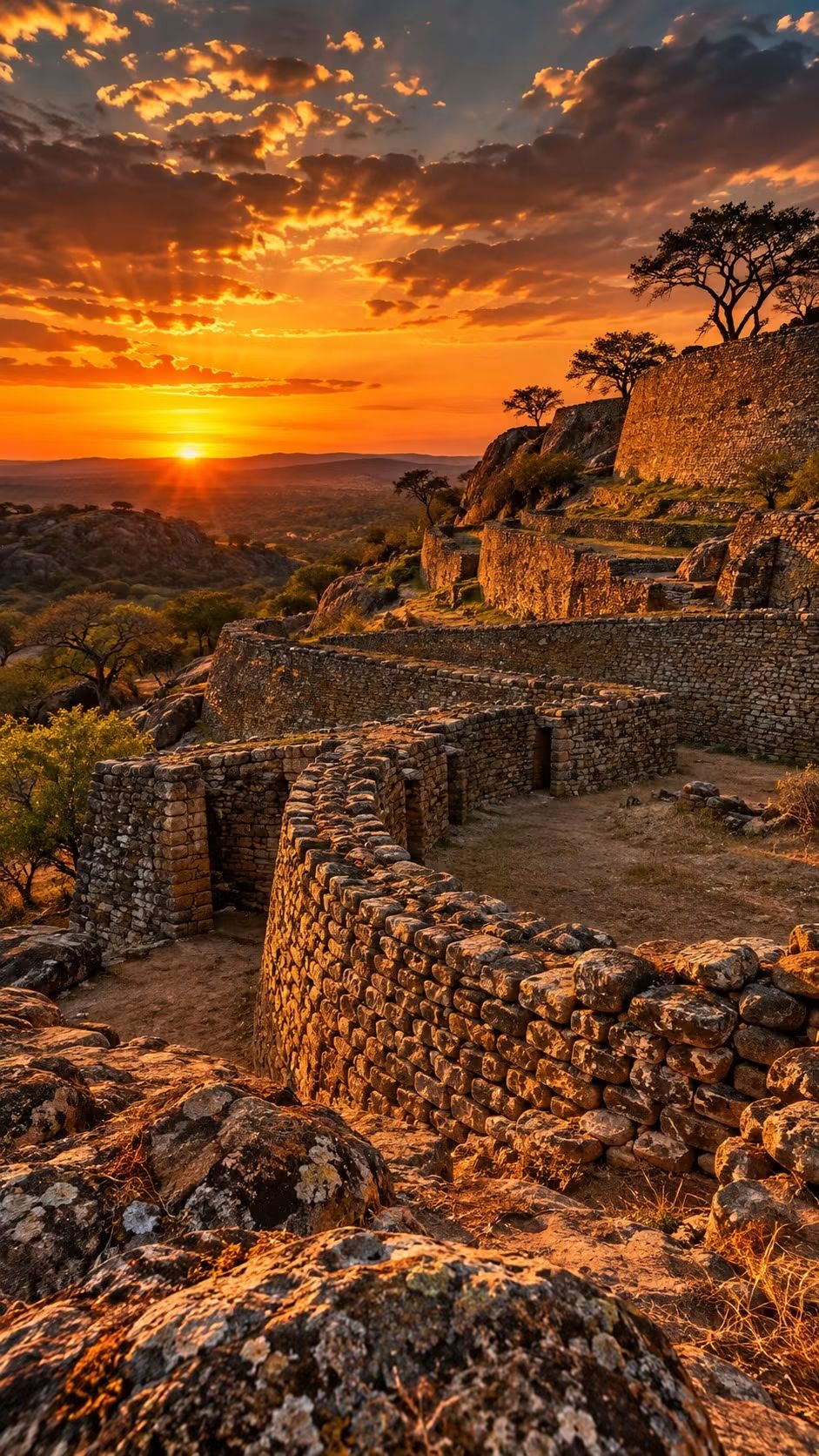
KHAMI — THE FORGOTTEN STONE CITY OF ZIMBABWE
KHAMI — THE FORGOTTEN STONE CITY OF ZIMBABWE
Across the rocky landscape of southwestern Zimbabwe lie enormous stone walls built without mortar.
They curve around hillsides.
Form terraces.
Create passages.
And preserve the remains of a powerful African city that once controlled trade across a wide region.
This is Khami.
Although less internationally famous than Great Zimbabwe, Khami is one of southern Africa’s most important archaeological sites.
The city developed after the decline of Great Zimbabwe and became a major center of the Torwa state, especially from the 15th century onward.
Today, Khami’s most recognizable features are its carefully constructed dry-stone walls.
Thousands upon thousands of stones were stacked without cement or mortar.
The builders selected and positioned them with remarkable skill.
Some walls include decorative patterns.
Others support large artificial platforms and terraces.
These elevated areas were important parts of the settlement.
The architecture reflects both continuity with earlier regional traditions and innovations that gave Khami its own distinctive identity.
When people hear the phrase “ancient stone city,” they often imagine Europe, the Mediterranean, or the Americas.
Khami is an important reminder that sophisticated monumental architecture developed across Africa as well.
Southern African societies created complex states, managed long-distance trade, produced specialized crafts, and constructed impressive urban centers centuries before European colonial rule.
Khami participated in trade networks that reached far beyond the local region.
Archaeologists have found imported objects showing connections with the wider Indian Ocean commercial world.
Goods could move from inland southern Africa toward trading ports on the eastern coast.
From there, merchants connected with networks stretching across the Indian Ocean.
Imported ceramics and luxury items found at sites such as Khami provide evidence of these long-distance connections.
Gold was particularly important within regional trade.
Ivory and other valuable resources also moved through commercial networks.
This means Khami should never be imagined as an isolated settlement.
It was part of a connected world.
Merchants thousands of kilometers away may never have visited the city, yet trade still linked their economies.
A material produced in southern Africa could travel toward coastal markets.
An imported object created far away could eventually reach an elite household in Khami.
Archaeology allows us to reconstruct these connections even when written records are limited.
A piece of pottery can become evidence of international trade.
A bead can reveal exchange networks.
Metal objects can show technological knowledge.
Animal remains can help reconstruct diet.
Building foundations reveal how communities organized space.
Stone walls show engineering traditions and social structure.
This is what makes archaeology so powerful.
Ancient people do not need to leave thousands of written documents for their history to survive.
They leave evidence everywhere.
Khami’s architecture is especially interesting because the settlement was organized around stone platforms.
Elite residences were associated with elevated areas.
The arrangement of space therefore reflected social organization.
Architecture communicated status.
Height mattered.
Access mattered.
The design of the settlement expressed political and social relationships.
Even centuries later, the walls still communicate something about the society that built them.
Imagine Khami at its height.
The ruins would not have looked ruined.
Stone terraces would have supported structures.
People would have moved through narrow passages.
Craft specialists worked.
Animals were kept nearby.
Merchants brought goods.
Political leaders received visitors.
Smoke rose from cooking fires.
Children crossed spaces that archaeologists now carefully document.
The surrounding landscape supplied resources that supported daily life.
The city was alive.
Over time, however, power shifted.
During the 17th century, the political environment changed significantly.
The rise of the Rozvi state altered the region.
Khami declined as a major political center.
Like many historic cities, its decline was not simply one dramatic moment.
Political change, conflict, shifting centers of power, trade networks, and population movements all shaped what happened afterward.
Eventually, the city stopped functioning as it once had.
Buildings deteriorated.
Organic structures disappeared.
Stone survived.
Centuries later, those surviving walls became evidence of a world that outsiders often underestimated or misunderstood.
Older colonial narratives sometimes wrongly presented African history as if complex cities and states had to come from outside influence.
Archaeological research has overwhelmingly demonstrated the sophistication of indigenous African societies.
Sites including Khami and Great Zimbabwe are central to that history.
Their builders were African.
Their architectural traditions developed within regional cultures.
Their states participated in long-distance commerce while maintaining their own identities.
Khami is therefore more than an attractive ruin.
It is evidence.
Evidence of architecture.
Evidence of power.
Evidence of trade.
Evidence of social organization.
Evidence of technological skill.
Evidence that the history of global exchange has always been wider than many simplified stories suggest.
The site is recognized internationally as Khami Ruins National Monument and is a UNESCO World Heritage Site.
Its preservation matters because dry-stone architecture is vulnerable.
Individual stones can shift.
Vegetation can damage walls.
Erosion can weaken structures.
Tourism needs to be carefully managed.
Conservation specialists work to protect the remains while allowing people to learn from them.
One of the most beautiful things about Khami is the way the stonework follows the natural landscape.
Walls curve with the contours of hills.
Terraces rise above rocky ground.
Trees grow around ancient structures.
At sunset, the stone changes color.
Warm light reveals textures that can disappear under harsh midday sun.
The landscape and architecture begin to look almost inseparable.
That harmony reflects a building tradition developed through deep knowledge of local materials.
The builders worked with available stone and transformed it into durable architecture.
And they did it without mortar.
Think about the precision required.
If stones are badly positioned, a wall becomes unstable.
If weight is distributed incorrectly, sections collapse.
If foundations are weak, the entire structure fails.
Yet significant portions of Khami’s walls have survived for centuries.
That survival is a silent tribute to the builders.
We may not know every individual architect.
We do not know the names of every stoneworker.
But their skill remains visible.
Their hands shaped the city.
Their decisions determine what archaeologists see today.
A wall is never only a wall.
It contains choices.
Why was it placed there?
Who built it?
Who was allowed beyond it?
What stood above it?
What happened nearby?
What resources supported its construction?
Which political system organized the labor?
Every ruin is a question.
Khami contains thousands of them.
And beneath the ground, additional evidence still remains.
Future archaeological research may reveal even more about the city.
Scientific analysis can identify where materials originated.
Environmental evidence can reconstruct ancient landscapes.
Digital mapping can document structures in extraordinary detail.
New methods may answer questions that researchers could not solve in the past.
That is why preservation matters.
We are not protecting ruins only for ourselves.
We are preserving unanswered questions for future generations.
When the sun sets over Khami, the walls cast long shadows across the same landscape people watched centuries ago.
Kingdoms changed.
Trade routes shifted.
Political capitals disappeared.
But the stones remained.
And through those stones, the city still speaks.
Follow Lost History Files for forgotten African kingdoms, lost cities, ancient engineering, archaeology, world heritage, historical mysteries, and extraordinary places that deserve to be remembered.

