ETHIOPIAN IMPERIAL, ROYAL, NOBLE, MILITARY, AND RELIGIOUS TITLES
ETHIOPIAN IMPERIAL, ROYAL, NOBLE, MILITARY, AND RELIGIOUS TITLES
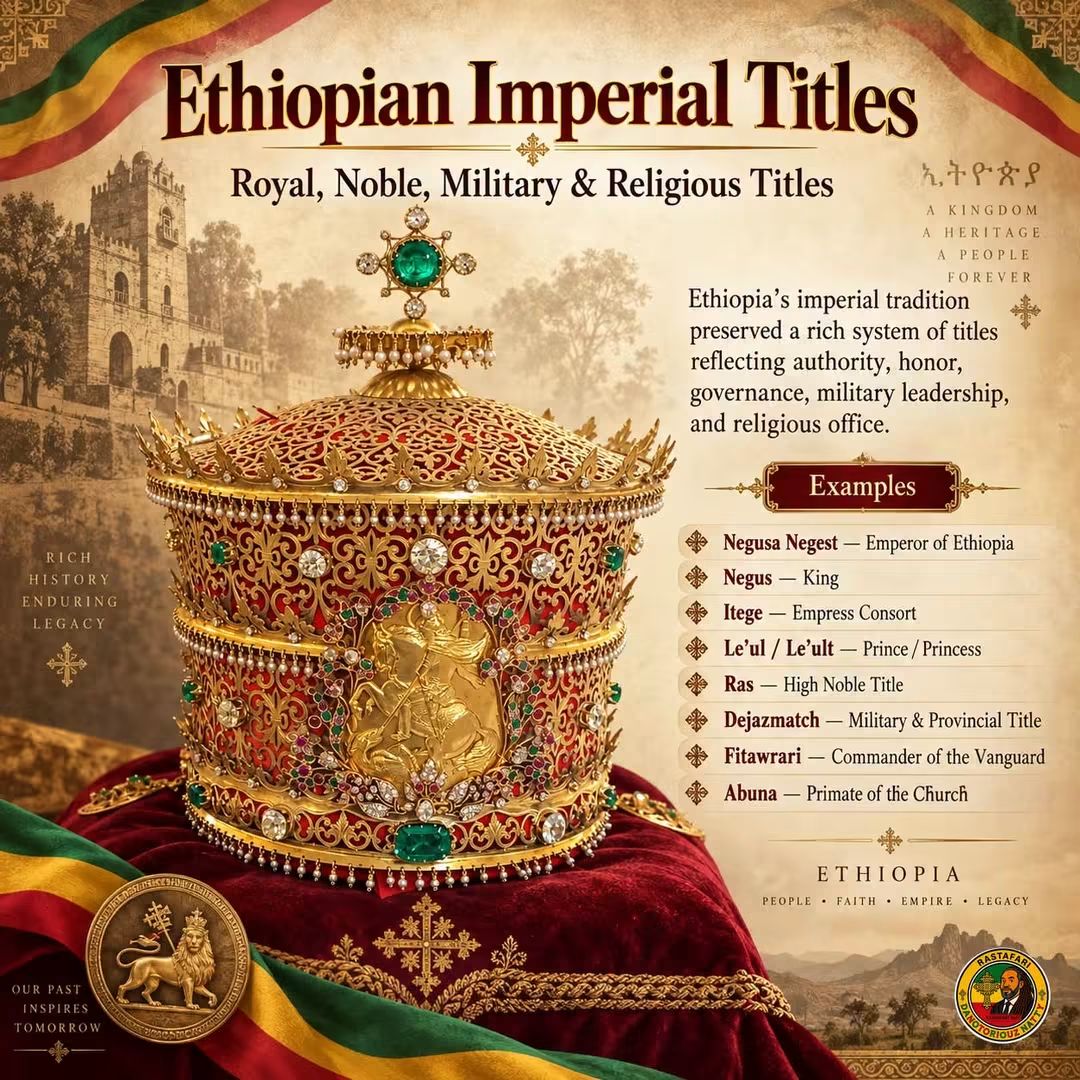
The Ethiopian Empire possessed a sophisticated system of imperial, royal, noble, military, administrative, and religious titles. These titles reflected an individual’s position within the imperial household, government, armed forces, aristocracy, or Ethiopian Orthodox Tewahedo Church.
Unlike European systems of nobility, Ethiopian titles frequently carried multiple meanings. A title could indicate hereditary status, military command, administrative authority, or an honorary distinction bestowed by the Emperor.
Understanding these titles is essential to understanding Ethiopia’s imperial history, particularly the reign of His Imperial Majesty Emperor Haile Selassie I.
I. IMPERIAL, ROYAL, AND NOBLE TITLES
Negusa Negest ze Ethiopia — Emperor of Ethiopia; King of Kings of Ethiopia.
Negus — King.
Negeste-Negestate — Empress in her own right.
Itege — Empress consort.
Alga Worr(a)ch — Heir Apparent; Crown Prince.
Enderassé — Viceroy; representative of the Emperor.
Mesfin — Duke; a title associated with members of the imperial family and high nobility.
Meridazmatch — Traditionally a title of the rulers of Shewa; also a military title.
Le’ul — Prince of the Imperial House.
Le’ul Ras — Prince of the Blood; a title also associated with governorship and military leadership.
Le’ult — Princess of the Imperial House.
Wagshum — Hereditary title associated with the former Zagwe dynasty and the region of Wag.
Bahr Negus — Historical title meaning Ruler of the Sea or Ruler of the Maritime Province, associated with Eritrea.
Ras — Literally, Head; traditionally a high-ranking noble title, often compared to Duke.
II. TITLES BESTOWED BY THE CROWN AND COURT TITLES
Bitwoded — Literally, Beloved; principal adviser to the Emperor or a Negus. Historically also a military commander.
Dejazmatch — Keeper of the Door; a provincial governor or high military commander.
Fitawrari Imperial — A title traditionally given to the Minister of Defence.
Liqa Maqas / Liqa Makwas — Gatekeeper; an imperial official who walked before the Emperor and historically had a role in military command.
Qaññazmatch / Kegnazmatch — Leader of the Right Wing of an army; also bestowed on governors of districts.
Fitawrari — Leader of the Front or Centre; commander of the advance guard.
Gerazmatch — Leader of the Left Wing of an army; also a civilian administrative title.
Blattengeta — Privy Councillor; Prelate to the Sovereign. Literally, Master of Youths.
Afe-Negus — Minister of Justice. Literally, Mouth of the King.
Azazh / Azaj — Minister of the Palace.
Bajirond — Treasurer.
Tsahafi Te’ezaz — Minister of the Pen; imperial spokesman, speechwriter, historian, custodian of the imperial seal, and chancellor of imperial orders and decorations.
Enderassé — Governor of a province representing the Emperor.
Lij — Male descendant of a noble, generally a Le’ul or Ras. Literally, Boy.
Emebet — Female descendant of a noble, generally a Le’ul or Ras. Literally, Girl or Woman.
Ahagaz — Ruler of a district or region.
Balambaras — Local civilian leader or commander of a fort.
Negradas — Chief of Merchants; trade commissioner.
Kantiba — Mayor, subordinate to the chief of a province.
Agafari — Protocol official; historically superintendent of banquets. In the modern sense, chief of protocol.
III. MODERN TITLES OF NOBILITY AND FORMS OF ADDRESS
The following Western equivalents and forms of address help explain how Ethiopian noble titles were understood in an international context.
Mesfin (Duke) — Your Imperial Highness, Your Highness, or Your Grace, depending on the holder’s status.
Marquis — Lord; Your Lordship.
Count — Lord; Your Lordship.
Viscount — Lord; Your Lordship.
Baron — Lord; Your Lordship.
Knights of the Chivalric Orders — Excellency; Your Excellency.
The Amharic terms Abetu and Ato were also used as forms of address, with Abetu indicating a higher-ranking form of address in the aristocratic context described.
IV. ETHIOPIAN MILITARY TITLES
Ethiopia’s traditional military hierarchy included titles that identified commanders according to their rank, responsibilities, and position within the imperial army.
The following are approximate Western equivalents.
Ras — General; Lieutenant General when the Emperor was in the field.
Dejazmatch — Lieutenant General.
Fitawrari — Major General.
Gerazmatch — Brigadier General (Staff).
Qaññazmatch / Kegnazmatch — Brigadier General (Line).
Meridazmatch — Colonel (Staff).
Shalaqa — Colonel (Line).
Balambaras — Lieutenant Colonel.
Shambal — Major.
Matoalaga — Captain.
Hamsalaga — Lieutenant.
Basha / Bacha — Commander of a rifle corps; no direct Western equivalent.
Gwandari — Private.
These equivalences are historical comparisons and should not be interpreted as exact equivalents within Ethiopia’s modern military rank structure.
V. ETHIOPIAN RELIGIOUS TITLES
The Ethiopian Orthodox Tewahedo Church possesses its own ecclesiastical hierarchy, including titles associated with spiritual leadership, monastic administration, and the imperial court.
Abuna — Primate of the Ethiopian Orthodox Church.
Etchege — Traditional title of the administrative head of the Ethiopian Orthodox Church; historically associated with the head of the monastic community.
Nibure-Id — The High Priest of Axum; historically associated with Axum-Zion.
Aqabe Sa’at — An important churchman attached to the imperial palace.
Dabtaras — A priest entitled to marry, according to the source’s description.
Alaqa — Chief Priest.
Abba — Priest; father-confessor.
HISTORICAL SIGNIFICANCE
The Ethiopian imperial system was not merely a collection of royal titles. It represented an interconnected structure of monarchy, nobility, military leadership, provincial administration, and ecclesiastical authority.
A single Ethiopian title could carry different responsibilities depending on the individual who held it and the historical circumstances under which it was conferred.
For example, Ras could identify a high-ranking nobleman, a provincial governor, or a military commander. Similarly, Dejazmatch could signify both administrative authority and military leadership.
The Ethiopian monarchy was overthrown in 1974, and the institution was formally abolished in 1975. Nevertheless, many traditional titles remain historically and culturally significant.
Understanding these distinctions provides essential context for studying the Solomonic dynasty, the Ethiopian Orthodox Tewahedo Church, and the imperial government of Emperor Haile Selassie I.

