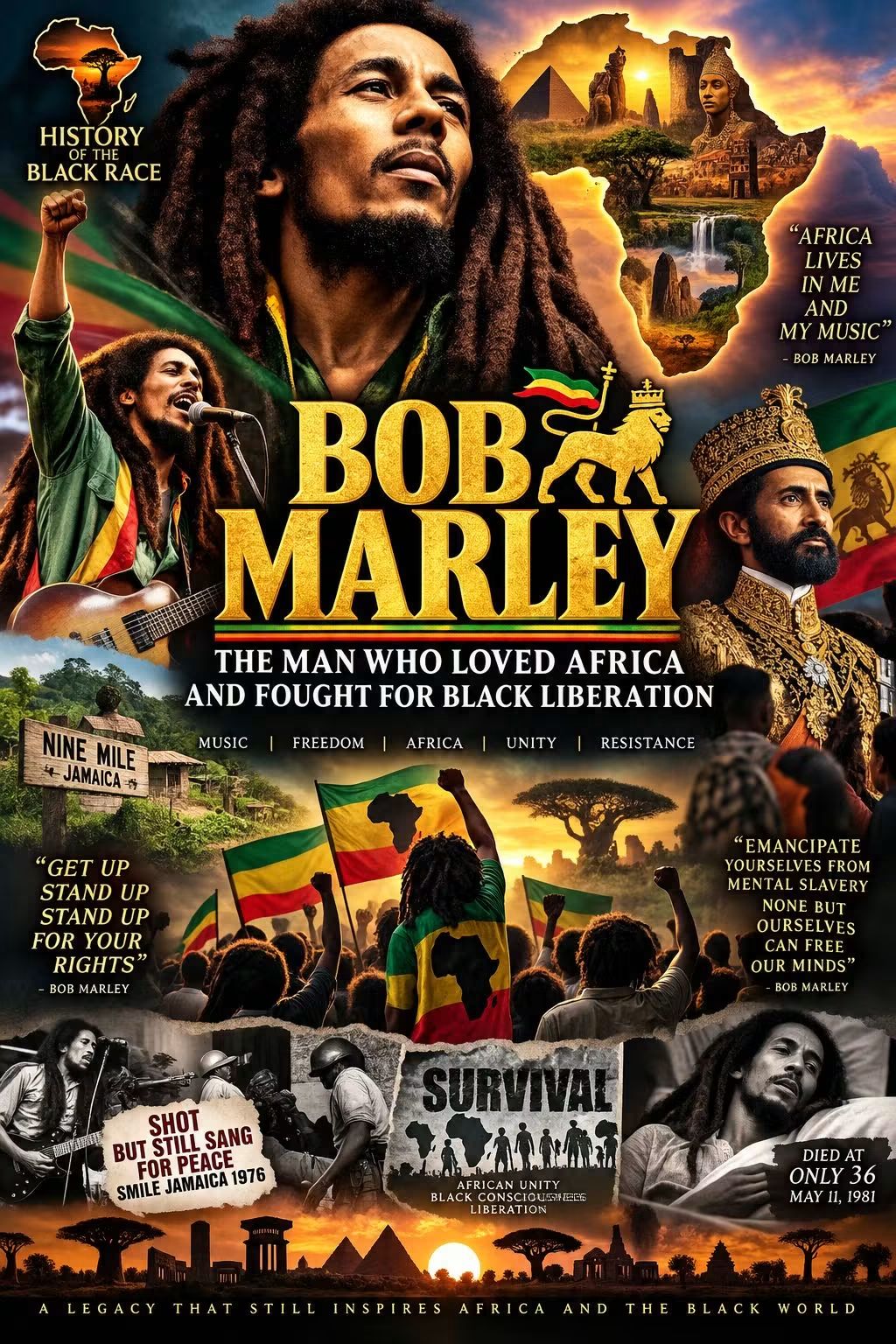
BOB MARLEY: THE MAN WHO LOVED AFRICA AND FOUGHT FOR BLACK LIBERATION
THEIR IS ANOTHER FASCINATING HISTORY THAT WE ALMOST FORGOT ABOUT BOB MARLEY HE IS DEAD BUT WE STILL REMEMBER HIM
BOB MARLEY: THE MAN WHO LOVED AFRICA AND FOUGHT FOR BLACK LIBERATION
Why did a Jamaican musician become one of the most powerful voices for Africa and Black liberation?
Bob Marley was not born in Africa.
He was born thousands of miles away, in the small rural village of Nine Mile, Jamaica, on February 6, 1945.
Yet throughout his life, Africa remained deeply connected to his identity, his spirituality, his music, and his vision of freedom.
So what made this Jamaican man speak so passionately about Africa?
And why did he believe that the liberation of Black people everywhere was connected to the liberation of Africa?
THE CHILD WHO GREW UP BETWEEN TWO WORLDS
Bob Marley was the son of Cedella Malcolm, a young Black Jamaican woman, and Norval Sinclair Marley, a white British naval captain.
Growing up as a mixed-race child in rural Jamaica and later in the impoverished Trench Town community of Kingston, Marley experienced social rejection and identity challenges.
These early experiences deeply shaped his understanding of racial division, poverty, inequality, and injustice.
He would eventually transform those experiences into music that reached millions of people around the world.
But Marley was not interested in making music simply for entertainment.
For him, music could be a weapon.
A weapon against oppression.
A weapon against colonial thinking.
And a weapon against the belief that Black people were destined to remain powerless.
HOW BOB MARLEY FOUGHT FOR BLACK PEOPLE
Marley used reggae music to transform local Jamaican struggles into a global message of Pan-African solidarity and liberation.
He constantly reminded Black people that freedom was not only about changing governments.
It was also about freeing the mind.
“MENTAL SLAVERY”
One of his most powerful messages came through “Redemption Song.”
The song challenged people to free themselves from psychological oppression and from the lasting effects of colonial systems.
Marley understood something that many liberation movements had already recognized:
A person can be physically free and still live mentally imprisoned.
His music therefore attacked not only political oppression, but also the ideas and beliefs that oppression leaves behind.
AFRICA WAS AT THE HEART OF HIS MESSAGE
Marley’s connection to Africa became increasingly visible through his Rastafari faith and his music.
His album Survival (1979) was particularly powerful.
It was not simply another reggae album.
It was a declaration.
A call for African unity, Black consciousness, and liberation.
Songs such as “War”, which drew heavily from a speech by Ethiopian Emperor Haile Selassie, confronted racial inequality and oppression.
The message was uncompromising:
As long as racial supremacy and injustice existed, genuine world peace would remain impossible.
For Marley, Africa was not merely a distant continent.
It represented ancestral identity, dignity, freedom, and the unfinished struggle against oppression.
His music connected Jamaica, Africa, and the wider Black diaspora into one conversation.
HE DIDN’T JUST SING ABOUT RESISTANCE
There was a moment when Bob Marley’s message became more than words.
In December 1976, Jamaica was experiencing intense political violence.
Then gunmen attacked Marley at his home.
Marley, his wife, and his manager were shot.
He had every reason to stay away from the stage.
But just two days later, Marley appeared at the Smile Jamaica concert, an event intended to promote peace.
Imagine that.
A man had just been shot.
Yet instead of disappearing, he returned to the stage.
He continued singing.
He continued speaking.
And he continued calling for peace.
For Marley, music was not simply something he performed.
It was part of his struggle.
WHY DID HE LOVE AFRICA SO MUCH?
This is where Marley’s story becomes even more fascinating.
Although he was Jamaican by birth, Marley increasingly saw the struggles of Africans and people of African descent as interconnected.
His Rastafari beliefs placed Ethiopia at the center of his spiritual worldview, particularly through the figure of Emperor Haile Selassie I.
Africa became deeply woven into his understanding of Black identity.
He saw the history of slavery, colonialism, racial discrimination, poverty, and political oppression as parts of a larger struggle.
And he wanted Black people to remember something:
They had a history before oppression.
They had civilizations.
They had kingdoms.
They had cultures.
They had dignity.
And they had the right to determine their own future.
That message is one reason Marley’s music traveled far beyond Jamaica.
THE FIGHT CONTINUED UNTIL THE END
But while Marley was fighting oppression through music, another battle was quietly developing inside his own body.
In 1977, a dark spot appeared beneath his right big toenail.
At first, he believed it was an injury from playing football.
It was eventually diagnosed as acral lentiginous melanoma (ALM), a rare and aggressive form of skin cancer that is unrelated to sun exposure and can occur on areas such as the soles of the feet, palms, and nail beds.
Doctors strongly recommended amputating his toe to prevent the cancer from spreading.
Marley refused a full amputation.
His decision was influenced partly by his Rastafari faith, which included beliefs concerning the cutting or alteration of the body, as well as concerns about his ability to perform and dance.
Instead, he chose a partial removal of the affected tissue.
Tragically, the cancer later metastasized.
It spread throughout his body.
And while traveling home from a European tour, Marley’s health deteriorated severely.
He was forced to make an emergency landing in Miami, Florida.
THE WORLD LOST HIM AT ONLY 36
On May 11, 1981, Bob Marley died at Cedars of Lebanon Hospital in Miami.
He was only 36 years old.
The cancer had spread to his lungs, liver, and brain.
A voice that had spoken about freedom, Africa, Black dignity, peace, poverty, and oppression was suddenly silent.
But his message was not.
BOB MARLEY’S LEGACY
Bob Marley never became an African head of state.
He never commanded an army.
He never governed a country.
His weapon was different.
A guitar.
A microphone.
A song.
And with them, he reached millions.
He made people around the world question racism.
He made Black people think about identity.
He spoke about Africa when much of the world was still comfortable ignoring its struggles.
And he reminded the African diaspora that their connection to Africa was not something to be ashamed of.
It was something to understand.
Perhaps that is why Bob Marley remains so powerful decades after his death.
He did not simply sing about love.
He sang about freedom.
He did not simply sing about Jamaica.
He sang about Africa and the Black world.
And he did not simply ask people to change their governments.
He asked them to change their minds.
But here is the question:
Was Bob Marley simply a reggae musician who loved Africa—or was he one of the most influential Pan-African voices of the 20th century?
What do you think?

