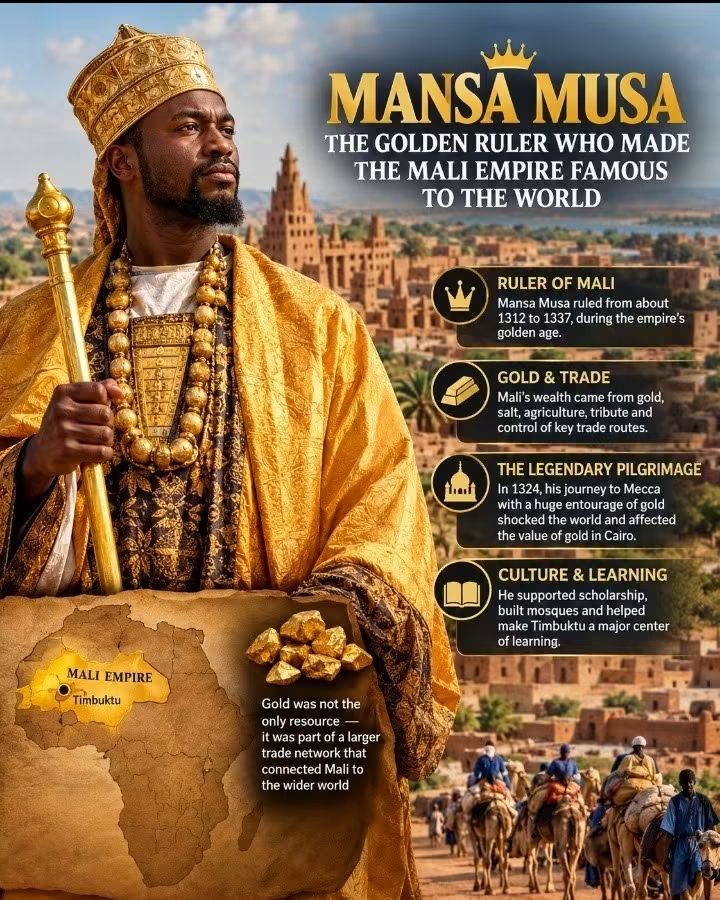
MANSA MUSA: THE GOLDEN RULER WHO MADE THE MALI EMPIRE FAMOUS TO THE WORLD
🔥 MANSA MUSA: THE GOLDEN RULER WHO MADE THE MALI EMPIRE FAMOUS TO THE WORLD
Imagine a ruler so wealthy that his journey across North Africa was remembered for years because the gold he distributed affected the value of gold in Cairo.
This was Mansa Musa I, ruler of the Mali Empire in West Africa during the 14th century.
But his story is about far more than personal wealth.
It is the story of an African empire built around trade, political power, gold, salt, agriculture, scholarship, and control of important trans-Saharan routes.
👑 WHO WAS MANSA MUSA?
Mansa Musa ruled Mali from approximately 1312 to 1337, during one of the empire’s most powerful periods.
Under his rule, Mali controlled or influenced vast territories and major commercial centers across West Africa. The empire was connected to important trade networks stretching across the Sahara toward North Africa and the Mediterranean world.
Mali’s wealth was closely connected to the region’s enormous gold resources.
However, there is an important historical detail often missed in popular stories:
Mali’s rulers did not necessarily own or directly operate every gold mine.
Much of the empire’s wealth came through tribute, taxation, trade, and political control over regions connected to gold-producing areas. Gold from places such as Bambuk and Bure entered wider commercial networks, while Mali also benefited enormously from controlling the routes through which gold and other commodities moved.
🪙 GOLD — BUT ALSO SALT
Gold was not the only foundation of Mali’s economy.
Salt was enormously valuable, particularly in the southern regions where it was scarce.
Merchants crossed the Sahara carrying salt southward while gold moved northward toward North African markets.
This exchange helped make cities and trading centers such as Timbuktu extremely important.
The Mali Empire therefore became powerful not simply because it possessed gold, but because it was positioned within a sophisticated network connecting West Africa, the Sahara, North Africa and the wider Islamic world.
🕋 THE JOURNEY THAT SHOCKED THE WORLD
In 1324, Mansa Musa embarked on the Hajj, the Islamic pilgrimage to Mecca.
His caravan became legendary.
Medieval accounts describe an enormous entourage carrying large quantities of gold across the Sahara. Exact numbers vary considerably between sources, so popular figures about the size of his caravan should be treated cautiously rather than as precise statistics.
When Musa reached Cairo, however, his generosity became the stuff of legend.
According to the 14th-century Egyptian writer al-Umari, Musa distributed and spent so much gold that its value in Cairo declined.
Al-Umari recorded that the value of gold fell from roughly 25 silver dirhams per mithqal to about 22 or less, and he stated that the lower value persisted for around twelve years.
The Metropolitan Museum of Art likewise notes that Musa’s arrival with an extraordinary quantity of gold caused a major disruption in the Cairo gold market.
That is one of the strongest historical reasons why Mansa Musa became associated with extraordinary wealth.
🌍 THEN EUROPE HEARD ABOUT HIM
Mansa Musa’s reputation did not disappear after his pilgrimage.
In 1375, more than three decades after his death, the famous Catalan Atlas depicted the ruler of Mali holding a large gold nugget.
The image helped reinforce Mali’s reputation in the wider Mediterranean world as a land of extraordinary wealth.
And there was something else Europeans became increasingly interested in:
Where was all that gold coming from?
The fame of Mali, Timbuktu and West African gold would eventually contribute to centuries of fascination with West Africa.
🕌 MANSA MUSA’S LEGACY WAS BIGGER THAN GOLD
Mansa Musa was not simply a wealthy king who gave away gold.
His reign is associated with the expansion and strengthening of Mali’s political and commercial influence and with the development of important centers of Islamic learning.
Timbuktu became increasingly famous as a center of scholarship, religion and commerce.
Musa also became associated with major architectural projects, including the development of mosques and other monumental structures.
His pilgrimage connected Mali more visibly with the wider Islamic world and demonstrated that medieval West African states were deeply connected to international networks of trade, religion, diplomacy and scholarship.
⚠️ WAS MANSA MUSA REALLY “THE RICHEST PERSON IN HISTORY”?
This is where we need to be careful.
You will often see Mansa Musa described as “the richest person who ever lived.”
It is a powerful description—but there is no reliable modern calculation that can prove exactly how much wealth he personally possessed, or place his fortune precisely against modern billionaires.
There are no surviving Malian financial records that allow historians to calculate his personal net worth in today’s currency.
What we can say with much greater confidence is that Mansa Musa controlled an exceptionally wealthy empire and became famous across the medieval world for his extraordinary access to gold.
His reputation was so powerful that centuries later, his name remains almost synonymous with wealth.
🔥 THE BIGGER LESSON
Mansa Musa’s story challenges the outdated idea that medieval Africa was isolated from the rest of the world.
The Mali Empire participated in enormous commercial networks.
Its merchants crossed the Sahara.
Its gold reached North African and Mediterranean markets.
Its rulers communicated with the wider Islamic world.
Its cities became centers of scholarship and commerce.
And one of its rulers traveled thousands of miles to Mecca carrying enough wealth to leave a lasting impression on the people of Cairo.
Mansa Musa did not make Mali rich by simply “finding gold.”
He ruled within a sophisticated economic system built on gold, salt, agriculture, taxation, tribute, trade routes and political power.
And that is what makes the history of the Mali Empire even more remarkable.
Long before modern African nations existed, a powerful West African empire was already participating in an international economy—and the world was paying attention.
🔥 Mansa Musa’s gold made him famous.
But the civilization behind that gold made him historically important.
What do you think made Mansa Musa more remarkable: his wealth, his empire, his pilgrimage, or his support for scholarship and architecture?


Hello
LikeLiked by 1 person
Hi
LikeLike
Hello sir
My name Amit Kumar
LikeLiked by 2 people
Alright Kumar how are you doing
LikeLike