
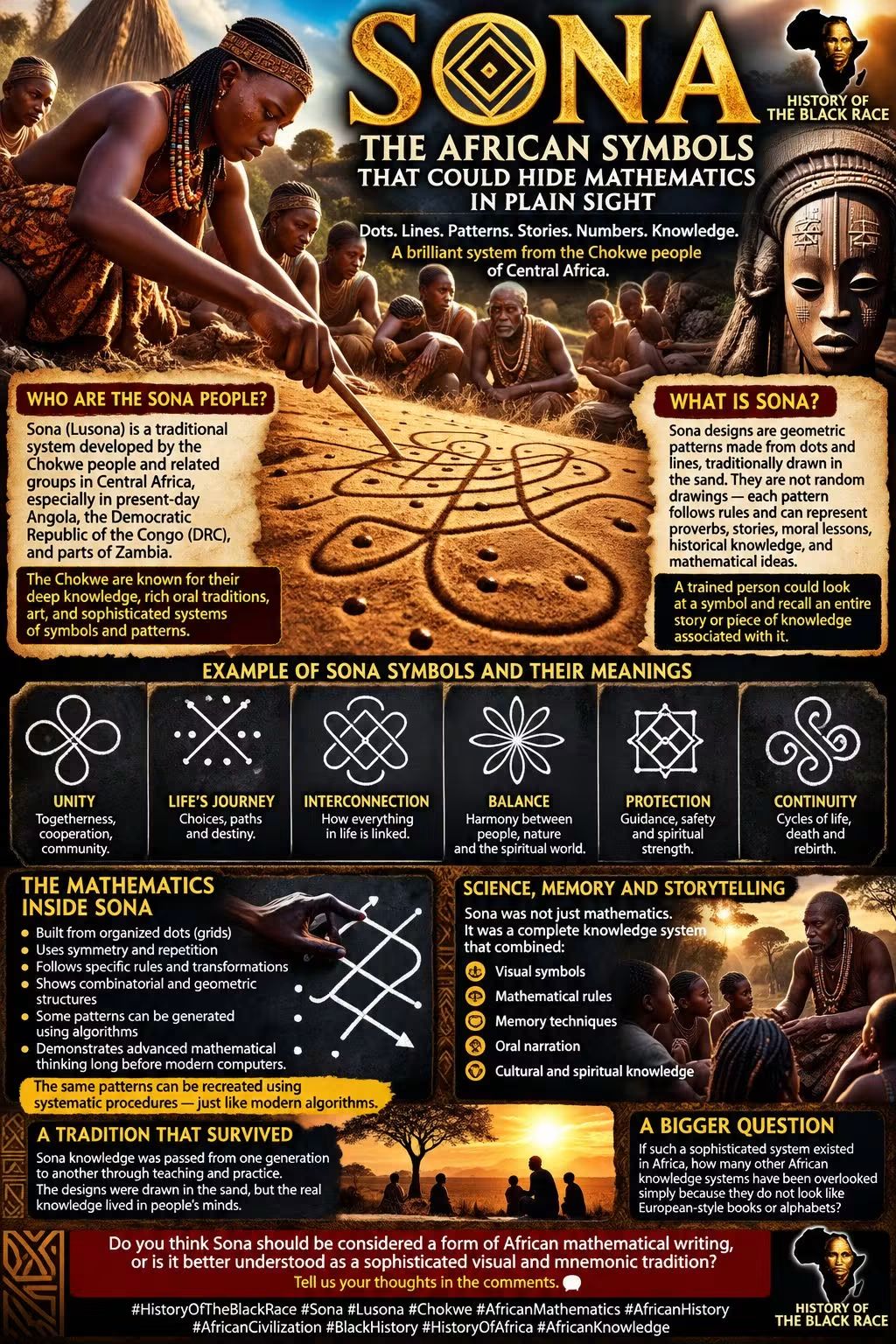
THE AFRICAN SYMBOLS THAT COULD HIDE MATHEMATICS IN PLAIN SIGHT
THE AFRICAN SYMBOLS THAT COULD HIDE MATHEMATICS IN PLAIN SIGHT
What if I told you that some African symbols were not merely drawings… but mathematical systems built from dots, lines, patterns and rules?
Long before computers, calculators and modern programming languages, people in Central Africa were creating intricate designs in the sand.
They called them Sona or Lusona.
And here is where the story becomes fascinating.
At first glance, a Sona design can look like nothing more than an elegant geometric pattern.
But look closer.
The dots are arranged deliberately.
The lines follow rules.
The patterns repeat.
And in some cases, a person trained in the tradition could reproduce a complicated figure using a systematic procedure.
So the question becomes:
Were these simply artistic designs—or was mathematics hiding inside them?
THE “DOTS” WERE NOT RANDOM
Among the Chokwe and related peoples of Central Africa, Sona designs could be drawn in sand as part of storytelling and teaching.
A knowledgeable person could create a pattern while explaining a proverb, riddle, story, or piece of cultural knowledge.
The design acted as a memory device.
But some of these patterns also contain remarkable mathematical structures.
Their arrangements can involve symmetry, repetition, counting, transformations and systematic construction.
In other words, you couldn’t necessarily draw every Sona figure any way you wanted.
There were rules.
And once the rules were understood, the pattern could be reconstructed.
That is where modern researchers became extremely interested.
COULD A SONA PATTERN BE “READ” LIKE A CODE?
Not exactly in the same way we read English or an alphabet.
This is one of the most important things to understand.
Sona was not simply an African alphabet where every symbol represented a particular letter.
Instead, the designs could function as visual information systems and mnemonic devices.
A pattern could trigger knowledge that had been transmitted orally.
The meaning was therefore not contained only in the lines themselves.
It was contained in the relationship between:
THE SYMBOL → THE PATTERN → THE RULE → THE MEMORY → THE STORY.
And this is extraordinary.
Because it means a person could look at a seemingly simple geometric figure and, with the right cultural knowledge, unlock an entire body of information.
THEN MATHEMATICIANS STARTED LOOKING CLOSER
When researchers began analyzing Sona mathematically, they discovered that some designs could be described using formal mathematical concepts.
Certain figures involve relationships between points and lines that can be studied using combinatorics, graph theory, symmetry and algorithms.
Suddenly, something that colonial-era observers might have dismissed as “tribal drawings” could be examined as a sophisticated mathematical tradition.
And that raises an uncomfortable question:
How much African mathematics was overlooked because outsiders did not recognize what they were looking at?
Imagine seeing a computer algorithm without knowing what an algorithm is.
You might see only a sequence of instructions.
But once you understand the underlying logic, you realize there is a system operating underneath the surface.
Sona offers a fascinating example of why cultural knowledge must be understood on its own terms.
BUT HERE IS THE BIGGER SECRET…
Sona wasn’t created to impress modern mathematicians.
It existed because people needed ways to teach, remember, communicate and preserve knowledge.
The mathematics was embedded inside the cultural practice.
A pattern could be beautiful.
It could be educational.
It could carry a story.
And at the same time, it could obey mathematical rules.
That combination is what makes Sona so remarkable.
ART + MEMORY + STORYTELLING + MATHEMATICS.
All inside patterns drawn in the sand.
And perhaps the most powerful part of the story is this:
The sand disappeared.
The knowledge didn’t.
Generation after generation could recreate the patterns.
The physical drawing was temporary, but the system for producing it lived in human memory.
So perhaps the real question isn’t:
“Did Africans have writing?”
Perhaps we should ask:
“How many different ways did Africans develop to store and transmit information—and how many of those systems have we still not fully understood?”
Because sometimes history isn’t written on stone.
Sometimes…
it’s drawn in the sand.
What do you think?
Do you believe Sona should be considered a form of African mathematical writing, or is it better understood as a sophisticated visual and mnemonic tradition?

