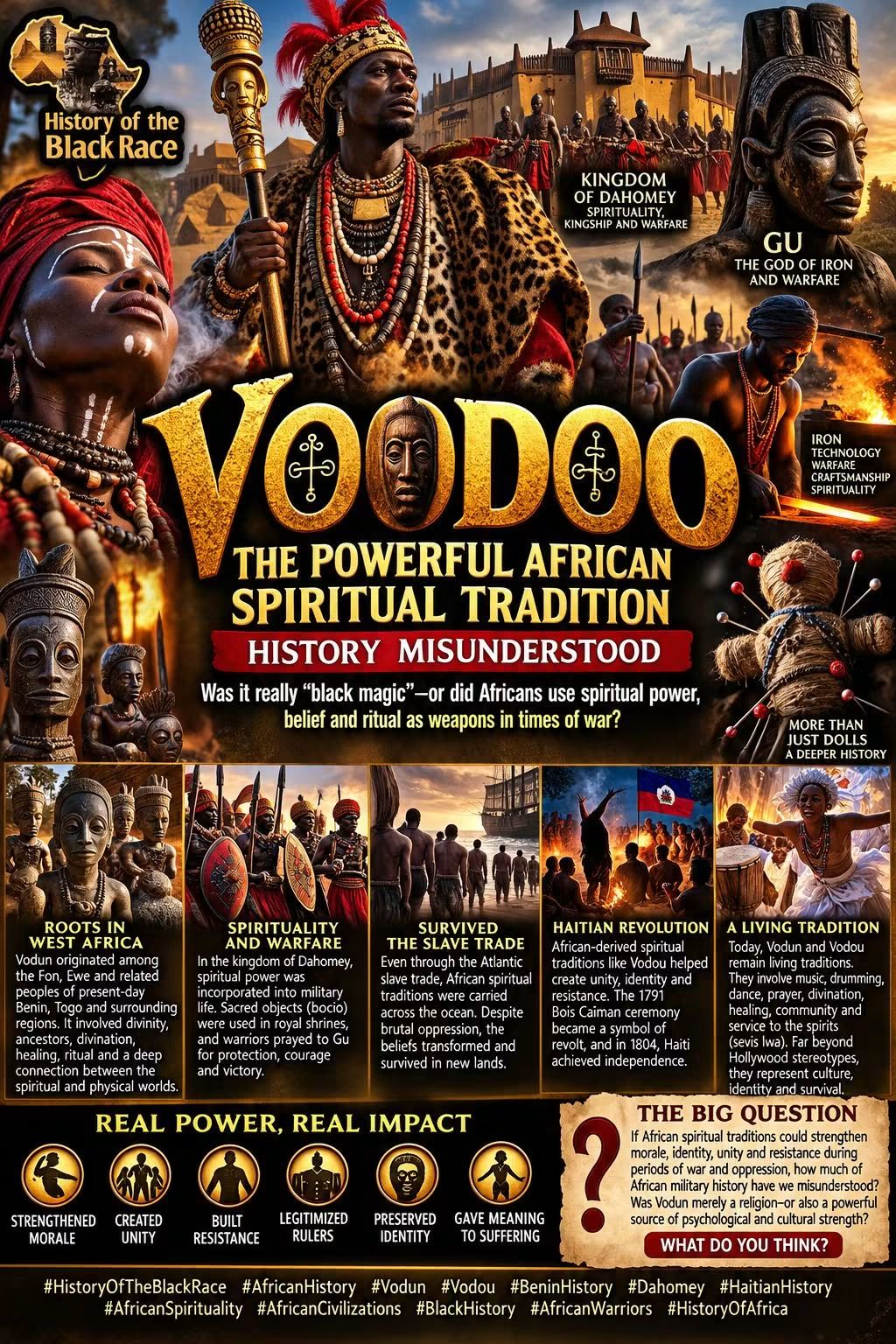
VOODOO: THE POWERFUL AFRICAN SPIRITUAL TRADITION HISTORY MISUNDERSTOOD
VOODOO: THE POWERFUL AFRICAN SPIRITUAL TRADITION HISTORY MISUNDERSTOOD
Was it really “black magic”—or did Africans use spiritual power, belief and ritual as weapons in times of war?
For centuries, the word “Voodoo” has been used to create an image of dolls, curses, zombies and mysterious spells.
Hollywood made it darker.
Colonial writers made it more frightening.
And popular culture turned one of Africa’s complex spiritual traditions into a caricature.
But behind the stereotype is a much older story.
A story that begins in West Africa.
And when you look closely at the history, one question becomes difficult to ignore:
Could spiritual belief itself become a weapon during war?
The answer is more complicated—and more fascinating—than the legends suggest.
BEFORE “VOODOO” BECAME A WORD OF FEAR
The traditions commonly associated with Voodoo have deep roots in West Africa, particularly among peoples of the Fon, Ewe and related cultural worlds of present-day Benin, Togo and surrounding regions.
The African tradition is more accurately called Vodun.
It was not simply a system of spells.
It was a religious worldview involving divinity, ancestors, sacred forces, healing, divination, ritual specialists, sacred objects and relationships between the spiritual and physical worlds.
In the kingdom of Dahomey (Danhomè), religion was deeply connected to political authority.
The rulers were associated with a vast pantheon of vodun, and communication with the spiritual world could involve prayer, sacrifice and divination.
This means something important:
Religion was not necessarily separated from politics, kingship, society and warfare.
THEN CAME WAR
Dahomey was not a peaceful kingdom surrounded by enemies.
It became a powerful and highly militarized state.
Its rulers maintained large armies, conquered neighboring territories and developed a political culture in which military power was central to the kingdom.
And this is where the story of Vodun becomes particularly interesting.
In Dahomey, spiritual power could be incorporated into the preparation for conflict.
Certain sacred objects were believed to possess protective or empowering qualities.
During periods of war, bocio—power objects or figures associated with spiritual forces—could be placed in royal shrines, where they became the focus of prayers and sacrifices to Gu, a deity associated with iron and warfare.
Imagine the psychological world of a warrior entering battle believing that:
the ancestors were watching,
the gods were present,
the king was spiritually protected,
and the forces of the unseen world were on his side.
That belief could produce enormous courage.
BUT WAS IT REALLY A “SUPERWEAPON”?
Here we need to separate history from legend.
There is no reliable historical evidence that Vodun gave African armies supernatural powers that made bullets miss them or physically transformed warriors into invincible fighters.
That is where sensational stories often go too far.
But dismissing Vodun as “just superstition” is also misleading.
Because belief can have real social and psychological power.
A warrior who genuinely believes that a sacred object protects him may enter battle differently from someone who believes he has nothing protecting him.
A community united by ritual can develop extraordinary solidarity.
A king whose authority is considered sacred can command loyalty beyond ordinary political obedience.
And religious ceremonies can strengthen courage, discipline, identity and resistance.
Those effects are real—even when the supernatural claims cannot be scientifically demonstrated.
THE MOST POWERFUL WEAPON MAY HAVE BEEN BELIEF
This is the part of the history that is often missed.
War is not fought only with weapons.
It is also fought with:
morale.
fear.
unity.
loyalty.
identity.
confidence.
the willingness to die for something larger than yourself.
Religion can influence all of these.
And African societies were not unique in this.
European armies also marched under crosses and religious symbols.
Muslim armies invoked religious faith.
Kings throughout history claimed divine legitimacy.
Warriors carried sacred objects into battle.
So why is African spiritual warfare so often described as “primitive magic,” while similar relationships between religion and warfare elsewhere are described as faith, ritual or military culture?
That question deserves serious consideration.
THE ATLANTIC SLAVE TRADE COULD NOT DESTROY IT
Then came one of the greatest disruptions in African history.
The Atlantic slave trade.
Millions of Africans were violently transported across the ocean.
They lost their homes.
Their political institutions were destroyed.
Families were separated.
Languages were suppressed.
Religious practices were attacked.
Yet the spiritual traditions did not simply disappear.
They transformed.
West and Central African religious traditions interacted with Christianity and local Caribbean cultures, contributing to traditions such as Haitian Vodou.
And something extraordinary happened.
A religion carried by enslaved people survived the slave system that tried to erase their identities.
AND THEN VODOU BECAME CONNECTED WITH REVOLT
Haiti provides one of the most dramatic chapters in this story.
Enslaved Africans in Saint-Domingue lived under an extraordinarily brutal colonial system.
Their religious traditions became part of the social and cultural world in which resistance developed.
The famous Bois Caïman/Bwa Kayiman ceremony of 1791 has become deeply associated with the beginning of the Haitian Revolution.
However, historians caution against reducing the entire revolution to a single ceremony.
The revolution was the result of many political, economic, social and military forces.
But the larger point remains:
African-derived religious traditions helped provide community, identity, spiritual meaning and solidarity among people living under slavery.
And the result was extraordinary.
In 1804, Haiti became independent.
A population descended largely from enslaved Africans had defeated the colonial order and created an independent state.
WHY DID COLONIAL POWERS FEAR IT?
Because religion was not merely about what happened inside a shrine.
It could create community.
It could preserve African identity.
It could create networks of trust.
And it could provide oppressed people with a worldview in which their suffering was not the final word.
That was potentially dangerous to a slave-owning colonial system.
Historical evidence shows that colonial authorities and later political elites sometimes attempted to suppress Vodou and related practices.
Later, especially during the American occupation of Haiti and through popular culture, the Western image of “voodoo” became increasingly associated with black magic and horror.
THE VOODOO DOLL IS NOT THE WHOLE STORY
Perhaps the most famous symbol of “Voodoo” today is the little doll covered in pins.
But that image tells us almost nothing about the complexity of actual Vodun and Vodou traditions.
The real traditions involve:
ritual specialists.
spirits.
ancestors.
music and drumming.
dance.
prayer.
divination.
sacred objects.
community ceremonies.
healing.
offerings.
and relationships between the living and the spiritual world.
Haitian Vodou, for example, is commonly described by practitioners as sevis lwa—“service to the spirits.”
That is a very different picture from the Hollywood stereotype.
AND THERE WAS A GOD OF WAR
One of the fascinating examples is Gu, a deity associated with iron and warfare in the Vodun traditions of Benin.
Gu’s symbolism connects spirituality with one of humanity’s most transformative technologies:
iron.
Iron meant weapons.
Tools.
Farming.
Blacksmithing.
Military power.
And political expansion.
The Metropolitan Museum notes that Gu was associated with iron and war and was also connected with blacksmiths and craftsmen.
This reveals something profound about African religious thought:
technology, warfare, craftsmanship and spirituality were not necessarily separate worlds.
The blacksmith could be both an extraordinary technician and a person operating within a sacred world.
SO, HOW POWERFUL WAS VOODOO?
Perhaps the best answer is:
Its greatest power was not necessarily supernatural destruction.
Its power was its ability to shape how people understood the world.
It could give meaning to suffering.
Create courage.
Strengthen community.
Legitimize rulers.
Protect cultural identity.
Preserve ancestral memory.
Create ritual bonds between people.
And, in times of conflict, reinforce the psychological and spiritual foundations upon which warriors and communities depended.
That is power.
Not necessarily the power to magically stop a bullet—
but the power to make someone stand their ground when they are terrified.
THE BIGGEST MISUNDERSTANDING
The history of Vodun and Vodou raises a bigger question about how African history has been written.
Why were African spiritual traditions so often described using words such as:
primitive,
superstitious,
demonic,
witchcraft,
black magic?
Meanwhile, similar religious practices elsewhere were often described as:
faith,
ritual,
sacred tradition,
spiritual warfare,
or religious devotion?
Understanding Vodun does not require us to believe every supernatural claim.
It requires us to understand the people who believed it, the societies they built around it, and the historical circumstances in which those beliefs survived.
Because perhaps the real story is even more powerful than the legend.
They tried to enslave the people.
They tried to destroy their institutions.
They tried to suppress their religions.
But they could not completely erase the spiritual world those people carried with them.
And that may be the greatest power of all.
THE QUESTION FOR YOU
If African spiritual traditions could strengthen morale, identity, unity and resistance during periods of war and oppression, how much of African military history have we misunderstood by looking only at weapons and armies?
Was Vodun merely a religion—or was it also a source of psychological and cultural power that helped communities survive some of the darkest periods in African and Atlantic history?
What do you think?

