THE IGBO FOUR-DAY WEEK — AND WHY EACH DAY CARRIED SPIRITUAL ENERGY.
THE IGBO FOUR-DAY WEEK — AND WHY EACH DAY CARRIED SPIRITUAL ENERGY.
Before the modern calendar arrived in Africa
the Igbo people of Nigeria were already living by a system so precise
so spiritually sophisticated
that scholars are still studying it today.
Four days. Four energies. Four sacred fields.
Eke. Orie. Afor. Nkwo.
This was not just a market schedule.
This was a spiritual calendar.
Each day carried its own energy
its own deity
its own spiritual character
that determined what could be done
and what could not.
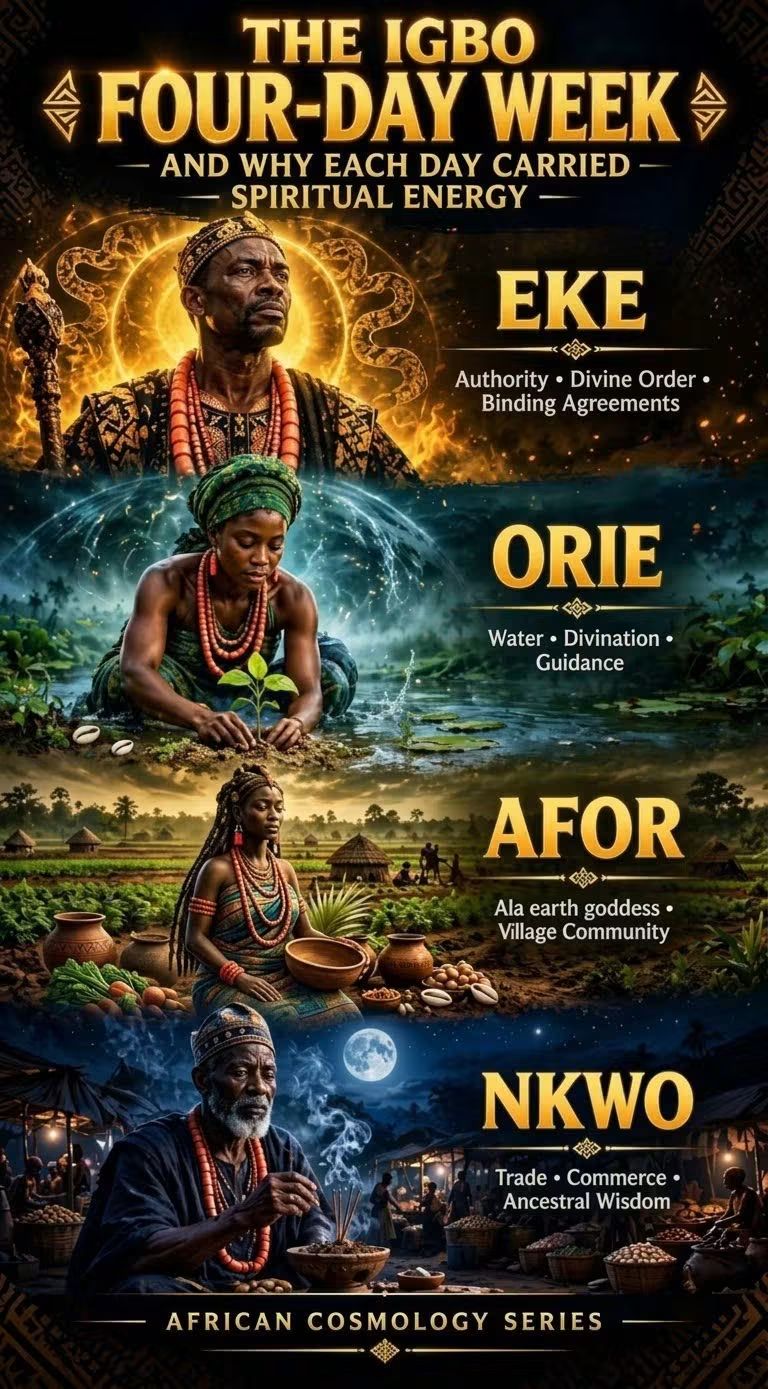
EKE — The Day of Creation and Authority
Eke is the first day, the head. In many southern towns its patron is Agwu, and in some communities the sacred python – Eke. It is the day of new beginnings, of peace and reconciliation, and of binding agreements. Business sealed on Eke carried spiritual weight. Rituals to honor the ancestors were often done on Eke.
ORIE — The Day of Water and Divination
Orie flows with the energy of water – Mmiri. Its patron is Ogwugwu. It is the day when the veil is thin. Dibia go for divination, people seek guidance, and families prepare the yam and produce that will go to market tomorrow. In towns like Uturu, Orie is the holy day of rest – the farmer does not enter the farm, he feasts with his family.
AFỌ — The Day of the Earth Goddess Ala
Afọ is grounded in Ala, the Earth Mother – goddess of fertility, morality, harvest and law. It is the day of justice, community decisions, and fertility rites. Because it belongs to Ala who holds the land, many communities avoid disturbing the earth deeply on Afọ.
NKWO — The Day of Trade and Completion
Nkwo carries the energy of air – Ikuku – and is strongly linked to Ala for commerce and to the ancestors. Its patron in many places is Amadioha. This is why the biggest markets in Igboland are Nkwo markets – Onitsha Main Market (Otu Nkwo), Nkwo Mbaise. It is a day for trade, wealth, bustling exchange, and for final consultations before a new cycle begins on Eke.
What our elders understood:
Time is not neutral.
You do not plant on every day.
You do not go to court on every day.
You do not travel or marry on every day.
You read who owns the day, and you move with that law — not against it.
This system still lives.
Markets still run on the four-day cycle. Towns still bear their market name: Eke-Ukwu, Orie-Igwe, Afor-Oji, Nkwo-Eri. And every Igbo child still bears it in their name: Okeke / Mgbeke, Okorie / Mgborie, Okafor / Nwafor / Mgbafor, Okonkwo / Nwankwo / Mgbokwo – child born on that market day.
✍🏿Simple meaning:
The Igbo four-day week was never just about buying and selling.
It was a spiritual map
showing the community which energy was available
on which day
and how to align their actions with the natural and spiritual order of the world.
Eke for Creation and Authority.
Orie for Water and Insight.
Afọ for Earth and Law.
Nkwo for Air and Commerce.
Four days. Four spirits. One people wise enough to never separate time from spirit.
❓Did you grow up knowing your market day name? What does your culture teach about sacred time?

