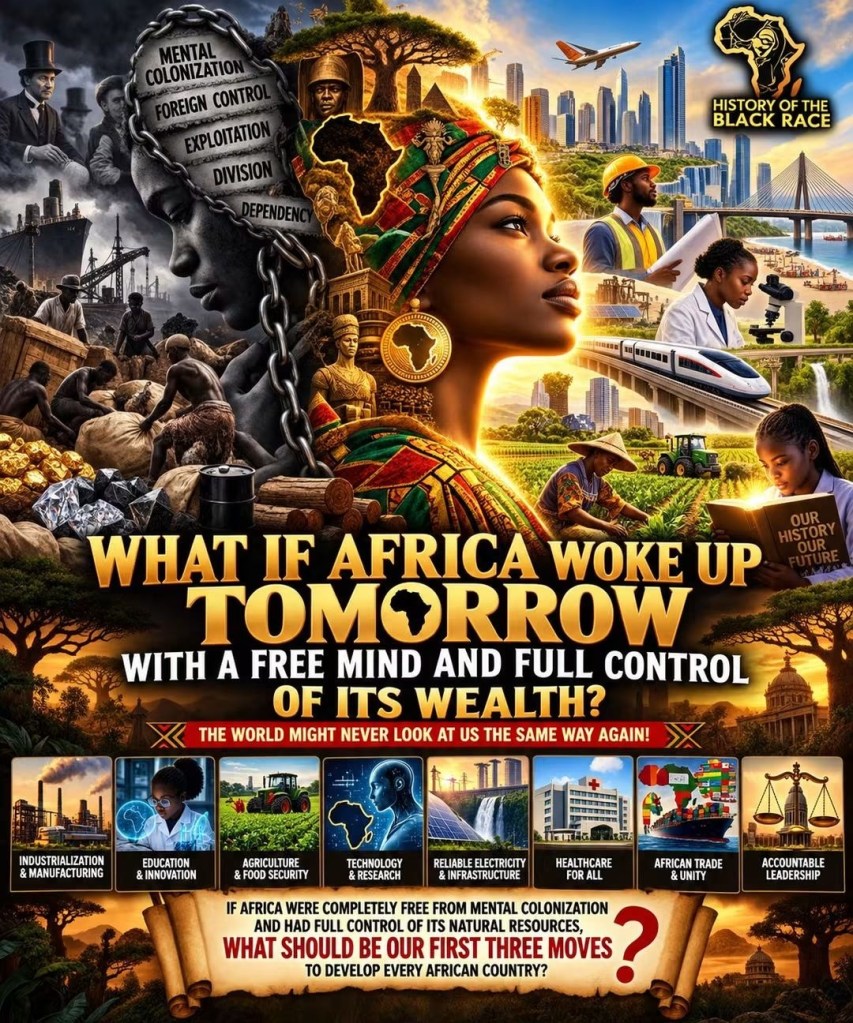
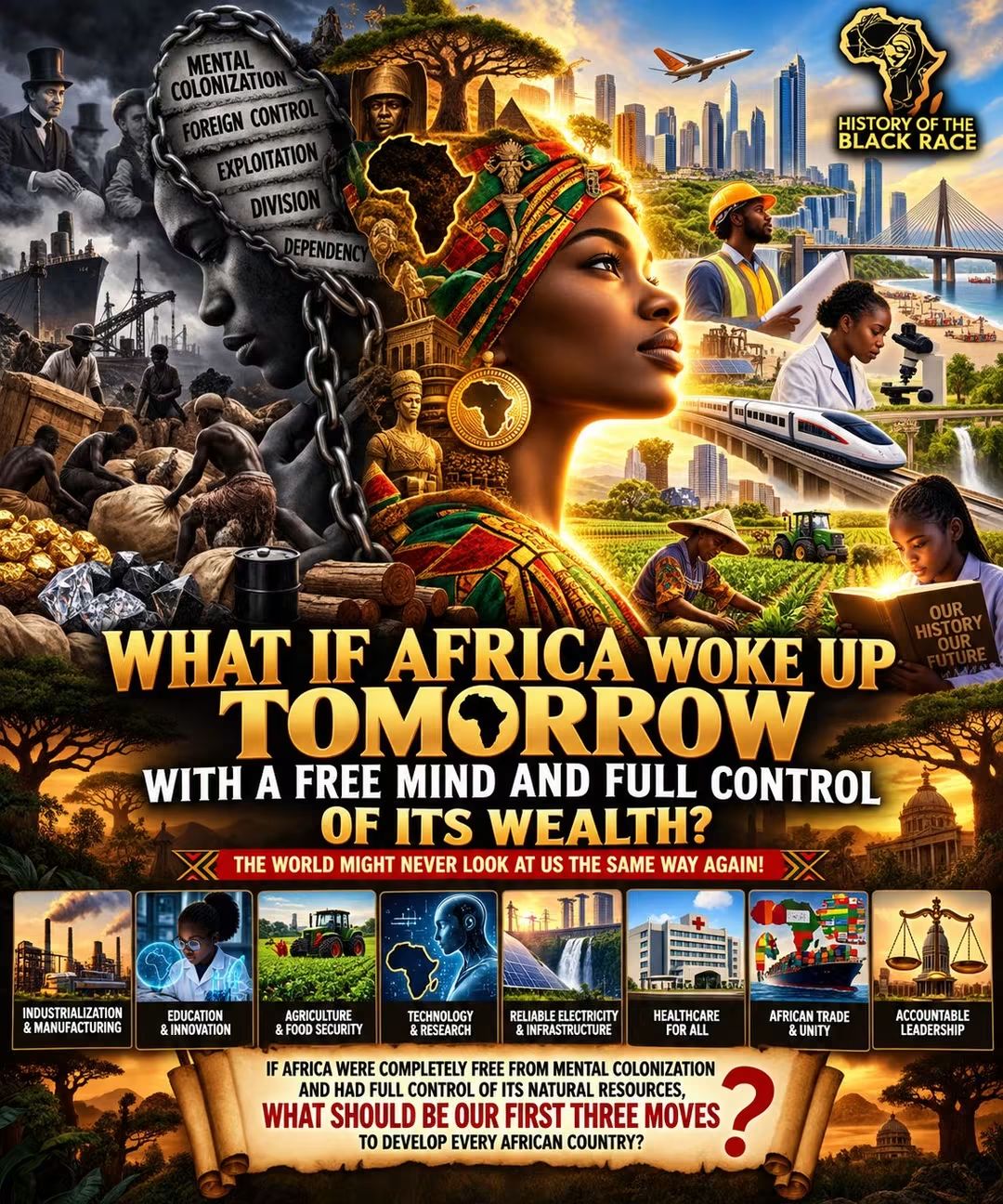
WHAT IF AFRICA WOKE UP TOMORROW WITH A FREE MIND AND FULL CONTROL OF ITS WEALTH? THE WORLD MIGHT NEVER LOOK AT US THE SAME WAY AGAIN!
🌍 WHAT IF AFRICA WOKE UP TOMORROW WITH A FREE MIND AND FULL CONTROL OF ITS WEALTH? THE WORLD MIGHT NEVER LOOK AT US THE SAME WAY AGAIN!
Imagine waking up tomorrow to a completely different Africa. No mental chains. No foreign control over our natural wealth. No endless export of raw materials while our people struggle to afford the finished products made from them. What would happen next?
Would Africa finally become a global economic powerhouse, or would we repeat the same mistakes under new leadership?
This is the question every African must think deeply about!
🔥 THE GREAT AFRICAN QUESTION: WHAT WOULD WE DO WITH TRUE FREEDOM?
Imagine Nigeria controlling its oil resources and refining them efficiently at home, creating industries, millions of jobs, and affordable energy for its citizens.
Imagine the Democratic Republic of the Congo transforming its enormous mineral wealth into finished technological products instead of remaining primarily a supplier of raw materials.
Imagine Ghana adding greater value to its gold and cocoa, Ethiopia expanding its manufacturing industries, and Kenya turning technological innovation into opportunities for millions of young people.
Now imagine every African nation developing its own industries, investing in research, educating its children, and trading more effectively with its neighbours.
What if the wealth we have been searching for outside Africa could be the very wealth we already possess—but have not fully transformed into prosperity?
Our continent has fertile lands, extraordinary mineral resources, enormous renewable-energy potential, rich cultural knowledge, and one of the world’s youngest populations. Yet possessing resources is not the same as building prosperity. The real challenge is how we manage them, process them, and use them to improve people’s lives.
But there is another question we cannot ignore.
🧠 WHAT IF THE BIGGEST BATTLE IS NOT BENEATH OUR SOIL, BUT INSIDE OUR MINDS?
Colonialism did not only reshape African borders, economies, and political institutions. In many places, it also undermined indigenous knowledge, disrupted cultural traditions, and promoted ideas that placed foreign systems above African achievements.
Even after political independence, the struggle for intellectual and cultural confidence has continued.
Some Africans have been taught to admire foreign products while overlooking the possibilities of local industries. Some regard African languages, traditional craftsmanship, indigenous philosophies, and ancestral knowledge as inferior without examining their value. Others believe development can only happen when foreign powers lead the way.
But mental liberation does not mean rejecting everything foreign. It means learning to think independently, questioning inherited assumptions, preserving valuable African knowledge, and adapting useful ideas from anywhere in the world.
An African who controls natural resources but lacks the knowledge, institutions, and confidence to develop them may still remain economically dependent.
That is why the liberation of our minds must go hand in hand with the transformation of our economies.
⚡ SO, IF AFRICA BECAME TRULY FREE TODAY, WHAT SHOULD HAPPEN FIRST?
- Stop exporting opportunity along with raw materials.
African countries should develop competitive industries that process their natural resources locally wherever economically and environmentally viable. Minerals, agricultural products, and energy resources should create more skilled jobs, technical knowledge, and industrial capacity within the continent.
- Make education a weapon of development.
Our schools and universities should prepare young Africans to become engineers, scientists, doctors, inventors, agricultural experts, entrepreneurs, and researchers. African history and indigenous knowledge should be studied seriously alongside modern science and global scholarship.
- Turn African creativity into African industries.
From textiles and pottery to pharmaceuticals, machinery, software, and artificial intelligence, Africa must create conditions in which local ideas can become competitive products. Celebrating African intelligence is important, but investing in it is even more important.
- Make electricity and infrastructure a priority.
Factories cannot operate efficiently without dependable energy, transport networks, water systems, and modern logistics. Governments must invest in these foundations while creating transparent, reliable environments for businesses to grow.
- Make African cooperation stronger than African division.
Imagine African nations trading more with one another, sharing research, developing regional industries, and negotiating international agreements from positions of greater collective strength.
Our different languages, cultures, and national identities need not prevent cooperation. Diversity can become an advantage when nations work towards shared economic goals.
- Make leadership accountable to the people.
Natural resources belong to the public through the laws and institutions of each country. Their benefits should translate into better hospitals, quality education, employment, infrastructure, and opportunities for future generations.
Without accountability, even the richest nation can leave its citizens struggling.
🌍 BUT HERE IS THE QUESTION THAT SHOULD KEEP EVERY AFRICAN THINKING…
Suppose tomorrow every African country gained genuine control over its natural resources, strengthened its political independence, and invested in the mental liberation of its people.
Would we know exactly what to do with that freedom?
Would we build industries or simply compete to become the next exporters of wealth?
Would we invest in our children or allow another generation to inherit the same problems?
Would we unite our strengths or allow political rivalries and ethnic divisions to weaken our collective potential?
And if we truly believe Africa has the human and material resources to achieve greater prosperity, what practical steps must we take to make that belief a reality?
The truth is that freedom is not the final destination. Freedom is the opportunity to build something greater.
Africa does not need to become a copy of another continent. It needs to develop its own strengths, learn from the experiences of others, and create systems that reflect the needs and aspirations of its people.
Our ancestors left us histories of ingenuity, trade, craftsmanship, governance, philosophy, and cultural achievement. We must study that heritage honestly, learn from both its successes and failures, and combine valuable knowledge from the past with the innovations of the present.
The next chapter of African history must not be written by natural resources alone. It must be written through knowledge, courage, innovation, cooperation, and responsible leadership.
🔥 AFRICANS, LET US DEBATE!
If Africa woke up tomorrow completely free from mental colonization and with full control of its natural resources, WHICH THREE THINGS SHOULD WE DO FIRST to transform every African country into a place where our people can prosper?
Would you choose education, industrialization, electricity, agriculture, technology, or leadership reform?
Tell us why in the comments. Your answer might inspire another African to think differently about our future.