THEY FOUGHT EMPIRES, DEFIED SLAVERY, AND CHANGED HISTORY—SO WHY DON’T MORE PEOPLE KNOW THEIR NAMES?
🌍 THEY FOUGHT EMPIRES, DEFIED SLAVERY, AND CHANGED HISTORY—SO WHY DON’T MORE PEOPLE KNOW THEIR NAMES?
What if some of the most extraordinary freedom fighters in world history are not the people whose names we learned first in school?
Across Africa and the Americas, Black men and women challenged slavery, confronted colonial powers, defended their communities, and fought for freedom when the price of resistance could be death.
Some led armies. Some built independent communities. Others challenged injustice through education, political organizing, and extraordinary acts of courage.
Their stories are not all unknown, and some are celebrated in their own countries. Yet many remain less familiar to international audiences than other historical figures.
Today, let’s travel across continents and centuries to discover 10 remarkable Black heroes whose stories deserve far greater recognition around the world.
🌍✊🏿 Read until the end, because number one helped establish a remarkable tradition of resistance to slavery in Mexico.
━━━━━━━━━━━━━━━━━━
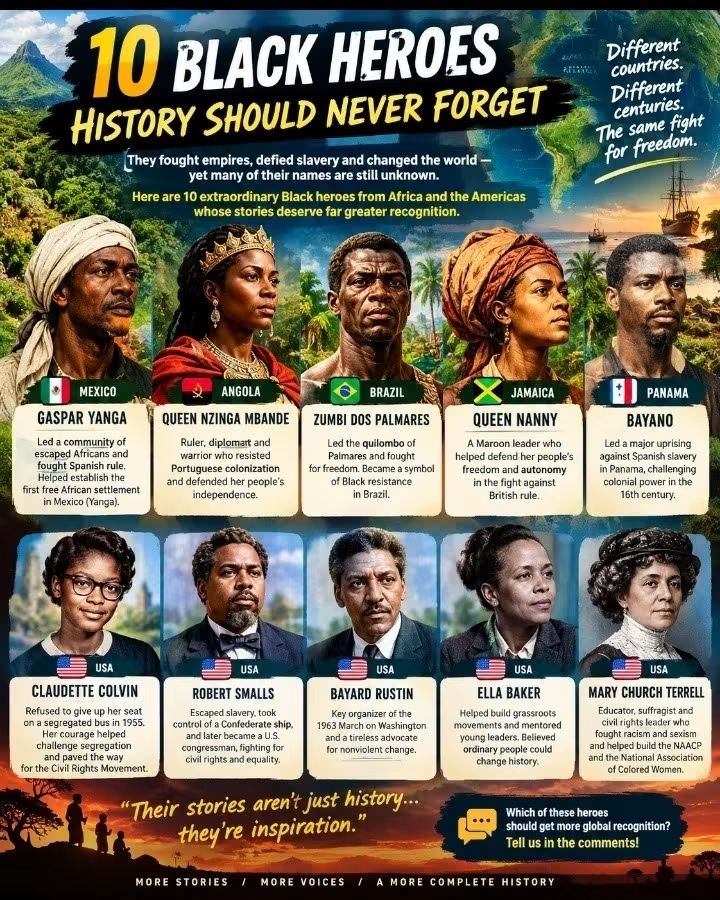
1️⃣ GASPAR YANGA — THE AFRICAN FREEDOM FIGHTER WHO CHALLENGED SPANISH RULE IN MEXICO 🇲🇽
Imagine being taken from Africa, enslaved in a foreign land, and expected to spend the rest of your life under someone else’s control.
Gaspar Yanga refused to accept that fate.
Yanga was an African-born leader who escaped slavery in colonial Mexico, then part of New Spain. He organized a community of Africans who had escaped enslavement and established a settlement in the mountainous region of what is now Veracruz.
For decades, his community resisted attempts by Spanish colonial authorities to bring it under their control.
In 1609, Spanish forces launched a major campaign against the maroon community. The fighting did not produce a straightforward Spanish victory, and resistance continued.
Eventually, negotiations led to an agreement recognizing the freedom of Yanga’s community and the establishment of a settlement known as San Lorenzo de los Negros.
The settlement became an important landmark in the history of African resistance in the Americas. The town is now called Yanga, in his honor.
Why does his story matter?
Yanga’s struggle demonstrates that resistance to slavery was not confined to the United States or the Caribbean. Africans also fought for freedom in Mexico, South America, and other parts of the Americas.
His achievement was not simply escaping enslavement. He helped lead a community that negotiated for freedom and a place to live beyond direct colonial control.
One important historical distinction: Yanga’s community was not the first rebellion against slavery in the Americas. Its significance lies in the remarkable outcome of its prolonged resistance and negotiations.
His name deserves to be known far beyond Mexico.
2️⃣ QUEEN NZINGA MBANDE — THE AFRICAN RULER WHO RESISTED PORTUGUESE EXPANSION 🇦🇴
Long before modern Angola became independent, a formidable African ruler fought to defend her people’s political independence.
Her name was Nzinga Mbande.
Born around 1583, Nzinga became a prominent ruler of Ndongo and Matamba, kingdoms in what is now Angola.
During the seventeenth century, Portuguese expansion, slave trading, and military campaigns threatened the independence of African states in the region.
Nzinga became known for her diplomatic skill, military leadership, and determination to protect her kingdom.
In 1622, she negotiated with Portuguese representatives. Later, after becoming ruler of Ndongo and establishing her authority in Matamba, she continued resisting Portuguese attempts to dominate the region.
She used diplomacy when it served her interests and military resistance when necessary. She also developed political and commercial relationships that helped strengthen her position.
Her reign unfolded within a complicated regional struggle involving rival African powers, Portuguese colonial ambitions, and the Atlantic slave trade.
Nzinga’s story should not be reduced to a simple tale of one ruler fighting one enemy. She was a political strategist navigating a dangerous world in which African sovereignty was under growing pressure.
She died in 1663, but her legacy remains influential in Angola and throughout the African diaspora.
Her story reminds us that African history includes powerful women who commanded armies, negotiated with foreign powers, and defended their political interests centuries before modern independence movements.
3️⃣ ZUMBI DOS PALMARES — THE BRAZILIAN LEADER WHO REFUSED TO SURRENDER 🇧🇷
Brazil received millions of enslaved Africans during the Atlantic slave trade. Yet enslaved people did not simply accept their captivity.
One of the most powerful examples of resistance was Palmares, a network of settlements established by people who escaped slavery and others who joined them.
Located in northeastern Brazil, Palmares grew into a significant community that resisted Portuguese colonial authorities for decades.
Zumbi dos Palmares became one of its most prominent leaders.
Born around 1655, Zumbi became associated with the defense of Palmares during a period of intense conflict with Portuguese forces.
He opposed an agreement that would have granted freedom to some inhabitants while leaving other enslaved people outside the settlement unfree.
The conflict continued, and Portuguese forces eventually destroyed Palmares’ principal strongholds.
Zumbi was captured and killed on November 20, 1695.
But his death did not erase the importance of the resistance he represented.
Today, Zumbi is remembered in Brazil as a symbol of Black resistance, and November 20 is observed as Black Consciousness Day.
Why is his story important?
Palmares challenges the false idea that enslaved Africans were merely passive victims of history.
They escaped, built communities, organized defenses, developed systems of leadership, and fought to protect their freedom.
Zumbi’s legacy also connects Black history in Brazil to the broader struggle against slavery throughout the Americas.
4️⃣ QUEEN NANNY OF THE MAROONS — THE JAMAICAN LEADER WHO HELPED DEFEND A FREE COMMUNITY 🇯🇲
In the mountains of Jamaica, people who escaped enslavement built communities that resisted British colonial rule.
These people became known as the Maroons.
Among their most celebrated leaders was Queen Nanny, a leader of the Windward Maroons during the eighteenth century.
Nanny is associated with the resistance to British forces during the First Maroon War, fought mainly in the 1720s and 1730s.
Her leadership became legendary within Maroon tradition. Stories remember her as a strategist who helped protect her people and preserve their independence.
However, the historical record about her individual military actions is limited, and some details of her life are preserved primarily through oral tradition.
That distinction matters: respecting her legacy does not require treating every popular story about her as independently verified fact.
The First Maroon War eventually led to treaties between British authorities and Maroon communities in 1739 and 1740. These agreements recognized a measure of Maroon autonomy while imposing conditions and obligations on the communities.
Nanny’s importance extends beyond battlefield stories.
She represents the determination of people who escaped slavery and fought to establish communities where they could govern themselves.
In Jamaica, she is honored as a National Hero.
Her legacy asks us to remember that freedom was not simply granted by powerful institutions. Many people fought, organized, and sacrificed to secure it.
5️⃣ BAYANO — THE AFRICAN LEADER WHO CHALLENGED SPANISH SLAVERY IN PANAMA 🇵🇦
During the sixteenth century, Spanish colonial authorities transported enslaved Africans to the Americas to work under brutal conditions.
Some Africans escaped and organized resistance.
One such leader was Bayano, who led a major uprising in Panama during the 1550s.
Bayano organized a community of escaped enslaved Africans and resisted Spanish colonial forces in the region.
His followers established a base from which they challenged colonial control, and Spanish authorities mounted campaigns to suppress them.
The struggle eventually led to negotiations and an agreement involving Bayano and Spanish representatives. The arrangement did not produce lasting freedom for all his followers, and colonial authorities continued to pursue their interests.
Historical accounts differ in their details, but Bayano’s rebellion remains an important example of early African resistance in Spanish America.
His story is especially significant because Panama occupied an important position in Spain’s American empire. Colonial routes through the isthmus helped connect Atlantic ports with territories on the Pacific coast.
Resistance in Panama therefore challenged a colonial system built on forced labor and imperial expansion.
Bayano’s story also reminds us that Black resistance in the Americas began centuries before the abolition of slavery in the United States.
Freedom struggles in the Americas were interconnected, but they also had their own leaders, circumstances, and histories. Bayano deserves to be remembered as part of that wider story.
━━━━━━━━━━━━━━━━━━
🇺🇸 THE BLACK AMERICAN HEROES WHO DESERVE MORE RECOGNITION
The struggle for freedom and equality did not stop with resistance to slavery. In the United States, generations of Black Americans challenged discrimination, organized political movements, and helped transform the country.
Here are five more figures whose contributions deserve wider recognition.
6️⃣ CLAUDETTE COLVIN — THE TEENAGER WHO CHALLENGED BUS SEGREGATION BEFORE ROSA PARKS
On March 2, 1955, 15-year-old Claudette Colvin refused to give up her seat to a white passenger on a segregated bus in Montgomery, Alabama.
She was arrested months before Rosa Parks made her historic stand on December 1, 1955.
Why is Parks better known?
Civil rights leaders considered several factors when deciding how to present their campaign to the public. Colvin was young, and the circumstances surrounding her arrest differed from those of Parks.
But Colvin’s contribution did not end with her arrest.
She became one of the plaintiffs in Browder v. Gayle, the federal court case that successfully challenged segregation on Montgomery’s buses.
In 1956, the United States Supreme Court allowed the ruling against bus segregation to stand.
Her role demonstrates that the Montgomery movement was not the achievement of one individual. It depended on numerous people willing to challenge injustice, support legal action, and sustain a campaign.
Colvin’s story is an essential reminder that a person’s contribution to history should not be measured by how frequently their name appears in popular culture.
7️⃣ ROBERT SMALLS — THE ENSLAVED MAN WHO TOOK A CONFEDERATE SHIP TO FREEDOM
In May 1862, during the American Civil War, Robert Smalls was an enslaved Black man working aboard the Confederate transport ship Planter in Charleston, South Carolina.
When the white officers left the vessel, Smalls and other Black crew members took control.
Smalls navigated the ship past Confederate defenses and delivered it to Union forces.
His daring operation helped secure freedom for his family and other enslaved people who escaped with him.
It also provided the Union with a valuable vessel and information about Confederate military operations.
But Smalls’ achievements did not end with the war.
He became a politician during Reconstruction, serving in the South Carolina legislature and later in the United States House of Representatives.
He advocated for civil rights and worked to expand political opportunities for Black Americans.
Think about the extraordinary transformation: a man born into slavery became a member of the national legislature.
His life shows that Black Americans were not merely participants in the struggle for emancipation. They also helped shape the political future of the United States.
8️⃣ BAYARD RUSTIN — THE STRATEGIST BEHIND THE MARCH ON WASHINGTON
On August 28, 1963, approximately 250,000 people gathered in Washington, D.C., for the March on Washington for Jobs and Freedom.
Martin Luther King Jr.’s “I Have a Dream” speech became one of the defining moments of the civil rights movement.
But the event required extraordinary planning.
Bayard Rustin played a central role in organizing the march, coordinating logistics, transportation, communications, and the practical arrangements required for a massive national demonstration.
He was an experienced organizer who advocated nonviolent protest and worked with prominent civil rights leaders.
Yet he frequently remained outside the movement’s public spotlight.
His homosexuality and his political associations made some leaders reluctant to place him at the forefront of the campaign.
In later years, Rustin received increasing recognition for his contributions, including the Presidential Medal of Freedom, awarded posthumously by President Barack Obama in 2013.
His story illustrates a recurring feature of history: public achievements often depend on people whose names are less familiar than those of the figures standing before the cameras.
Without organizers, even the most powerful speeches can remain only words.
9️⃣ ELLA BAKER — THE WOMAN WHO HELPED YOUNG PEOPLE BECOME CIVIL RIGHTS LEADERS
Ella Baker spent decades organizing communities and helping ordinary people develop the confidence and skills to challenge injustice.
Born in Virginia in 1903, she worked with the NAACP and helped establish the Southern Christian Leadership Conference.
She believed lasting change required more than charismatic leaders. It required ordinary people to organize within their own communities and take responsibility for their future.
In 1960, following the wave of student sit-ins across the American South, Baker helped bring student activists together at Shaw University in Raleigh, North Carolina.
That gathering helped establish the Student Nonviolent Coordinating Committee, known as SNCC.
The organization became an important force in civil rights campaigns, particularly in voter registration and grassroots activism.
Baker encouraged young activists to trust their own abilities rather than depend entirely on established leaders.
Her approach helped nurture a generation of organizers who challenged segregation and racial discrimination.
She did not need to be the most famous person in the room to influence history.
Ella Baker’s legacy teaches us that powerful leadership sometimes means creating opportunities for other people to lead.
🔟 MARY CHURCH TERRELL — THE EDUCATOR WHO FOUGHT RACISM AND SEXISM
Mary Church Terrell was born in 1863, during the American Civil War.
She became an educator, writer, suffragist, and civil rights activist who challenged racial discrimination and fought for women’s rights.
Terrell was a founding member of the NAACP in 1909 and became the first president of the National Association of Colored Women, established in 1896.
She advocated education, political participation, and equal opportunities for Black Americans.
Her activism also confronted discrimination against women, demonstrating how racial and gender inequalities could overlap.
In 1950, Terrell joined other activists in challenging racial discrimination at a segregated restaurant in Washington, D.C.
Their efforts contributed to a legal victory against segregation in the city’s restaurants.
Consider the significance of her long life: Terrell continued challenging discriminatory practices well into her eighties.
She helped build organizations, mobilize communities, and fight for equal treatment long before the modern civil rights movement reached its most famous moments.
Her legacy reminds us that movements for equality are built over generations, with each generation creating opportunities for the next.
━━━━━━━━━━━━━━━━━━
🌍 WHAT CONNECTS THESE 10 HEROES?
They lived in different centuries, countries, and political circumstances.
Some fought colonial armies. Some escaped slavery and built independent communities. Others organized campaigns, challenged discriminatory laws, or helped create movements for equality.
They did not all share the same goals, methods, or experiences.
But their stories reveal an important truth about world history:
Black history is not confined to one country, one continent, or one period.
It includes African kingdoms defending their sovereignty, Africans resisting slavery in Mexico and Panama, Maroon communities protecting their freedom in Jamaica and Brazil, and Black Americans challenging segregation and discrimination.
Their histories are part of the larger story of humanity’s struggle over freedom, power, justice, and equality.
We should also remember that several of these figures are already recognized in their home countries and by historians. The problem is not that their stories have never been told. It is that their recognition is often uneven, especially across national borders and popular education.
A more complete understanding of history requires us to look beyond the names we encounter most frequently.
💬 NOW, LET’S HAVE A REAL CONVERSATION!
🔥 Which of these 10 Black heroes do you think deserves far more international recognition?
🇲🇽 Gaspar Yanga
🇦🇴 Queen Nzinga
🇧🇷 Zumbi dos Palmares
🇯🇲 Queen Nanny
🇵🇦 Bayano
🇺🇸 Claudette Colvin
🇺🇸 Robert Smalls
🇺🇸 Bayard Rustin
🇺🇸 Ella Baker
🇺🇸 Mary Church Terrell
Write the person’s name in the comments and tell us why their story deserves to be remembered.
And here is the bigger question:
Why do you think some historical figures become household names while others remain less familiar, even when their contributions changed lives and challenged powerful systems?
Let’s discuss respectfully, learn from one another, and help more people discover these remarkable stories.
📢 Share this post with someone who loves history. The more we learn about the past, the better we understand the world we live in today.


A powerful and thought-provoking reminder that history is filled with extraordinary people whose courage and sacrifices deserve greater recognition. These freedom fighters challenged oppression, defended their people, and proved that the human desire for dignity and liberty cannot easily be silenced. Learning their stories helps us understand history from a broader perspective and appreciate the countless individuals who fought for freedom, often at tremendous personal cost
LikeLiked by 1 person
Thanks for your in courage me to write more
LikeLiked by 1 person
This was a beautiful written piece! Thank you for creating this blog!
LikeLiked by 1 person
You are welcome brother
LikeLiked by 1 person