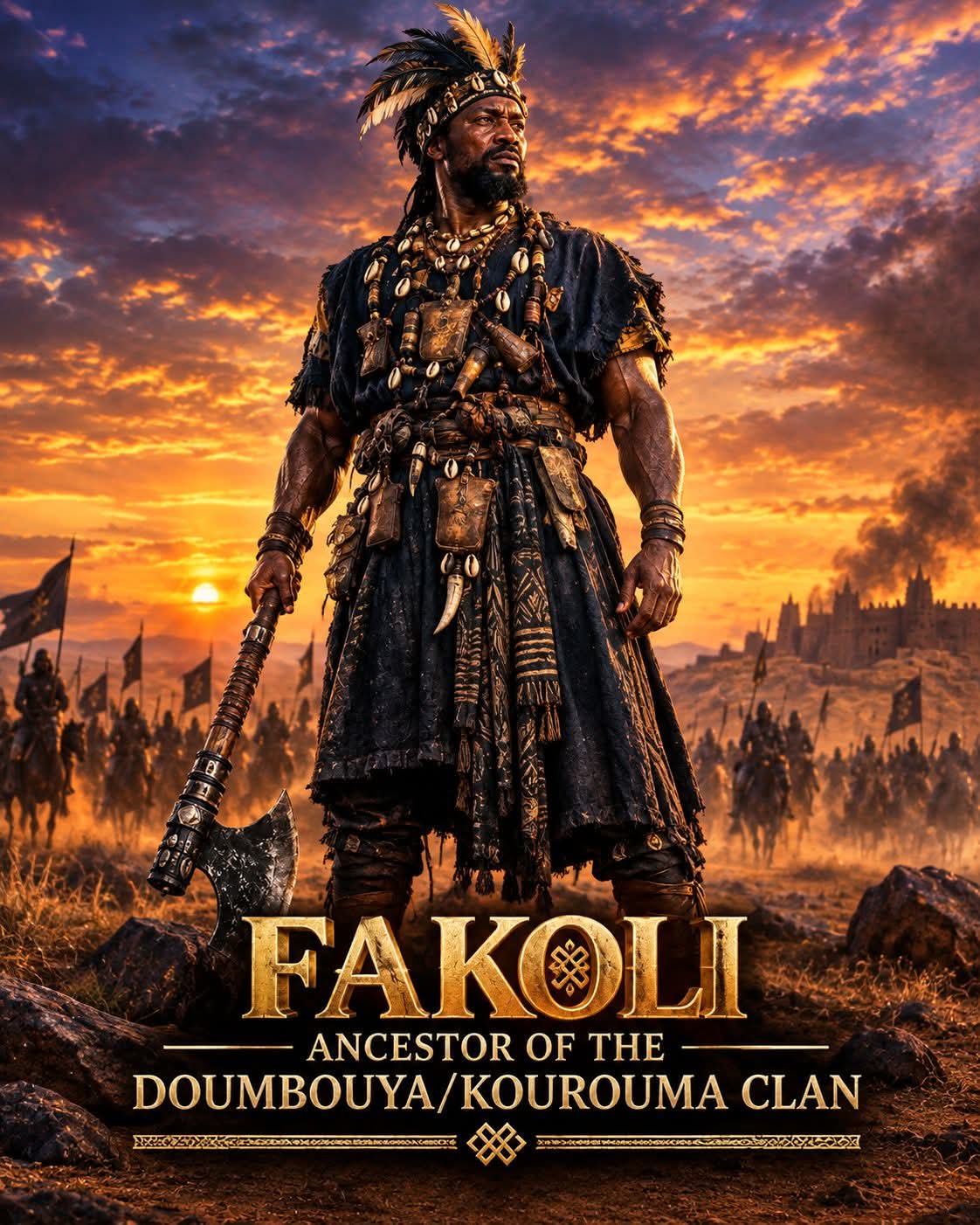
THE HISTORY OF FAKOLI: ANCESTOR OF THE DOUMBOUYA/KOUROUMA CLAN
THE HISTORY OF FAKOLI: ANCESTOR OF THE DOUMBOUYA/KOUROUMA CLAN
How do we study a legendary warrior whose story survives through different versions of oral tradition?
The history of Fakoli Doumbouya offers an opportunity to explore the relationship between oral tradition, ancestry, political power, warfare, and the formation of the Mali Empire. His story appears in different versions of the Epic of Sundiata, and these accounts do not always agree on his parentage, his relationship with Soumaoro Kanté, or the circumstances that led him to join Sundiata Keita.
To understand Fakoli, we must examine these traditions carefully, distinguish their differences, and recognize what the available sources tell us.
- WHO WAS FAKOLI DOUMBOUYA?
Fakoli Doumbouya, also known as Manden Fakoli, meaning “Fakoli of the Manden,” is remembered in West African oral traditions as a formidable warrior associated with the rise of the Mali Empire in the thirteenth century.
He is also called Fakoli Koroma, translated in the tradition as “Fakoli with the Big Head,” and Fakoli Dâ bâ, meaning “Fakoli with the Big Mouth.”
Fakoli appears in the Epic of Sundiata as one of the important military figures involved in Sundiata Keita’s campaigns. His story connects him to the political struggles surrounding Soumaoro Kanté, the kingdom of Sosso, and the consolidation of power across the Manden.
His history is particularly interesting because different traditions offer different explanations of his ancestry.
- THE ORIGINS OF FAKOLI: WHY DO THE TRADITIONS DIFFER?
There is no single version of Fakoli’s parentage in the accounts discussed here. Several traditions offer different explanations, and understanding these differences is essential to studying his history.
The tradition recorded by Wa Kamissoko
In the version of the epic recounted by Wa Kamissoko, Fakoli Doumbia was the son of Tamba Fotigui, also associated with the Tamba-Woura mountains. His great-grandfather was named Koliyoro Tamba Fotigui.
In his commentary, Youssouf Tata Cissé explains that Fakoli claimed descent from an ancestor said to have ruled Karatabougou, the capital of Solon.
According to this interpretation, Fakoli’s connection to that ancestral line explains his title, Manden Fakoli, or “Fakoli of the Manden.”
This version places considerable importance on paternal descent, royal ancestry, and Fakoli’s relationship with Karatabougou.
The tradition of supernatural parentage
Another version gives Fakoli a different origin.
In this account, Fakoli is the nephew of Soumaoro Kanté. Soumaoro’s sister, called Kangouba or Kankoumba Kanté, travels in search of a way to obtain an army for her brother.
Near Toufinna, close to Koulikoro in present-day Mali, she encounters a male spirit and becomes pregnant with Fakoli following their union.
The spirit gives her a red-copper gun that will enable Soumaoro to produce an army through supernatural means. However, he warns her that the child is a sacred trust and that Soumaoro must never treat him unjustly.
In the tradition, Fakoli later invokes this obligation when disagreements arise between him and Soumaoro.
What should we learn from these two versions?
They offer different explanations of Fakoli’s parentage. One emphasizes descent from the ruling lineage of Karatabougou, while the other introduces supernatural parentage and a sacred obligation connecting Fakoli to Soumaoro.
A careful historical account should present these differences rather than combine them into one unquestioned genealogy.
- DOUMBI FAKOLY’S INTERPRETATION OF FAKOLI’S PARENTAGE
The Malian writer Doumbi Fakoly recounts both traditions and proposes his own interpretation.
According to him, Fakoli was the son of Tamba Fotigui Doumbia, the king of Karatabougou, from whom he inherited the surname Doumbia. He was also the son of Kankoumba Kanté, Soumaoro Kanté’s sister.
This interpretation attempts to reconcile the two accounts through a single explanation of Fakoli’s parentage.
According to the narrative, Kankoumba and her brother travelled to Karatabougou to request assistance from its king. They remained there for some time before the king agreed to help them. During that period, Kankoumba became pregnant by the king.
The account explains that their union was considered forbidden under the social codes of the time. Kankoumba was a female blacksmith, and a relationship between her and the king was described as unacceptable to the people of Solon.
When Kankoumba returned to Sosso, the king provided her with food, horses, gold, and other assistance. He also placed a priest of the Komo society, griots, and educators in her caravan to help provide Fakoli with a royal education within his maternal family.
Doumbi Fakoly interprets the supernatural explanations of Fakoli’s parentage as arising from the controversy surrounding this allegedly forbidden union.
Historical lesson: An interpretation that reconciles different traditions is not automatically the same as an independently established historical fact. We must distinguish the existence of a tradition from the certainty of its explanation.
- FAKOLI IN CAMARA LAYE’S LE MAÎTRE DE LA PAROLE
Another account appears in Camara Laye’s Le Maître de la parole, adapted from Babou Condé’s narrative and published in 1978.
In this version, Fakoli is called Fakoli Koroma and Fakoli Dâ bâ.
His father is identified as Makata Djigui Koroma, while his mother, described as Soumaoro’s sister, is named Kassia Diarrasso. His spirit or totem is an eagle.
This account differs from the versions associated with Wa Kamissoko and Doumbi Fakoly, particularly in its names and genealogical details.
Rather than treating all these names and relationships as interchangeable, we should recognize that the traditions preserve different representations of Fakoli.
Comparing those representations is part of understanding how his story has been transmitted.
- FAKOLI’S RELATIONSHIP WITH SOUMAORO KANTÉ
One of the central episodes in Fakoli’s story concerns his break with Soumaoro Kanté.
According to the epic, Fakoli initially fought alongside Soumaoro during the conflicts that preceded the consolidation of Sundiata Keita’s power.
However, their relationship eventually deteriorated.
One explanation connects the conflict to Karatabougou, Fakoli’s paternal kingdom. According to the account, Soumaoro had brought the surrounding region under his authority but had spared Karatabougou, which was ruled by Fakoli’s half-brothers.
The tradition suggests that Soumaoro may have spared the kingdom because he feared Fakoli. Other members of his army reportedly resented the unequal treatment given to Karatabougou.
After Kankoumba’s death, Soumaoro allegedly decided to confront Fakoli. He humiliated him in front of his family, made advances against his wife, and eventually sent him on a fictitious military expedition far from the Manden.
During Fakoli’s absence, Soumaoro attacked Karatabougou.
When Fakoli returned and found his father’s kingdom devastated, he abandoned Soumaoro’s army and joined Sundiata Keita.
In this version, the destruction of Karatabougou becomes the decisive event that turns Fakoli against his former ally.
The alternative explanation: a conflict over Fakoli’s wife
Another version emphasizes Soumaoro’s attempt to take Fakoli’s wife, Kènda Nala Naniouma.
According to the epic, Soumaoro possessed 333 wives. He offered Fakoli the opportunity to exchange his wife for all 333 of them.
Kènda Nala Naniouma is described as possessing supernatural abilities that allowed her to prepare more food than Soumaoro’s 333 wives could produce collectively. This extraordinary ability meant that she could supposedly feed Soumaoro’s entire army.
Fakoli refused the offer. Following Soumaoro’s threats, he rebelled against his authority.
These accounts offer different explanations of the breakdown in their relationship: one focuses on the destruction of Karatabougou and political injustice, while the other emphasizes the conflict over Fakoli’s wife.
Historical lesson: When oral traditions offer different explanations of the same event, the differences should be documented and compared. We should not assume that every version preserves precisely the same sequence of events.
- FAKOLI JOINS SUNDIATA KEITA
Following his break with Soumaoro, Fakoli joined Sundiata Keita’s forces and became one of the principal military figures in the epic.
The traditions associate him with the Battle of Kirina and the Battle of Nâréna.
Fakoli’s importance in these narratives is closely connected to his previous relationship with Soumaoro.
Soumaoro was portrayed as a powerful ruler whose apparent invincibility was associated with supernatural abilities. According to the epic, Fakoli understood Soumaoro’s secrets because the two men had previously fought together and participated in the expansion of Sosso’s power.
When Soumaoro fled with his brother Sosso Bali, he sought refuge around Koulikoro and the surrounding mountains.
Fakoli’s men reportedly pursued him and cornered him in a cave. Depending on the version, Soumaoro was sealed inside the cave or disappeared.
His final fate remains unresolved in the traditions. The accounts associate his disappearance with the caves of Niana Koulou, near Koulikoro, and leave open the question of whether Fakoli later released him.
After Soumaoro’s defeat, Sundiata entrusted Fakoli with bringing the defeated kingdom of Sosso under control.
Fakoli’s story therefore connects military conflict, political realignment, and the establishment of Sundiata’s authority.
- FAKOLI AND THE CONSOLIDATION OF THE MALI EMPIRE
Fakoli is remembered alongside Tiramakhan Traore as one of the important military leaders responsible for subduing rulers who resisted Sundiata’s authority over the Manden.
The narrative attributes several further campaigns to Fakoli.
One concerns Niani Massa Kara. According to the account, Fakoli arranged his assassination with the assistance of Niani Massa’s wife, Kènda Kala Niagalén Traore, who was Tiramakhan’s daughter. Fakoli allegedly secured her cooperation through bribery and subsequently had her executed for treason.
The narrative also describes Fakoli as an opponent of slavery. It claims that he fought against the Moors of the Sahel to prevent the resurgence of slavery, which Sundiata was said to have abolished.
Another episode describes Fakoli and Soumaoro Kanté punishing Arab, Fulani, and Moorish slave traders through extreme violence. According to the account, they burned groups of captives alive and released another captive to spread news of the punishment.
These details belong to the narrative as presented in the cited account and should not automatically be treated as independently verified descriptions of historical events.
Fakoli is also credited with repelling a Fulani army from Bankassi that had besieged Dakadjalan, then identified in the narrative as the capital of the Mali Empire.
He reportedly used deception, convincing the attacking force that the city was defended by an army of spirits.
Together, these episodes portray Fakoli as a military commander whose role extended beyond defeating Soumaoro to securing the authority claimed by Sundiata.
- WHY DID TIRAMAKHAN TRAORE LEAD THE CAMPAIGN AGAINST JOLOF?
The narrative presents the campaign against the Jolof Empire as an important exception to Fakoli’s military leadership.
The king of Jolof had refused to submit to Sundiata. When Sundiata decided to launch an expedition against Jolof, both Fakoli and Tiramakhan wanted to command it.
Tiramakhan reportedly argued that Fakoli had already been entrusted with the other conquests and that he should also be given an opportunity to lead a campaign.
According to the tradition, Tiramakhan dug his own grave and swore that he would die if Sundiata did not appoint him commander.
Sundiata eventually granted him command of the expedition.
In some versions of the epic, Fakoli is portrayed as proud and difficult to manage, and Sundiata is said to have trusted him only partially. These versions explain why Tiramakhan was preferred for the campaign against Jolof.
This episode introduces another dimension of the epic: the relationship between military achievement, personal ambition, political authority, and competition among commanders.
- WHAT DOES FAKOLI’S HISTORY TEACH US?
Fakoli’s story is important not only because of the military achievements attributed to him, but also because it demonstrates the challenges involved in reconstructing history from oral traditions.
Several different accounts preserve his name, his association with the Manden, his relationship with Soumaoro Kanté, and his role in Sundiata Keita’s campaigns. Yet they disagree over important details of his parentage and personal history.
A responsible historical investigation must therefore distinguish between what a source reports and what can be independently established.
We should ask:
Which version of Fakoli’s parentage does a particular source preserve?
How do the accounts of Wa Kamissoko, Doumbi Fakoly, and Camara Laye differ?
Which details are shared across the traditions, and which appear only in particular versions?
What do the sources establish about Fakoli’s military role, and what remains part of the epic narrative?
How should we interpret disagreements between traditions without automatically dismissing them or treating them as identical accounts?
These questions do not diminish the importance of Fakoli. They help us study his legacy with greater precision.
History is not simply the repetition of an inherited story. It is the careful examination of sources, the comparison of competing accounts, and the distinction between tradition, interpretation, and established evidence.
For Hidden World Vault, the aim is to preserve the significance of African historical traditions while encouraging readers to examine them critically and responsibly.
SOURCES FOR FURTHER READING
- Youssouf Tata Cissé and Wa Kamissoko, La Grande Geste du Mali. Des origines à la fondation de l’Empire. Paris: Karthala, 1988; second edition, 2000.
- Youssouf Tata Cissé and Wa Kamissoko, Soundiata, la gloire du Mali: La Grande Geste du Mali, Volume 2. Paris: Karthala, 1991; new edition, 2009.
- David C. Conrad, “Searching for History in the Sunjata Epic: The Case of Fakoli.” History in Africa, no. 19 (1992), pp. 147–200.
- Doumbi Fakoly, Fakoli Prince du Mande. Paris: L’Harmattan, 2005.
- Camara Laye and Babou Condé, Le Maître de la parole. Paris: Plon, 1978; edition consulted: Presses Pocket, 1980.
A NOTE ON HISTORICAL METHOD: These works preserve or examine different accounts of Fakoli. Their publication does not mean that every genealogical claim, supernatural episode, military detail, or political event described in the traditions has been independently verified. Those distinctions are essential to a careful study of the past.

