THE ISLAMIC SLAVE TRADE: THEY DID NOT JUST ENSLAVE BLACK AFRICANS—SOME WERE CASTRATED TO SERVE AS EUNUCHS!
THE ISLAMIC SLAVE TRADE: THEY DID NOT JUST ENSLAVE BLACK AFRICANS—SOME WERE CASTRATED TO SERVE AS EUNUCHS!😭
There is a dark chapter of African history that deserves more attention than it receives.
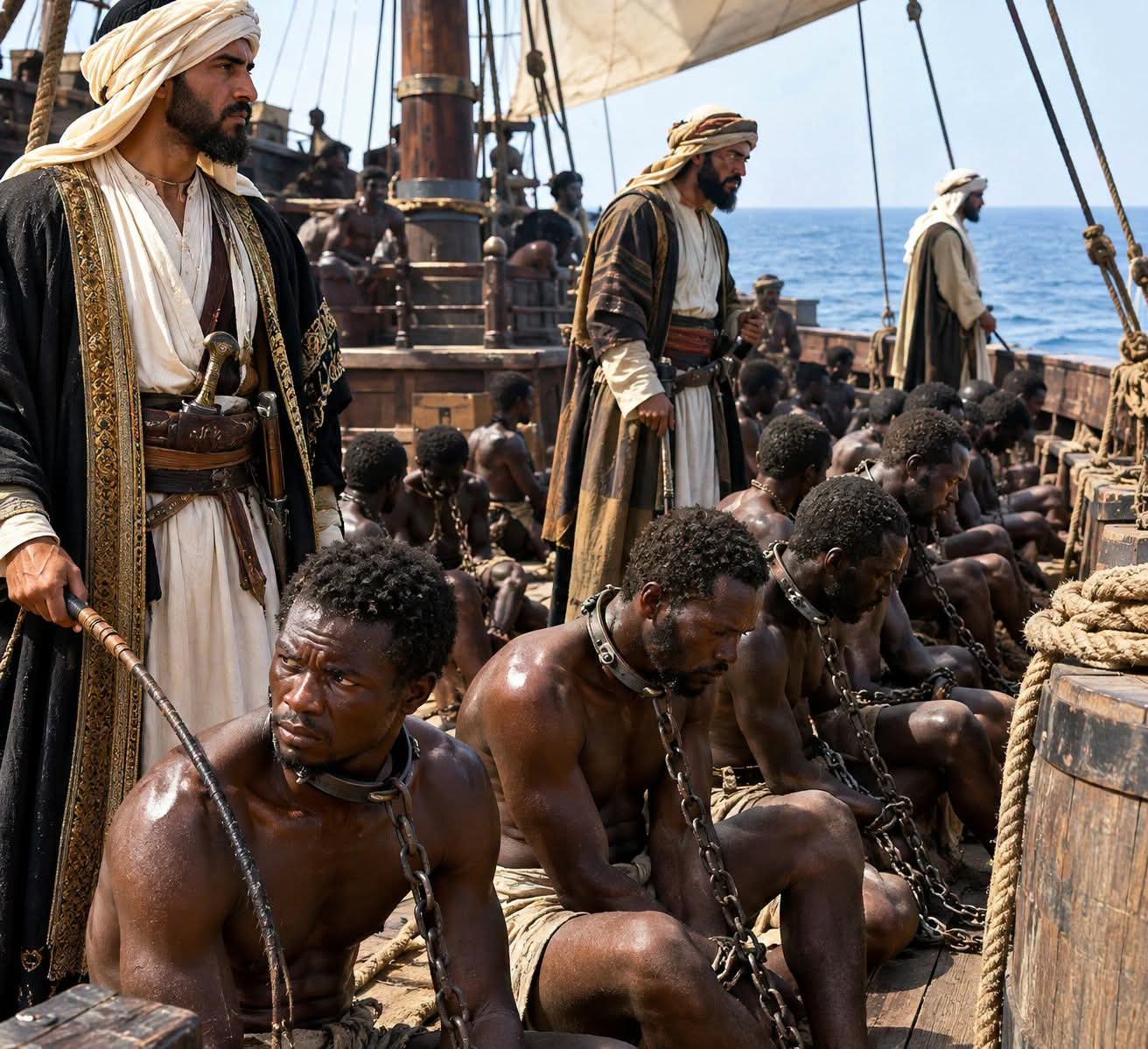
For centuries, African men, women and children were captured, sold and transported across the Sahara Desert, through the Red Sea and along Indian Ocean trading routes into North Africa and the Middle East.
These were not merely stories of people changing masters. They were stories of human beings losing their freedom, families being separated, children being taken from their parents, and human bodies becoming commodities in markets where buyers paid for the services they expected to obtain.
BUT ONE OF THE MOST HORRIFYING PRACTICES ASSOCIATED WITH PARTS OF THIS SLAVE TRADE WAS THE CASTRATION OF ENSLAVED AFRICAN MALES.
Why would anyone capture a young African boy, subject him to an operation that could permanently destroy his reproductive capacity, and then sell him into a life of servitude?
The answer lies partly in the historical demand for eunuchs.
In some Middle Eastern and North African societies, eunuchs served in royal palaces, wealthy households and harems. Some were entrusted with guarding women’s quarters, managing domestic affairs and performing administrative duties.
This created a demand for enslaved males who had been castrated.
African boys and men were among those subjected to this practice. Some were castrated before reaching their destinations, while others were subjected to the procedure elsewhere. The precise circumstances varied by region and period.
The operation could involve removing the testicles alone or more extensive genital mutilation. Without modern surgical care, the danger of severe bleeding, infection and death was substantial.
STOP AND THINK ABOUT WHAT THIS MEANS.
Imagine being born in an African community, growing up with a family, and having your entire future destroyed because another person considers your body a product to be purchased.
Imagine being captured, transported far from home, subjected to forced castration and then sold to someone who has paid for control over your life.
You were not consulted. You were not free to refuse. Your suffering did not determine whether the transaction would continue.
And the people responsible still treat the transaction as an ordinary part of their society.
This was the cruelty of slavery: the enslaved person’s humanity became secondary to the interests of the person who owned him.😭
RELIGIOUS QUESTION THAT MAKES THIS HISTORY UNCOMFORTABLE FOR SOME PEOPLE.
Islamic law historically permit slavery and permitted the ownership of enslaved people. Muslim-ruled societies participated in slave trading for centuries, even though Islamic it may not exist today but many still believe in it strongly .
The historical record therefore raises a difficult question: if a religion teaches moral responsibility toward human beings, how should we evaluate legal traditions that permitted one human being to own another?
It is not enough to say that slavery existed everywhere. That is a statement about history, not a complete moral defence of any particular religion.
Slavery existed in numerous civilisations, including African, European, Asian, Christian and Muslim societies. But the existence of slavery elsewhere does not erase the responsibility of those who participated in it.
THE BIGGER PROBLEM IS THE SELECTIVE MEMORY OF HISTORY.
When slavery is discussed today, attention often focuses on European ships crossing the Atlantic and the plantation systems of the Americas.
That history deserves attention.
But the trans-Saharan, Islamic, Red Sea, Indian Ocean slave trades also deserve serious examination. Their victims should not disappear from historical memory simply because their suffering occurred along different routes or under different political and religious authorities.
The experiences of enslaved Africans were not identical across these systems. Neither were the systems’ duration, organisation or consequences.
Yet the suffering of Africans enslaved in North Africa and the Middle East was no less worthy of historical investigation.🤔
HERE ARE THE QUESTIONS I WANT PEOPLE TO ANSWER:
- What moral justification could make the forced castration of an enslaved African boy acceptable?
- If Islamic law historically permitted slavery, should Muslims openly examine the consequences of that legal tradition instead of discussing only emancipation?
- Why do some discussions of African slavery focus almost entirely on the Atlantic trade while neglecting the trans-Saharan, Red Sea Islamic slaves trade and Indian Ocean routes?
- If another civilisation had practised these same atrocities, would we hesitate to condemn them because of their religion?
- Can we honestly claim to respect African history while ignoring the suffering of Africans enslaved and mutilated in societies outside Europe?
- Imagine religion that claim moralism upright be part of a cr’u€lt’y ideology of d€’hum∆n!z!ng people?😭
MY POSITION IS SIMPLE: NO RELIGION, RACE OR CIVILISATION SHOULD BE ABOVE HISTORICAL SCRUTINY.
European slave traders must answer for their role in the Atlantic slave trade. Arab and Muslim slave traders and the political authorities that supported slavery must also be examined. African rulers and merchants who sold captives must not be exempt from scrutiny either.
The victims were Africans. Their suffering belongs to African history, regardless of who captured them, who purchased them or which religion dominated the society in which they were enslaved.
AFRICAN HISTORY MUST NOT HAVE SACRED COWS.
If we can question European Christianity’s historical relationship with slavery, we can also question historical Muslim societies’ relationship with slavery.
Where are the black Africans in Arab Emirates today what happened to the historical enslaved Africans?

