THE GARAMANTES: THE ANCIENT AFRICAN CIVILIZATION THAT CONQUERED THE DESERT
THE GARAMANTES: THE ANCIENT AFRICAN CIVILIZATION THAT CONQUERED THE DESERT
How did an African civilization build thriving cities, cultivate crops, and sustain life in one of the harshest deserts on Earth—long before modern technology?
Long before modern engines, electric pumps, and industrial machinery, an ancient African people developed ingenious ways to survive and prosper in the Sahara Desert. They established settlements, cultivated land, traded across vast distances, and built a powerful regional society in an environment where water was—and remains—one of the most precious resources on Earth.
They were the Garamantes, the people of ancient Fezzan in what is now southwestern Libya.
Their story challenges the assumption that the Sahara was always an empty, lifeless barrier. It reveals a history of African ingenuity, adaptation, commerce, and political power that deserves far greater attention.
- Who were the Garamantes?
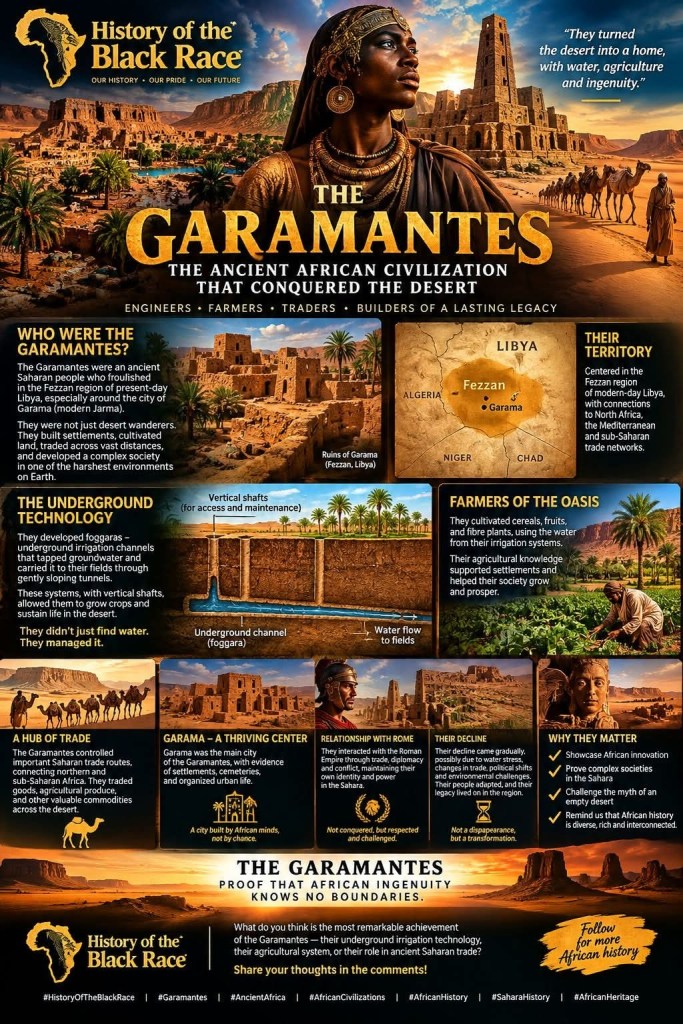
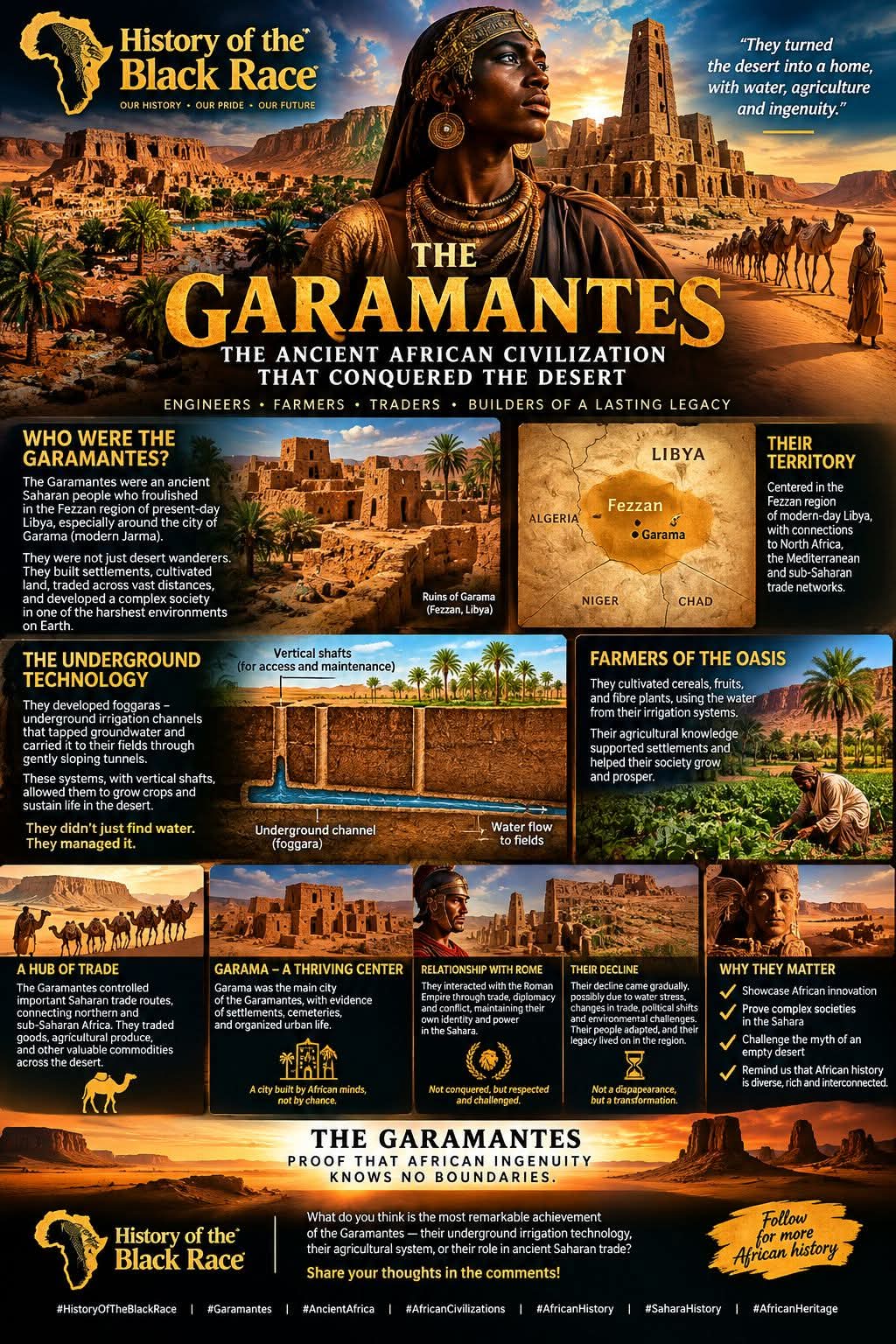
The Garamantes were an ancient Saharan people whose civilization flourished in the Fezzan region of present-day Libya, particularly during the first millennium BCE and the first centuries CE.
Their principal center was Garama, generally identified with the archaeological site of modern Germa.
Greek and Roman writers described the Garamantes as a significant people of the interior Sahara. Their territory was connected to North Africa and the Mediterranean, but their society developed its own ways of organizing settlements, producing food, and managing scarce water.
2. The underground technology that made the desert bloom
World-class aquifer’ enabled ancient African kingdom to thrive in the Sahara for hundreds of years
One of the most remarkable achievements of the Garamantes was their use of underground irrigation channels known as foggaras.
Imagine living in a land where rainfall is scarce, the sun is relentless, and rivers are nowhere nearby. How could a civilization feed its population, support settlements, and maintain agricultural production?
The Garamantes developed systems that tapped groundwater and transported it through gently sloping underground tunnels toward agricultural fields.
These channels were often accompanied by vertical shafts that helped workers construct, access, and maintain the tunnels. Archaeological research has documented hundreds of these systems in the Fezzan region.
Their ingenuity allowed them to cultivate crops in an environment that might otherwise have supported far fewer permanent settlements.
Their achievement was not simply finding water. It was organizing the knowledge, labour, and maintenance needed to manage water over generations.
This is one reason historians study the Garamantes when examining early African engineering and the development of complex societies.
3. They were farmers, not merely desert wanderers
The Garamantes combined engineering with agricultural knowledge.
Archaeobotanical research at Jarma, associated with ancient Garama, has identified evidence of cereal crops, fruits, and fibre plants. The findings indicate that farming included both winter and summer cultivation.
Their agricultural system helped sustain communities in the oases, where water could be channelled toward cultivated land.
Consider what this meant: they were not just surviving in the Sahara. They were transforming parts of the desert landscape into productive agricultural environments.
Agriculture supported settlements, while the organization of farming and irrigation helped sustain a more complex political society.
The Garamantes remind us that African innovation was not limited to famous stone monuments. Sometimes, the most important achievement was a sophisticated system hidden beneath the ground.
4. Garama: A center of ancient Saharan civilization
Aerial View of the Ruins at Germa (Garama) – World History
Garama, associated with modern Jarma in Libya, was the principal center of Garamantian civilization.
Archaeological investigations across the wider Fezzan region have revealed settlements, cemeteries, and extensive evidence of human occupation. These findings suggest that Garamantian society was more substantial and organized than early descriptions by outsiders often implied.
The civilization developed a regional political structure supported by agricultural production and long-distance trade.
Although Garama was not comparable in scale or monumental architecture to ancient Rome or Egypt, its importance lay in its ability to sustain urban life in the central Sahara.
Its existence challenges the simplistic idea that major African civilizations could flourish only beside enormous rivers or along the Mediterranean coast.
The Garamantes created their own path to power by adapting to the environment in which they lived.
5. The Garamantes and the ancient trans-Saharan trade
The Sahara was not simply a wall separating northern and sub-Saharan Africa. It was also a landscape through which people, goods, and ideas moved.
The Garamantes occupied a strategically important position within Saharan exchange networks, linking communities in the desert interior with settlements farther north and south.
Their prosperity was connected to caravan commerce, oasis agriculture, and the movement of goods across difficult terrain. Modern scholarship increasingly emphasizes their central role in Saharan networks rather than portraying them merely as a remote people on the edge of the Roman world.
Trade across these networks involved different commodities at different times, including agricultural produce and goods transported over long distances. Historical accounts also associate Saharan commerce with enslaved people, although the scale and precise organization of particular Garamantian-era activities remain subjects for careful historical interpretation.
Their position gave them an important advantage: they could connect communities that were geographically distant but economically interdependent.
The lesson is powerful: control of water, agricultural production, and trade routes can create political power even in a harsh environment.
6. Their relationship with the Roman Empire
The Roman-African borderlands and expeditions south of the Sahara.
While Rome expanded across North Africa, the Garamantes maintained their own political identity in the Sahara.
Roman writers described encounters with them, sometimes portraying them through the prejudices that ancient Mediterranean authors commonly directed toward peoples beyond their own political world.
Relations were not always peaceful. Conflict, diplomacy, and commercial connections all formed part of the wider relationship between the Roman world and the Saharan interior.
Yet the Garamantes were not simply a population waiting to be conquered. Their ability to organize agricultural production and participate in long-distance trade gave them their own sources of influence.
Their history illustrates an important distinction: an empire does not need to conquer every neighbouring territory to shape regional politics, and a powerful neighbouring empire does not necessarily control every society within its reach.
7. What happened to the Garamantes?
The decline of Garamantian political power was a process, not a single event that can be explained by one cause.
Several factors may have contributed:
- Water stress: Irrigation systems depended on groundwater and continuous maintenance. Falling water tables could make some channels less effective.
- Changes in trade: Shifts in Mediterranean commerce and Saharan exchange could weaken the economic foundations of the state.
- Political and social change: The organization of communities and regional authority evolved over time.
- Changing settlement patterns: People adapted their farming and water-management practices as conditions changed.
Research on the Garamantes connects the changing fortunes of their society to both environmental pressures and wider economic networks. However, the precise weight of each factor remains a matter of scholarly investigation.
The Garamantes did not simply disappear overnight. Their society transformed over time, and populations continued living in the wider Fezzan region under changing political and cultural conditions.
It would therefore be inaccurate to claim that every Garamantian settlement vanished at once or that one modern ethnic group can be identified as their sole direct descendant without further evidence.
8. Why the Garamantes matter to African history today
The story of the Garamantes deserves a place in conversations about African civilization for several reasons.
First, it demonstrates that ancient Africans developed practical engineering solutions suited to their environments.
Second, it shows that complex political societies could emerge in the Sahara through the interaction of agriculture, water management, trade, and organized labour.
Third, it challenges the idea that Africa’s ancient history belongs only to Egypt, or that the Sahara was an absolute barrier between northern and sub-Saharan African societies.
Finally, it reminds us that historical achievement should not be measured only by the size of a monument, the territory conquered, or the number of surviving written records.
Sometimes, civilization is measured by the ingenuity required to make life possible where others see only hardship.
The forgotten lesson of the Garamantes
The Garamantes built a distinctive Saharan civilization by learning how to manage scarce water, cultivate the land, sustain settlements, and connect their world to wider commercial networks.
Their story is a reminder that Africa’s past was diverse, innovative, and interconnected.
We should study these societies not to invent exaggerated claims about their achievements, but to understand what the archaeological evidence genuinely reveals—and to give neglected African histories the attention they deserve.
Let us bring these forgotten civilizations back into the conversation.
What do you think is the most remarkable achievement of the Garamantes: their underground irrigation technology, their agricultural system, or their role in ancient Saharan trade?