THE IGBO CONNECTION IN JAMAICAN HISTORY:
THE IGBO CONNECTION IN JAMAICAN HISTORY:
Tracing African Roots,
The ancestral ties between Jamaica and West Africa remain a prominent subject of historical and genealogical research.
Among the various African ethnic groups that shaped Jamaican society, the Igbo people of southeastern Nigeria hold a well-documented and traceable position.
While tracking individual family trees back to specific pre-colonial ancestors presents significant historical challenges, the broader structural connection is firmly supported by scientific data, archival records, and linguistic patterns.
🧬 1. Autosomal DNA and Population Genetics
Modern commercial genetic mapping provides clear data regarding Afro-Jamaican ancestry.
Population studies from major databases frequently show that a significant percentage of modern genetic profiles in Jamaica contain substantial West African markers.
- Regional Matches: Genetic signatures tightly align with modern-day Nigerian populations, often matching or exceeding genetic markers from the Gold Coast (modern-day Ghana).
- Isolating the Region: While autosomal testing provides broad geographic percentages rather than specific family names, the density of these matches confirms heavy ancestral clusters rooted in the Bight of Biafra hinterlands.
📜 2. Colonial Shipping and Port Disembarkation Records
The paper trail maintained in transatlantic shipping manifests offers precise historical context regarding when and where specific populations arrived.
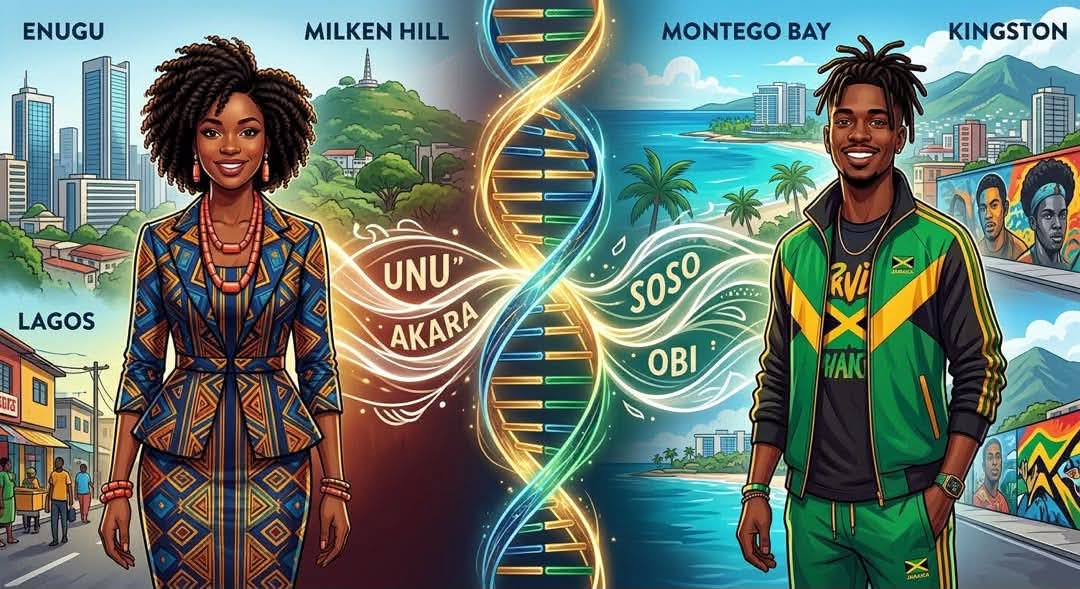
- The Bight of Biafra Wave: Historical trade databases show that the Bight of Biafra—the coastal outlet for the Igbo heartland—served as a primary source region for British ships bound for Jamaica during the late 18th and early 19th centuries.
- Geographic Concentration: Arrival records indicate that a vast number of these captives disembarked in northwestern Jamaican ports, particularly around Montego Bay and St. James.
This highly concentrated influx allowed cultural identities to remain resilient.
🗣️ 3. Linguistic Retentions in Jamaican Patois
Because traditional surnames were systematically replaced on plantations, historians analyze “linguistic fossils” to trace cultural survival.
The structure and vocabulary of Jamaican Patois retain undeniable loanwords from the Igbo language:
- “Unu” – The plural form of “you” (you people), used identically in both Igbo and Jamaican Patois today.
- “Akara” – Referring directly to traditional bean cakes.
- “Soso” – Used in both languages to mean only or exclusively.
- “Ima osu” – The distinct cultural expression of sucking or hissing through the teeth, rooted in the Igbo term imu oso.
🧱 The Practical Limits of Individual Genealogy
While the macro-history is completely verifiable, tracing an individual family lineage to a specific village or family compound faces a historical “brick wall” around the late 1700s and early 1800s.
Upon arrival in the colonies, individuals were typically documented under European surnames chosen by estate owners.
Consequently, modern researchers rely on a combination of matching shared DNA segments with continental West Africans and analyzing regional plantation records to piece together their historic lineages.

