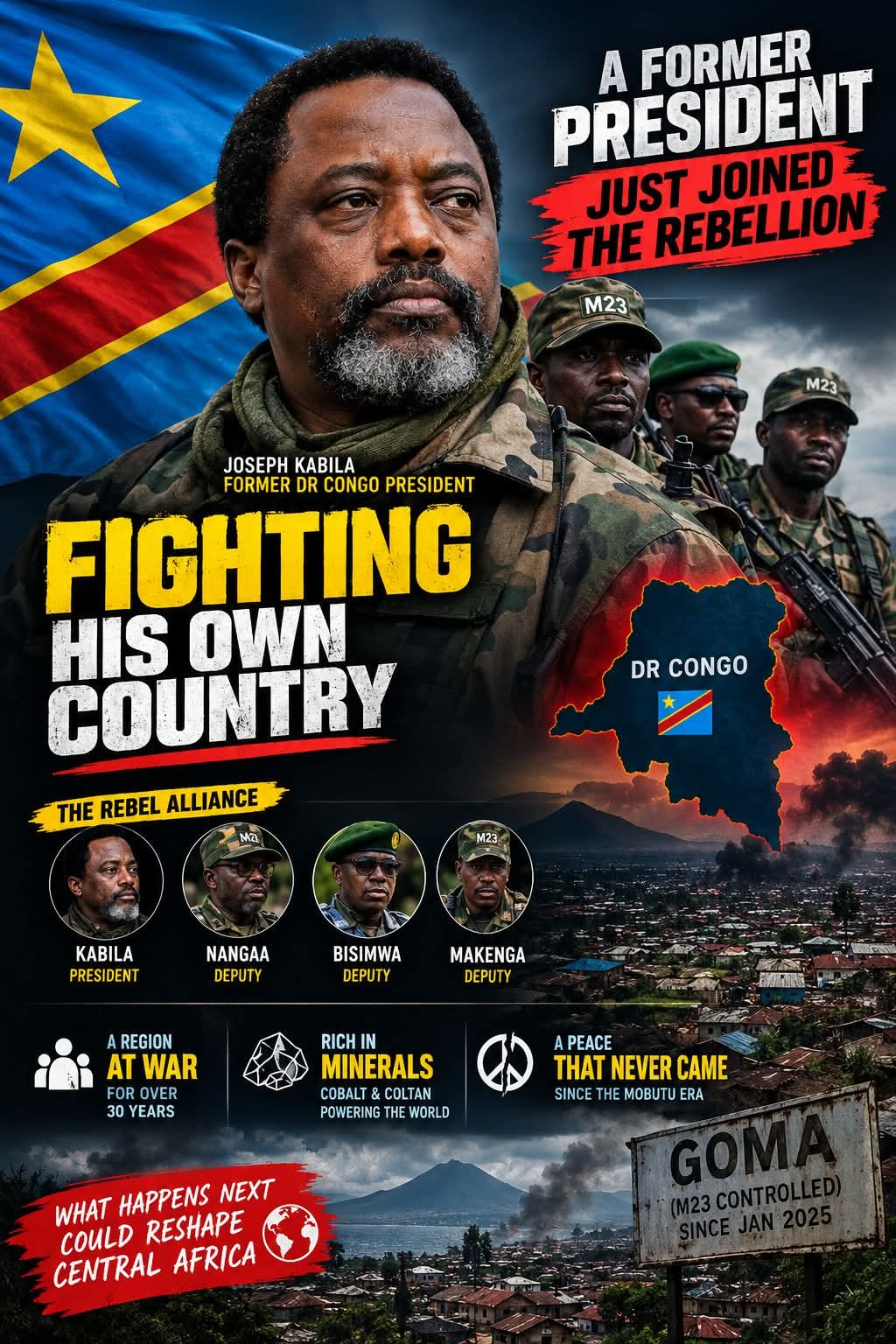
A FORMER PRESIDENT JUST JOINED THE REBELLION FIGHTING HIS OWN COUNTRY
🇨🇩 A FORMER PRESIDENT JUST JOINED THE REBELLION FIGHTING HIS OWN COUNTRY
On October 12, 2026, in Goma — a city controlled by M23 rebels since January 2025 — former DR Congo President Joseph Kabila did something almost unheard of for a former head of state.
He didn’t just criticize the government he once led. He joined the armed movement fighting it. 👇
The new group: Front pour la Refondation de la Nation (FRN) — “Front for the Refoundation of the Nation.” It absorbs the AFC/M23 alliance entirely, with Kabila as president and senior M23 commanders — Corneille Nangaa, Bertrand Bisimwa, and Major General Sultani Makenga — as his deputies.
Why it matters: Kabila isn’t a fringe figure. He ruled the DRC from 2001 to 2019, first taking power at just 29 years old after his father, Laurent-Désiré Kabila, was assassinated. Now, at 55, he’s openly aligned himself with the Rwanda-backed insurgency controlling much of the mineral-rich east — accusing current President Félix Tshisekedi’s government of failing to honor an October 2025 Doha ceasefire and of “pursuing a war it has neither the will nor the means to win.”
Kinshasa has already tried Kabila in absentia for treason and war crimes, convicting him in September 2025 — though reports differ on whether the sentence was life imprisonment or death.
The bigger picture: This isn’t just a 2026 headline. It’s the latest chapter in a Congolese political story that stretches back to the fall of Mobutu Sese Seko in 1997, when Laurent-Désiré Kabila took power with regional backing — only to be assassinated in 2001 and succeeded by his son. Eastern DRC has been gripped by conflict for over 30 years, fueled by a combination of ethnic tension, regional rivalries, and some of the richest mineral deposits on Earth — the same cobalt and coltan powering the world’s phones and electric cars.
A former president. A rebel alliance. A region that has never fully known peace since the Mobutu era ended.
What happens next in the DRC could reshape Central Africa for years. 🌍

