
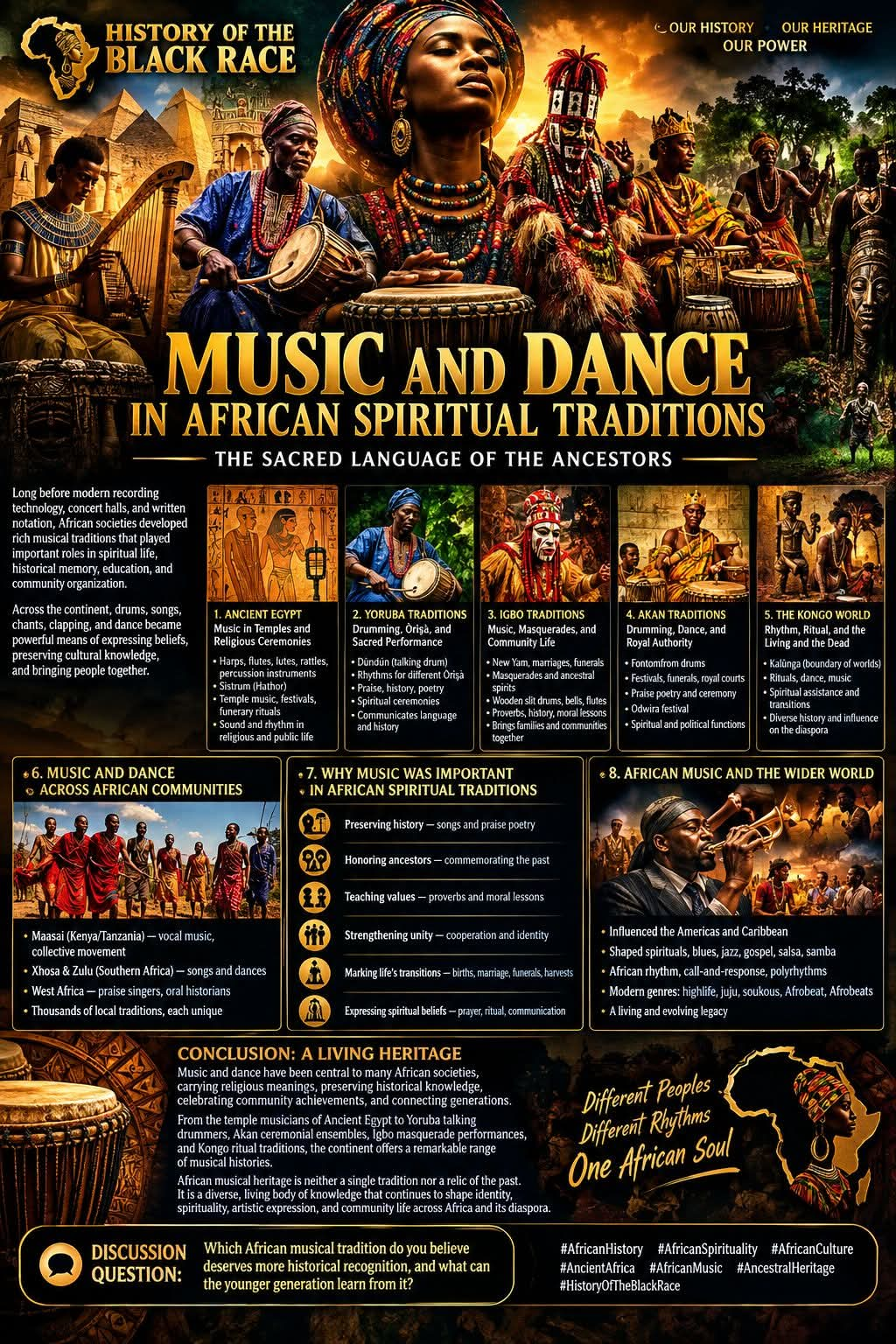
MUSIC AND DANCE IN AFRICAN SPIRITUAL TRADITIONS: THE SACRED LANGUAGE OF THE ANCESTORS
MUSIC AND DANCE IN AFRICAN SPIRITUAL TRADITIONS: THE SACRED LANGUAGE OF THE ANCESTORS
Long before modern recording technology, concert halls, and written musical notation, African societies developed rich musical traditions that played important roles in spiritual life, historical memory, education, and community organization. Across the continent, drums, songs, chants, clapping, and dance became powerful means of expressing beliefs, preserving cultural knowledge, and bringing people together.
In many African traditions, music was not separated from everyday life or spirituality. It accompanied births, naming ceremonies, initiations, marriages, funerals, harvest celebrations, royal occasions, and communal gatherings. However, every African society developed its own musical styles, instruments, rhythms, and spiritual interpretations.
- Ancient Egypt: Music in Temples and Religious Ceremonies
In Ancient Egypt, music was closely associated with religious worship, royal ceremonies, festivals, and public celebrations. Archaeological discoveries, tomb paintings, reliefs, and surviving instruments provide evidence of musicians playing harps, flutes, lutes, rattles, and percussion instruments.
The sistrum, a metal rattle associated particularly with the worship of the goddess Hathor, was used in religious ceremonies. Musicians and singers also performed in temples and at festivals, while music accompanied funerary rituals and other important occasions.
Egyptian musical practices demonstrate that sound and rhythm were integral to religious and public life. Although the exact melodies of ancient Egyptian music remain largely unknown, visual and archaeological evidence reveals the importance of musicians in the civilization.
- Yoruba Traditions: Drumming, Òrìṣà, and Sacred Performance
Among the Yoruba of present-day Nigeria and Benin, music and dance have long been connected to religious ceremonies, festivals, royal courts, and community life.
Drums such as the dùndún, often called the talking drum, can imitate the tonal patterns of Yoruba speech. Skilled drummers use changes in pitch, rhythm, and phrasing to communicate praise, recount histories, accompany poetry, and announce important occasions.
Within Yoruba religious traditions, particular rhythms, songs, and dances are associated with different Òrìṣà. During certain ceremonies, music supports prayer, ritual participation, and forms of spiritual expression. These practices differ among communities and religious lineages.
The talking drum also demonstrates how African musical traditions can preserve language and historical knowledge. A performance may communicate praise names, social messages, and cultural meanings that listeners familiar with the tradition understand.
- Igbo Traditions: Music, Masquerades, and Community Life
Among the Igbo of southeastern Nigeria, music accompanies many cultural and religious occasions, including the New Yam Festival, traditional marriages, funerals, and masquerade performances.
In communities where masquerade traditions are practiced, music, dance, costumes, and performance may represent ancestral figures, spirits, social values, or particular community institutions. The meaning of each masquerade depends on its specific cultural context.
Instruments such as wooden slit drums, membrane drums, bells, flutes, and rattles contribute to different musical ensembles. Songs may preserve proverbs, recount historical events, praise individuals, or communicate moral lessons.
Music also strengthens social relationships by bringing families and communities together during collective celebrations. In this way, performance becomes a means of transmitting knowledge and maintaining cultural identity.
- Akan Traditions: Drumming, Dance, and Royal Authority
Among the Akan peoples of Ghana and Côte d’Ivoire, drumming and dance have important roles in festivals, funerals, royal ceremonies, and other communal events.
The Fontomfrom drums are associated with royal and ceremonial occasions, while other drum ensembles accompany traditional dances and public celebrations. Akan musical traditions can communicate status, commemorate important people, and express collective identity.
Royal courts historically used drumming, praise poetry, and ceremonial performance to communicate authority and preserve political memory. During festivals such as Odwira, music and dance form part of broader practices involving community renewal, remembrance, and celebration.
These traditions illustrate how African music has served both spiritual and political functions, connecting religious beliefs, public authority, and community life.
- The Kongo World: Rhythm, Ritual, and the Relationship Between the Living and the Dead
Among Kongo-speaking peoples of Central Africa, music, dance, ritual objects, and symbolic understandings of life and death have played important roles in religious and communal traditions.
Some Kongo cosmological traditions understand the world of the living and the world of the dead as related realms, often represented through the symbolism of the kalûnga, associated with a boundary or dividing line between these worlds.
In particular ritual contexts, music and dance accompany ceremonies intended to seek spiritual assistance, mark important transitions, or bring participants together in shared religious practice.
Kongo traditions are diverse, and their historical development includes centuries of interaction with neighboring peoples and, later, Christianity and Atlantic-world cultures. Their musical heritage also influenced the development of several Afro-diasporic traditions in the Americas.
- Music and Dance Across African Communities
Beyond these examples, musical traditions developed throughout East, West, Central, and Southern Africa.
Among the Maasai of Kenya and Tanzania, vocal music and collective movement feature in social ceremonies and age-related traditions. In many Xhosa and Zulu communities of Southern Africa, songs and dances accompany ceremonies, celebrations, and communal gatherings. Across parts of West Africa, praise singers and hereditary oral historians preserve genealogies and historical accounts through music and spoken performance.
These examples should not be treated as a single continental system. African music encompasses thousands of local traditions, each shaped by language, history, instruments, religious beliefs, and social organization.
- Why Music Was Important in African Spiritual Traditions
Music and dance served several important purposes in many African societies:
Preserving history: Songs, praise poetry, and musical performances helped transmit genealogies, accounts of historical events, and the achievements of leaders.
Honoring ancestors: In traditions that recognize ancestral participation in community life, particular songs, dances, and ceremonies commemorate deceased relatives and express continuing family connections.
Teaching values: Songs and performances communicate proverbs, moral lessons, social expectations, and knowledge about community responsibilities.
Strengthening unity: Collective singing, dancing, and drumming create opportunities for cooperation, shared identity, and mutual support.
Marking life’s transitions: Music accompanies naming ceremonies, initiation, marriage, funerals, harvests, and other important events.
Expressing spiritual beliefs: In some traditions, music forms part of prayer, ritual offerings, possession ceremonies, or communication with spiritual beings. The meaning and practice vary significantly across cultures.
- African Music and the Wider World
African musical traditions have influenced music around the world, particularly through the forced displacement of Africans during the transatlantic slave trade and through later migration, cultural exchange, and artistic innovation.
African rhythmic concepts, call-and-response singing, polyrhythms, and participatory performance contributed to the development of numerous musical traditions in the Americas and the Caribbean. These influences can be heard in spirituals, blues, jazz, gospel, salsa, samba, and many other genres, although each developed through complex interactions among different peoples and musical cultures.
African music has also continued to evolve on the continent through genres such as highlife, juju, soukous, Afrobeat, and Afrobeats. These modern styles reflect creativity and change while drawing on diverse African musical foundations.
Conclusion: A Living Heritage
Music and dance have been central to many African societies, carrying religious meanings, preserving historical knowledge, celebrating community achievements, and connecting generations. From the temple musicians of Ancient Egypt to Yoruba talking drummers, Akan ceremonial ensembles, Igbo masquerade performances, and Kongo ritual traditions, the continent offers a remarkable range of musical histories.
Understanding these traditions requires more than listening to rhythms or watching performances. It means learning about the languages, histories, beliefs, and communities that give them meaning.
African musical heritage is neither a single tradition nor a relic of the distant past. It is a diverse, living body of knowledge that continues to shape identity, spirituality, artistic expression, and community life across Africa and its diaspora.
Discussion


Shocker Zulu
LikeLiked by 1 person