THE HIDDEN HISTORY OF AFRICAN KNOWLEDGE: HOW THE MOORS HELPED SHAPE EUROPEAN CIVILIZATION
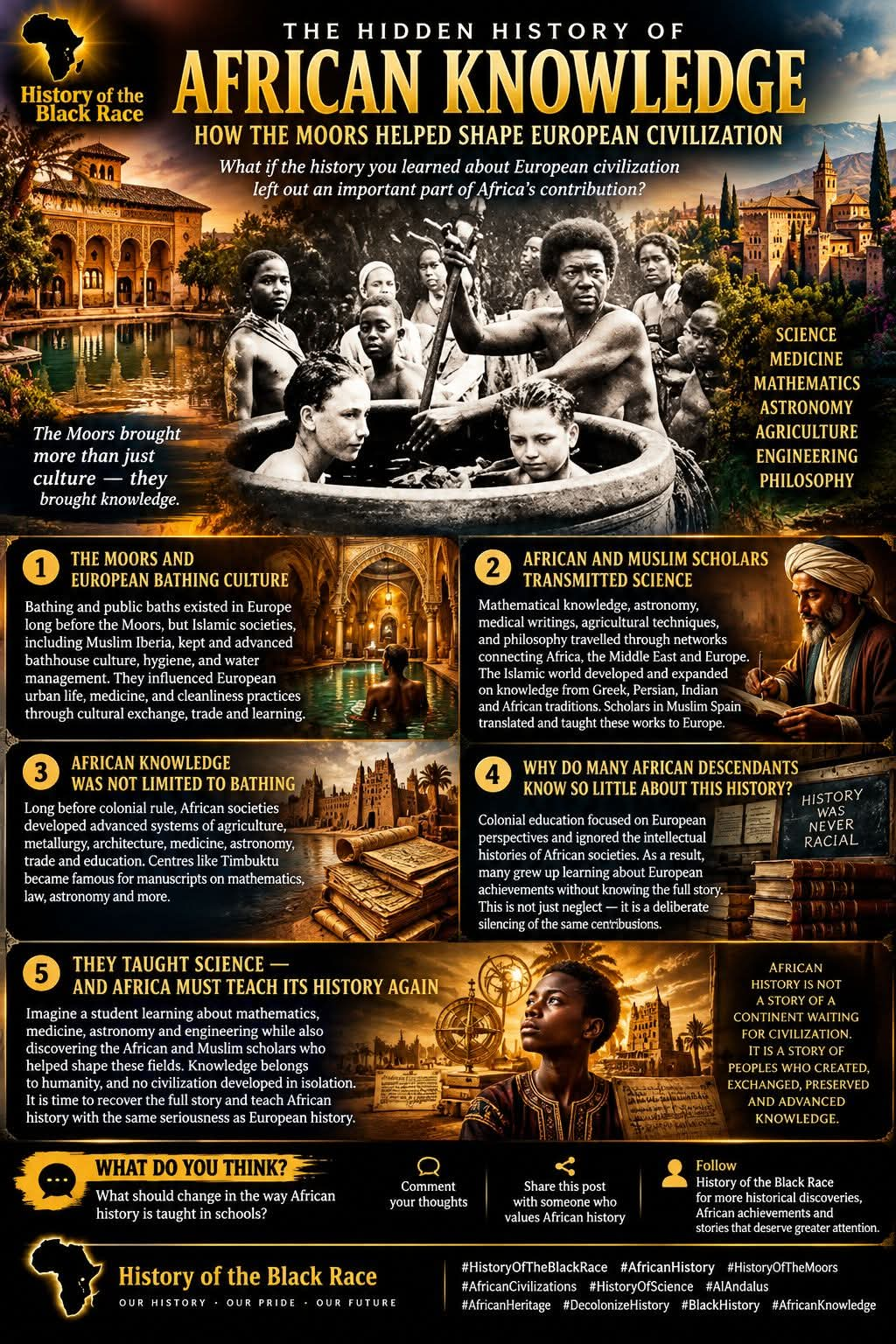
THE HIDDEN HISTORY OF AFRICAN KNOWLEDGE: HOW THE MOORS HELPED SHAPE EUROPEAN CIVILIZATION
What if the history you learned about European civilization left out an important part of Africa’s contribution?
For generations, many people of African descent have been taught about European scientific achievements without receiving the full story of the knowledge that travelled across Africa, North Africa, and the wider Mediterranean world.
One important chapter concerns the Moors, a term historically used for various Muslim peoples of North African and Iberian backgrounds, including many people of Amazigh (Berber) and Arab heritage, as well as others.
When Muslim rule expanded into the Iberian Peninsula in 711 CE, it helped establish centuries of cultural, intellectual, and scientific exchange between the Islamic world and Christian Europe. Al-Andalus, as Muslim-ruled Iberia was known, became an important centre of learning where scholars studied mathematics, astronomy, medicine, philosophy, agriculture, and engineering.
BUT HERE IS THE PART OF HISTORY THAT DESERVES MORE ATTENTION.
European intellectual development did not happen in isolation. Knowledge moved across borders through scholars, travellers, translators, merchants, and teachers. North African and Muslim societies played significant roles in preserving, developing, and transmitting scientific knowledge that contributed to Europe’s intellectual transformation.
- DID THE MOORS INFLUENCE EUROPEAN HYGIENE AND BATHING?
Bathing and public baths existed in Europe long before the arrival of the Moors. The ancient Greeks and Romans had established bathing traditions centuries earlier. However, bathing culture, public bathhouses, water management, and certain approaches to cleanliness remained important in many Muslim societies, including Muslim Iberia.
These traditions formed part of a wider cultural environment in which Europeans and Muslims interacted. It would therefore be misleading to claim that the Moors alone taught Europeans how to bathe, but it is equally misleading to ignore the influence of Islamic societies on European urban culture, medicine, and practices of cleanliness.
- AFRICAN AND MUSLIM SCHOLARS HELPED TRANSMIT SCIENCE
The history becomes even more interesting when we examine science.
Mathematical knowledge, astronomical observations, medical writings, agricultural techniques, and philosophical ideas travelled through networks connecting Africa, the Middle East, and Europe.
The Islamic world developed and expanded upon knowledge inherited from Greek, Persian, Indian, and other intellectual traditions. Scholars in Muslim Spain participated in the translation, study, and transmission of this knowledge into Latin-speaking Europe.
The development of algebra, advances in astronomy, medical scholarship, and the preservation and critical examination of ancient texts all formed part of this wider intellectual history.
The important lesson is this: the scientific history of Europe cannot be fully understood without studying the contributions of African and Muslim societies.
- AFRICAN KNOWLEDGE WAS NOT LIMITED TO BATHING
The story of African knowledge reaches far beyond hygiene.
Long before colonial rule, African societies developed sophisticated systems of agriculture, metallurgy, architecture, medicine, astronomy, trade, and education. In North Africa, ancient Egypt developed mathematical and architectural traditions. Across the Sahel, centres of scholarship such as Timbuktu became renowned for manuscripts dealing with mathematics, law, astronomy, theology, and other fields of learning.
In medieval North Africa and Muslim Spain, scholars also contributed to the development and transmission of scientific knowledge. One example is Abū al-Qāsim al-Zahrāwī, the Andalusian physician and surgeon whose medical writings influenced European medicine after being translated into Latin.
These achievements challenge the false idea that Africa was a continent without intellectual traditions before European colonialism.
- WHY DO MANY AFRICAN DESCENDANTS KNOW SO LITTLE ABOUT THIS HISTORY?
Colonial-era education often privileged European perspectives and gave insufficient attention to the intellectual histories of African societies. As a result, many people grew up learning about European scientific achievements without exploring the international networks through which knowledge travelled.
However, we should distinguish between historical neglect and deliberate concealment. There is strong evidence that African and Muslim contributions have sometimes been underrepresented, but it would be inaccurate to claim that every contribution was deliberately hidden through one coordinated plan.
The solution is to recover the records, study the manuscripts, examine the archaeological evidence, and teach African history with the same seriousness given to European history.
- THEY TAUGHT SCIENCE—AND AFRICA MUST TEACH ITS HISTORY AGAIN
Imagine a young African student learning about mathematics, medicine, astronomy, engineering, and sanitation while also discovering the African and Muslim scholars who helped shape the development of these fields.
Imagine that student studying Timbuktu’s manuscripts, the intellectual traditions of North Africa, the scientific achievements of medieval Muslim Spain, and the technological accomplishments of ancient African civilizations.
That student would understand something important: knowledge belongs to humanity, and no single civilization developed in isolation.
We must not replace one historical myth with another. We must recover the complete story, recognize the people whose contributions were overlooked, and distinguish documented achievements from popular exaggerations.
African history is not a story of a continent waiting for civilization. It is a story of peoples who created, exchanged, preserved, and advanced knowledge across generations.
Our responsibility is to ensure that the next generation knows this history.
The question is not whether the Moors invented bathing or every branch of modern science. They did not. The real question is why the contributions of African and Muslim societies are still not better known among the very descendants who deserve to study them.
If European students deserve to learn about Europe’s intellectual heritage, African students deserve to learn about Africa’s contributions to world civilization, too.
What do you think should change in the way African history is taught in schools?

