THE LIBERIAN CIVIL WAR: WHEN WARLORDS TURNED CHILDREN INTO SOLDIERS
🚨💔 THE LIBERIAN CIVIL WAR: WHEN WARLORDS TURNED CHILDREN INTO SOLDIERS
Imagine being a child who should be sitting in a classroom, playing with friends, or learning to read—but instead, you are carrying a gun, witnessing killings, and fighting in a war you never chose.
This was the horrifying reality for thousands of children during Liberia’s civil wars in West Africa.
🇱🇷 HOW DID LIBERIA DESCEND INTO WAR?
Liberia’s first civil war began in December 1989, when rebel leader Charles Taylor and his National Patriotic Front of Liberia (NPFL) launched an armed rebellion against the government of President Samuel Doe.
However, the roots of the conflict ran much deeper than one rebellion. Decades of political exclusion, corruption, ethnic tensions, economic inequality, and authoritarian rule had weakened the country.
In 1980, Samuel Doe had seized power in a military coup that overthrew and killed President William R. Tolbert Jr.
Doe’s government subsequently faced growing opposition, and abuses by state forces intensified existing tensions.
When Taylor’s forces invaded in 1989, Liberia descended into a devastating conflict. Rival armed factions emerged, government authority collapsed across much of the country, and civilians were caught between competing forces.
But one of the war’s most disturbing features was the widespread recruitment and exploitation of children.
💔 1. CHILDREN WERE TURNED INTO SOLDIERS
Children who should have been protected became targets for armed groups.
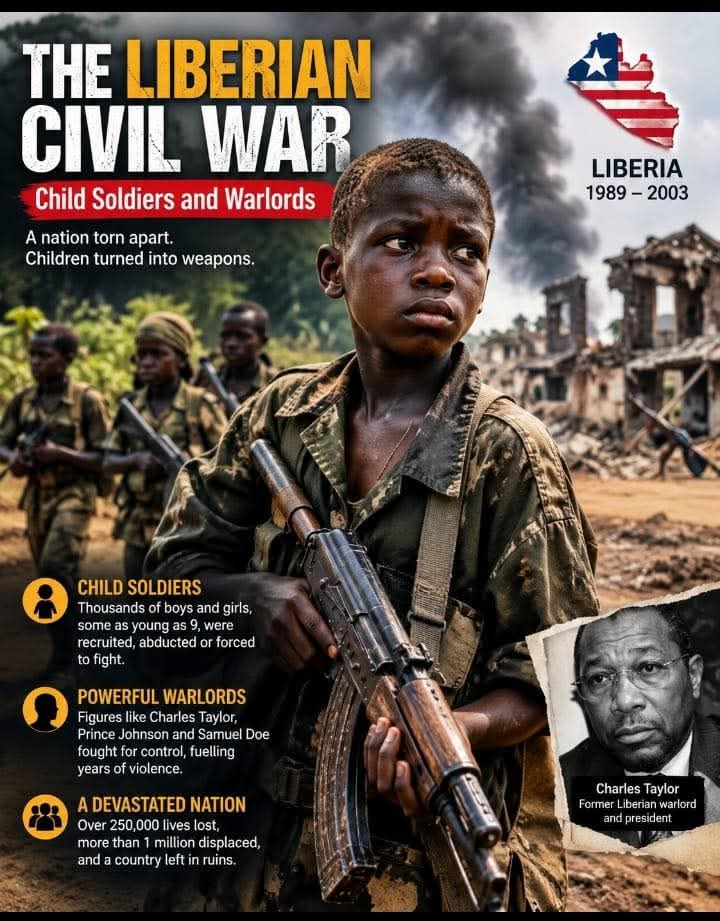
Human Rights Watch documented how boys and girls, including children as young as nine or ten, were recruited and used during Liberia’s wars.
Some were abducted from their homes, schools, and displacement camps. Others joined armed groups because their families had been killed, they needed food, they sought protection, or they believed fighting was their only chance of survival.
Charles Taylor’s NPFL became notorious for using children in units commonly known as the Small Boys Units.
Other armed factions, as well as government forces and associated militias, also recruited children.
These children were not simply carrying weapons. Depending on their age and the armed group involved, they were used as fighters, spies, messengers, porters, guards, and workers.
Some were sent into dangerous frontline combat.
Children were beaten, threatened, and subjected to psychological manipulation. Some were forced to take drugs, while others were compelled to commit acts of violence against civilians.
Girls were also recruited and suffered sexual violence, forced labour, and sexual exploitation.
They were children living through a nightmare that no child should ever experience.
⚔️ 2. THE WARLORDS WHO FOUGHT FOR POWER
Liberia’s civil wars involved numerous armed factions and commanders. Their rivalries contributed to years of violence and the destruction of communities.
Among the most prominent figures were:
🔴 Charles Taylor: He led the NPFL rebellion that began in 1989. After the first civil war, he won Liberia’s 1997 presidential election. His government subsequently faced another armed rebellion, and Taylor was eventually forced to leave office in 2003. He was later convicted by the Special Court for Sierra Leone for aiding and abetting war crimes and crimes against humanity committed during Sierra Leone’s civil war.
🔴 Prince Johnson: A former NPFL commander who broke away to establish the Independent National Patriotic Front of Liberia (INPFL). His forces became notorious during the 1990 fighting, and Johnson was directly associated with the capture, torture, and killing of President Samuel Doe.
🔴 Samuel Doe: Liberia’s president from 1980 until his violent death in 1990. Although he was not a rebel warlord in the same sense as Taylor or Johnson, his military government and its abuses formed an important part of the political background to the conflict.
These figures occupied different positions in Liberia’s political and military history. They should not be treated as interchangeable, but their stories illustrate how political power, armed rebellion, and competing military ambitions shaped the country’s tragedy.
Behind the names of prominent leaders were ordinary Liberians who paid an extraordinary price.
🏚️ 3. A COUNTRY DESTROYED FROM WITHIN
The consequences extended far beyond the battlefield.
Families were separated. Villages and neighbourhoods were attacked. Schools and hospitals were damaged or abandoned, while many people fled their homes in search of safety.
Civilians experienced massacres, torture, sexual violence, forced recruitment, and other grave abuses.
Liberia’s Truth and Reconciliation Commission reported that the country’s conflicts between 1989 and 2003 killed an estimated 250,000 people and displaced more than one million internally, while hundreds of thousands became refugees.
The suffering was not limited to one ethnic group or one political side. Civilians were victimised by multiple armed factions, including government forces.
The war devastated livelihoods, disrupted education, and left countless survivors struggling with grief and trauma.
For children who had been forced to fight, returning to civilian life could be especially difficult.
How could a child who had witnessed killings, lost family members, or been forced to commit violence simply return to normal life?
The wounds were physical, emotional, and social.
🕊️ 4. WHEN THE WAR FINALLY ENDED
Liberia experienced two major periods of civil war:
📌 First Civil War: 1989–1997.
📌 Second Civil War: 1999–2003, with fighting continuing into 2003.
The first war formally ended with a 1997 peace settlement and elections that brought Charles Taylor to the presidency.
However, peace did not last.
Renewed rebellions, including those led by Liberians United for Reconciliation and Democracy (LURD) and the Movement for Democracy in Liberia (MODEL), plunged the country back into conflict.
In August 2003, a comprehensive peace agreement was signed in Accra, Ghana. Taylor left office later that month, and international peacekeeping efforts helped consolidate the end of the major fighting.
Disarmament and reintegration programmes subsequently sought to help former combatants, including children, return to civilian life.
But ending a war is not the same as healing a nation.
Many survivors continued to struggle with poverty, trauma, lost education, and the absence of family members.
⚖️ 5. THE QUESTION OF JUSTICE
In 2009, Liberia’s Truth and Reconciliation Commission presented its final report, documenting the causes of the conflict and the widespread human rights violations committed during the wars.
The commission recommended measures to promote accountability, reconciliation, and reparations for victims.
Yet justice for crimes committed during Liberia’s civil wars has remained a long-standing challenge.
The story of Liberia raises a difficult question: Can a country fully heal when survivors are still waiting for accountability?
Remembering these events is not about condemning an entire nation. It is about recognising the suffering of its people, understanding how political violence destroys societies, and ensuring that the experiences of victims are not forgotten.
🌍 THE LESSON HISTORY MUST NEVER FORGET
The Liberian Civil War reminds us that children are among the most vulnerable victims of armed conflict.
When armed leaders exploit poverty, fear, political instability, and the vulnerability of young people, childhood itself can become a casualty of war.
The children who were recruited into armed groups were not all the same. Some were abducted. Some sought protection. Some were driven by desperation. Some committed terrible acts under circumstances of coercion and abuse.
Recognising their suffering does not erase the pain of their victims. It helps us understand why protecting children, holding responsible leaders accountable, and preventing future recruitment are essential to lasting peace.
Liberia’s history is not only a story of warlords and weapons. It is also the story of millions of ordinary people who struggled to survive, rebuild their communities, and reclaim their future.
💔 QUESTION FOR YOU:
How can a society help former child soldiers rebuild their lives while also delivering justice to the people who suffered because of their actions?
Should the priority be rehabilitation, accountability, or both?
Share your thoughts respectfully in the comments. 👇

