
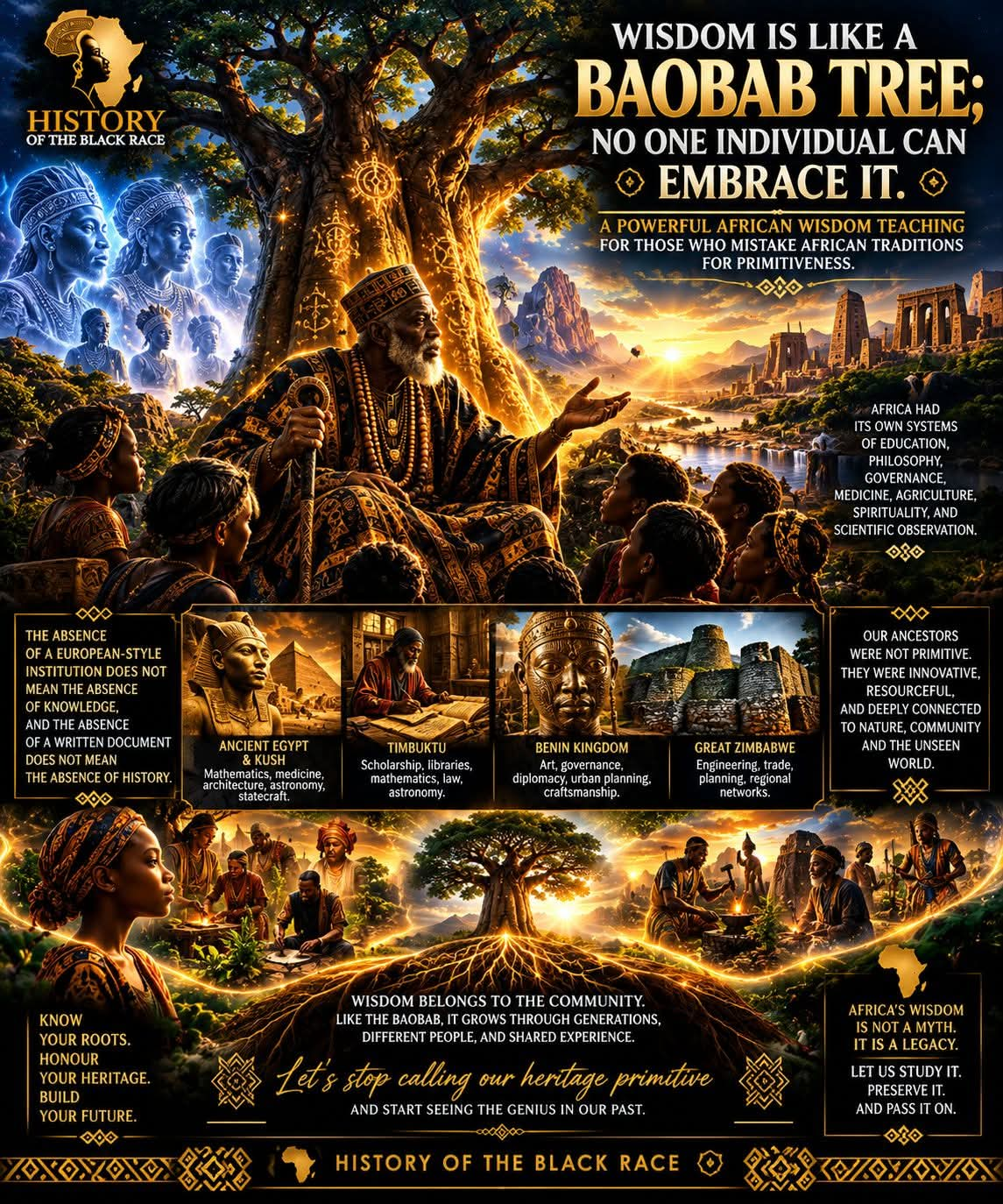
WISDOM IS LIKE A BAOBAB TREE: NO ONE INDIVIDUAL CAN EMBRACE IT
WISDOM IS LIKE A BAOBAB TREE: NO ONE INDIVIDUAL CAN EMBRACE IT 🌍🌳
A powerful African wisdom teaching for those who mistake African traditions for primitiveness.
“Wisdom is like a baobab tree; no one individual can embrace it.”
This saying carries a profound message about knowledge, humility, community, and the African understanding of life. Like the mighty baobab, whose enormous trunk cannot be surrounded by the arms of one person, true wisdom is too vast to be possessed by a single individual.
Yet, for centuries, African knowledge systems have been dismissed by people who confuse different ways of understanding the world with intellectual inferiority. African traditions have often been portrayed as primitive simply because they were not always written in European languages, organized according to European institutions, or preserved through the same methods used elsewhere.
But the absence of a European-style institution does not mean the absence of knowledge, and the absence of a written document does not mean the absence of history.
Africa had its own systems of education, philosophy, governance, medicine, agriculture, spirituality, and scientific observation. Much of this knowledge was transmitted through oral traditions, apprenticeship, community practices, specialized institutions, and generations of observation.
AFRICA UNDERSTOOD THAT WISDOM BELONGS TO THE COMMUNITY
In many African societies, knowledge was not understood as something to be hoarded by one person. Elders preserved memories and traditions. Farmers understood soils, seasons, and crops. Blacksmiths mastered metallurgy. Healers developed knowledge of medicinal plants. Hunters studied animal behavior and landscapes. Storytellers preserved collective memory, moral lessons, and accounts of the past.
Each person carried a different branch of knowledge.
The elder might understand the history of a community, while the farmer understood the land. The healer might know the properties of certain plants, while the craftsperson understood the transformation of raw materials into useful objects.
Together, these forms of knowledge created a richer understanding of the world than any one individual could achieve alone.
This is the deeper lesson of the baobab: one person may hold knowledge, but a community can preserve a world of wisdom.
This does not mean that every traditional belief was correct or that every elder was infallible. It means that African societies developed diverse ways of gathering, testing, transmitting, and applying knowledge long before colonial rule.
AFRICAN HISTORY PROVES THAT OUR ANCESTORS WERE NOT PRIMITIVE
Consider the historical evidence.
- Ancient Egypt and the Kingdom of Kush
Ancient Egypt developed sophisticated systems of writing, mathematics, architecture, medicine, and administration. Further south, the Kingdom of Kush developed its own political institutions, monumental architecture, ironworking traditions, and the Meroitic script.
These were African civilizations with distinct histories and intellectual achievements. Their accomplishments challenge any simplistic claim that Africa lacked organized knowledge or advanced societies.
- The intellectual tradition of Timbuktu
In the medieval era, Timbuktu became an important center of Islamic scholarship, manuscript production, commerce, and education. Scholars studied subjects including law, theology, language, mathematics, and astronomy.
Thousands of surviving manuscripts testify to a rich written intellectual tradition in West Africa. They remind us that African scholarship was not confined to oral storytelling; it also included libraries, books, and scholarly debate.
- The Benin Kingdom
The historic Kingdom of Benin developed sophisticated systems of governance, urban organization, diplomacy, and artistic production. Its bronze and brass works demonstrate extraordinary technical skill and artistic knowledge passed down through specialized generations of craftspeople.
These achievements were not accidents. They required training, experience, organization, experimentation, and the preservation of knowledge.
- Great Zimbabwe
Great Zimbabwe’s monumental stone architecture demonstrates remarkable building skill, planning, and the ability to organize labor and resources. The civilization was also connected to wider regional and Indian Ocean trading networks.
Its stone walls stand as a powerful reminder that African history cannot be reduced to the false image of a continent without engineering, political organization, or economic sophistication.
AFRICAN WISDOM WAS ALSO A SYSTEM OF EDUCATION
Before modern schools became widespread across the continent, many African communities educated younger generations through storytelling, proverbs, observation, apprenticeship, ceremonies, practical work, and guidance from experienced members of society.
A child could learn responsibility through daily duties, courage through stories, conflict resolution through community discussions, and practical skills through working alongside experienced adults.
Proverbs compressed complex ideas into memorable expressions. Stories used characters and consequences to teach judgment. Initiation traditions in some societies marked transitions into new responsibilities, while apprenticeship helped preserve specialized crafts and skills.
These methods varied widely across Africa. They were not identical everywhere, and they were not substitutes for every form of formal education. But they demonstrate that education has never belonged exclusively to one civilization or one continent.
A classroom is one place where knowledge can grow, but it is not the only place where human beings have learned.
WHY DO SOME PEOPLE STILL CALL AFRICAN WISDOM PRIMITIVE?
Part of the answer lies in colonial history.
Colonial administrations and some colonial-era writers often portrayed African societies as backward to justify foreign domination, cultural assimilation, and the suppression of existing institutions. Colonial education sometimes privileged European histories and standards while giving limited attention to African intellectual traditions.
The consequences can remain visible when people automatically associate modernity with everything foreign and primitiveness with everything African.
But we must also be honest: not every criticism of an African tradition is colonial prejudice. Traditions can be examined, questioned, and improved. Some practices deserve preservation; others may deserve reform or rejection when they cause harm.
The solution is neither to glorify everything African nor to despise everything African.
The solution is to study our heritage with evidence, confidence, and critical thinking.
A people who cannot examine their traditions honestly risk losing the valuable parts along with the harmful ones.
THE BAOBAB TEACHES US HUMILITY
Look at the baobab tree.
Its roots draw nourishment from the earth. Its trunk carries the strength of its structure. Its branches reach outward, and its fruit nourishes life.
Yet no single person can embrace its entire trunk.
In the same way, no historian knows every detail of Africa’s past. No elder possesses every answer. No scholar understands every culture. No civilization has a monopoly on wisdom.
The wise person listens, observes, asks questions, studies evidence, and remains willing to learn.
Africa does not need to claim that our ancestors knew everything to defend their dignity. Their real achievements are remarkable enough to deserve serious study.
Our task is to recover neglected histories, preserve endangered languages, document oral traditions, study ancient manuscripts, support African research, and pass valuable knowledge to future generations.
We should learn from our ancestors without becoming prisoners of the past. We should welcome knowledge from other peoples without treating our own heritage as inferior.
That is how the baobab continues to grow: through deep roots, strong branches, and the ability to nourish life beyond itself.
CONCLUSION: AFRICA’S WISDOM DESERVES TO BE UNDERSTOOD, NOT MOCKED
To those who still call African traditions primitive, I ask one question:
Have you truly studied the histories, philosophies, languages, technologies, and knowledge systems of African peoples—or have you simply inherited somebody else’s judgment?
Do not confuse unfamiliarity with inferiority. Do not confuse oral preservation with ignorance. And do not assume that knowledge becomes valuable only when it arrives from somewhere else.
The baobab does not need to become a European tree to prove its greatness.
Neither does Africa need to abandon its identity to demonstrate its intellectual worth.
Wisdom is like a baobab tree; no one individual can embrace it. Our ancestors understood the importance of collective knowledge, and their histories provide powerful examples of what human beings can achieve when knowledge is preserved, developed, and shared.
Let us honour our heritage, investigate our past, correct our mistakes, and build a future in which African knowledge contributes confidently to humanity.
A QUESTION FOR YOU: Why do you think some people still associate African traditions with primitiveness, even when African history provides clear evidence of sophisticated knowledge, scholarship, engineering, and governance? Share your thoughts in the comments.

