ISANDLWANA, 1879: THE DAY THE ZULU ARMY SHATTERED BRITAIN’S CONFIDENCE!
🇿🇦 ISANDLWANA, 1879: THE DAY THE ZULU ARMY SHATTERED BRITAIN’S CONFIDENCE!
How did a powerful British invasion force suffer one of its most devastating defeats at the hands of the Zulu Kingdom? The answer lies in the courage, discipline, and military strategy of the Zulu warriors.
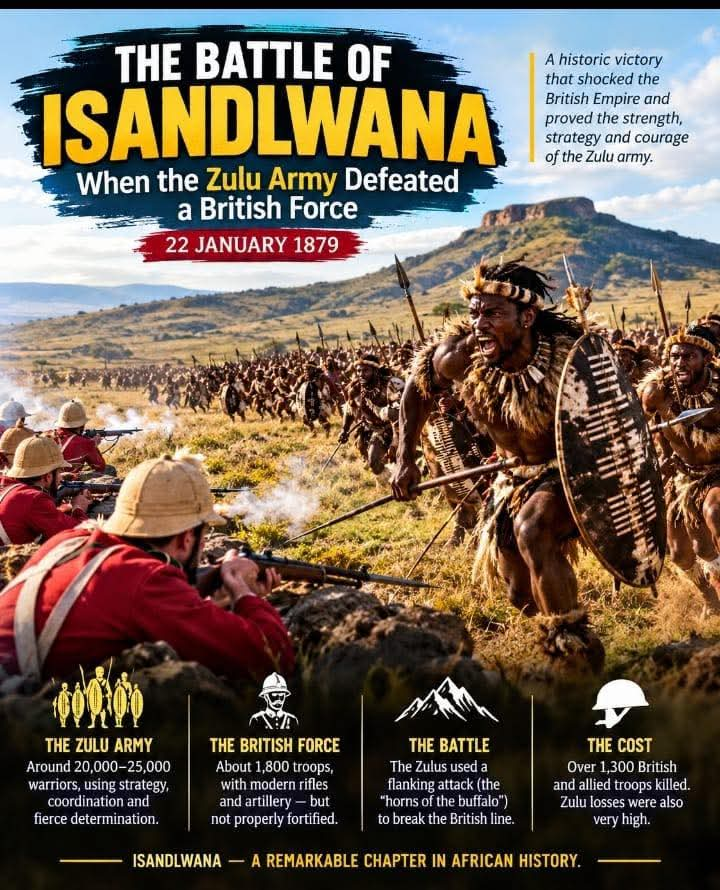
On 22 January 1879, in the shadow of Isandlwana Mountain in present-day South Africa, the Zulu army delivered a stunning defeat to British forces during the Anglo-Zulu War.
It was a battle that challenged British assumptions about African military power and became one of the most remarkable victories in African military history.
But what really happened that day? 👇
🔥 1. WHY DID THE BRITISH INVADE THE ZULU KINGDOM?
In the late 1870s, the British Empire sought greater political and territorial control in southern Africa.
The Zulu Kingdom, under King Cetshwayo kaMpande, remained an independent African state with a powerful military system. British colonial officials viewed the kingdom as an obstacle to their plans for regional federation and expansion.
In December 1878, the British presented the Zulu leadership with an ultimatum containing demands that threatened the kingdom’s independence and sovereignty.
When the ultimatum expired without the Zulu king accepting the British demands, the invasion began in January 1879.
The Zulu people were now facing an imperial power determined to force its political will upon their kingdom.
For the Zulus, this was not simply a military confrontation. It was a struggle to defend their homeland and political independence.
⚔️ 2. THE BRITISH ADVANCED WITH CONFIDENCE
The British invasion force entered Zululand under the overall command of Lieutenant-General Lord Chelmsford.
British troops possessed significant advantages, including modern rifles, artillery, and military supply systems.
Many British officers believed their weapons and training would give them a decisive advantage over the Zulu army.
However, the Zulus were not an untrained crowd of warriors.
They possessed an established military organization, experienced commanders, and a fighting tradition built around discipline, coordinated movement, and close combat.
Their forces were commanded at Isandlwana by experienced Zulu leaders, particularly Ntshingwayo kaMahole Khoza and Mavumengwana kaNdlela Ntuli, acting under King Cetshwayo’s authority.
The Zulu army also possessed some firearms, although most warriors relied primarily on traditional weapons, including the iklwa, a short stabbing spear, and the isihlangu, a shield.
The coming battle would demonstrate that military success depended on more than weapons alone.
🛡️ 3. A CRITICAL BRITISH MISTAKE
On 20 January 1879, the British established a large temporary camp near Isandlwana Mountain.
The location appeared suitable for their advance into Zululand. However, the camp was not adequately fortified, and the British failed to establish a defensive wagon laager.
On the morning of 22 January, Lord Chelmsford took a substantial part of his force away from the camp to investigate reports of nearby Zulu forces.
This left the camp’s remaining defenders under Lieutenant-Colonel Henry Pulleine, with Colonel Anthony Durnford arriving later with reinforcements.
The British were now divided, and the camp’s defensive arrangements were vulnerable.
These decisions would become important factors in the unfolding disaster.
🔥 4. THE ZULU ARMY LAUNCHES ITS ATTACK
As the battle developed, a large Zulu force emerged and advanced against the British position.
The size of the Zulu army is commonly estimated at approximately 20,000–25,000 warriors, although historical estimates vary.
The British defenders opened fire with their rifles, inflicting casualties as the Zulu warriors approached.
But the Zulu commanders employed a coordinated attack associated with the traditional izimpondo zankomo, or horns of the buffalo, formation.
The formation generally involved three elements:
🔴 The chest: The central force engaged the enemy directly.
🔴 The horns: The two flanking forces moved around the sides to encircle the opposing army.
🔴 The reserves: Additional warriors could be held back and committed when needed.
At Isandlwana, the Zulu advance and flanking movements placed increasing pressure on the British line.
The British rifle fire initially inflicted serious losses, but ammunition supply, the length of the defensive line, the terrain, and the pressure of the advancing Zulu forces all influenced the battle.
As the British position weakened, Zulu warriors pressed forward.
The defenders struggled to maintain an effective line, and their formation began to collapse.
💥 5. THE BRITISH POSITION COLLAPSED
Once the British line could no longer hold, the battle became a desperate struggle for survival.
British soldiers and African troops serving with the British force attempted to resist the advancing Zulus.
Some tried to retreat, but many were killed as the defensive position disintegrated.
By the end of the battle, the British camp had been overrun.
The Zulu army had defeated a major British force in a direct battlefield confrontation.
The scale of the defeat shocked British colonial society and challenged the widespread belief that European military superiority would guarantee victory against African armies.
It was a remarkable demonstration of how effective leadership, tactical coordination, and determination could overcome serious technological disadvantages.
🩸 6. HOW MANY PEOPLE DIED?
The battle came at a terrible human cost.
Historical records commonly report approximately 1,300 or more British-allied personnel killed, including European soldiers and African troops serving with the British force.
The National Army Museum records official casualty figures of 858 Europeans and 471 Africans killed.
Zulu losses were also severe. Estimates vary, but commonly cited figures place their dead and wounded in the thousands.
These numbers remind us that the victory was not achieved without enormous sacrifice.
Behind the military statistics were human beings: soldiers, warriors, families, and communities whose lives were permanently changed by the conflict.
The Zulu victory was historic, but it came at a devastating price.
👑 7. WHO WAS KING CETSHWAYO?
King Cetshwayo kaMpande was the ruler of the Zulu Kingdom during the war.
He inherited a kingdom with a powerful military tradition and sought to preserve its independence amid increasing British pressure.
Although he was not personally commanding the troops on the Isandlwana battlefield, the Zulu army fought under his authority.
The victory strengthened the reputation of the Zulu military and demonstrated that the kingdom could inflict a major defeat on one of the world’s most powerful empires.
However, one victory could not permanently stop Britain’s campaign.
The British regrouped, brought in reinforcements, and continued the war.
🇿🇦 8. DID THE ZULU VICTORY END THE WAR?
No. This is an important part of the story.
On the same day as the Battle of Isandlwana, another group of Zulu warriors attacked the British garrison at Rorke’s Drift.
The British defenders there successfully repelled the attack during the night of 22–23 January.
The two engagements had different outcomes: a major Zulu victory at Isandlwana and a British defensive success at Rorke’s Drift.
The British Empire subsequently reorganized its forces and resumed the invasion.
On 4 July 1879, British forces defeated the Zulu army at the Battle of Ulundi.
King Cetshwayo was eventually captured, and the Zulu Kingdom was dismantled as an independent political power.
Isandlwana was a historic Zulu victory, but it did not prevent the eventual conquest of the kingdom.
📚 9. WHY DOES THE BATTLE OF ISANDLWANA MATTER TODAY?
The Battle of Isandlwana remains significant for several reasons.
✅ It demonstrated African military capability. The Zulu army showed that African forces could organize, manoeuvre, and defeat a major imperial army in battle.
✅ It challenged colonial assumptions. The British defeat exposed the dangers of underestimating an opponent because of differences in weapons or technology.
✅ It highlighted the importance of strategy. The Zulu army’s coordinated movements and flanking attacks played a major role in its victory.
✅ It represents a struggle for sovereignty. The conflict took place within a broader British effort to extend its control over southern Africa.
✅ It preserves an important part of Zulu history. The battle remains a powerful symbol of resistance, courage, and the defence of an independent African kingdom.
The story of Isandlwana should not be reduced to a simple tale of one army defeating another. It was also part of a larger struggle over land, power, sovereignty, and the future of southern Africa.
✊ THE LESSON OF ISANDLWANA
On 22 January 1879, the Zulu army proved that the British Empire could be defeated on the battlefield.
Their victory did not end the war, and it could not ultimately prevent the destruction of the independent Zulu Kingdom.
Nevertheless, Isandlwana remains one of the most consequential African military victories of the nineteenth century.
History teaches us that no people should be underestimated simply because they possess fewer technological resources than their opponents.
The Zulu warriors who fought at Isandlwana left behind a legacy that continues to be studied and remembered.
Their story deserves to be told with historical accuracy, respect, and recognition of the sacrifices made on both sides.
━━━━━━━━━━━━━━━━━━
💬 LET’S DISCUSS IN THE COMMENTS!
The Zulu army defeated a major British force at Isandlwana despite the British Empire’s military and technological advantages.
Question: In your opinion, what contributed most to the Zulu victory—their military strategy, the leadership of their commanders, the mistakes made by the British, or the courage and determination of the Zulu warriors?
Share your thoughts below! 👇
📢 If you believe African history deserves to be told accurately and remembered by future generations, SHARE this post.

