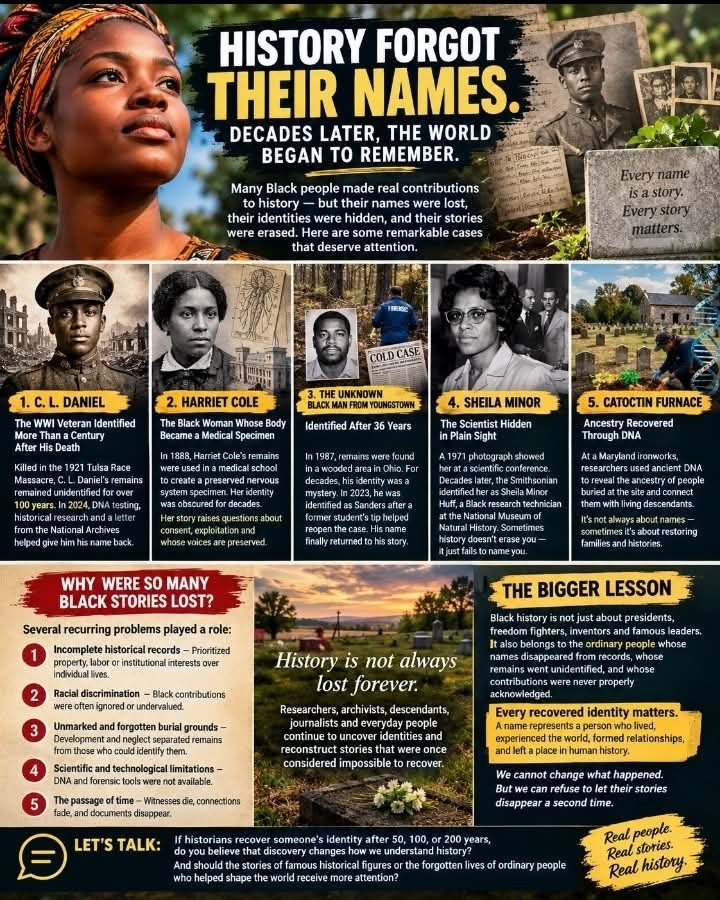
HISTORY FORGOT THEIR NAMES. DECADES LATER, THE WORLD BEGAN TO REMEMBER.
HISTORY FORGOT THEIR NAMES. DECADES LATER, THE WORLD BEGAN TO REMEMBER. 🖤📜
Imagine making a contribution to history, only for your name to disappear from the records. Imagine your remains being studied for generations while the world knows almost nothing about the person you were.
For many Black people, this is not fiction. It is part of history.
From African Americans whose remains were unidentified for decades to a scientist whose face appeared in a historical photograph without her name, these stories reveal how much of Black history remains hidden in archives, forgotten cemeteries, and incomplete historical records.
Here are some remarkable cases that deserve attention.
- C. L. DANIEL: THE WORLD WAR I VETERAN IDENTIFIED MORE THAN A CENTURY AFTER HIS DEATH
In 1921, a white mob destroyed much of Tulsa, Oklahoma’s prosperous Black community during the Tulsa Race Massacre.
Among the victims was C. L. Daniel, a World War I veteran from Georgia who was in his twenties when he was killed.
For more than a century, his family had no confirmed identification of his remains.
In 2024, investigators announced that DNA testing, combined with historical research and a letter discovered in the National Archives, had identified him among the remains recovered from a mass grave.
His identification was a significant moment for descendants seeking answers about relatives lost during the massacre.
Think about that: a man who served his country during wartime was killed in racial violence, and his identity remained unresolved for generations.
His story reminds us that recovering history is not only about discovering famous leaders. Sometimes, it means restoring a name to someone whose family never stopped needing answers.
- HARRIET COLE: THE BLACK WOMAN WHOSE BODY BECAME A MEDICAL SPECIMEN
In 1888, the remains of Harriet Cole, a 36-year-old African American woman, were delivered to the anatomy department of Hahnemann Medical College in Philadelphia.
An anatomist, Rufus B. Weaver, used her remains to create a preserved specimen of the human nervous system.
The specimen became known in medical circles, but Cole herself was largely reduced to an object of scientific interest.
Her identity as a working-class Black woman was obscured for decades.
A story later circulated claiming that she had voluntarily donated her body to medical science. However, historical researchers have questioned that account because convincing evidence of her consent has not been established.
That uncertainty matters.
During this period, Black people’s bodies were particularly vulnerable to exploitation within medical institutions, and the historical record does not always preserve their voices or choices.
Harriet Cole’s story raises a difficult question: Can scientific achievement be celebrated without honestly examining how the people behind it were treated?
Her name deserves to be remembered alongside the history of the specimen associated with her.
- THE UNKNOWN BLACK MAN FROM YOUNGSTOWN: IDENTIFIED AFTER 36 YEARS
In September 1987, a grandfather and his grandson discovered human remains in a wooded area near Youngstown, Ohio.
Investigators determined that the remains belonged to a Black man believed to have been between 30 and 44 years old.
Despite initial investigations, his identity remained unknown for decades.
Years later, Alisa Yelkin, a former student who had encountered the remains during a forensic anthropology class, came across a newspaper article about cold cases and contacted police.
Her intervention helped bring renewed attention to the case.
In 2023, authorities announced that the man had been identified as Sanders.
His story illustrates how an unresolved case can remain forgotten until someone decides to look again.
It also highlights the importance of forensic anthropology, persistent investigation, and the preservation of evidence.
For decades, he was known primarily through the circumstances of his death. Identification offered an opportunity to restore his name to the story.
- SHEILA MINOR: THE SCIENTIST HIDDEN IN PLAIN SIGHT
Sometimes, a person’s identity is not lost because nobody knows their name. Instead, the problem is that history fails to record it properly.
In 1971, a photograph was taken at a conference attended by scientists studying whale biology.
Decades later, the image circulated online, and people began asking who the lone woman visible among the male scientists was.
The Smithsonian Institution Archives investigated and identified her as Sheila Minor Huff, an African American biological research technician who worked at the National Museum of Natural History.
Her identification brought renewed attention to a Black woman whose presence in a scientific gathering had gone largely unrecognized.
Her story demonstrates something important: historical erasure does not always require someone to destroy a record.
Sometimes, a photograph survives, but the person in it remains unnamed.
When historians recover that identity, they help restore a missing piece of the story of Black participation in science.
- THE AFRICAN AMERICANS BURIED AT CATOCTIN FURNACE: ANCESTRY RECOVERED THROUGH DNA
At Catoctin Furnace in Maryland, an ironworks established in the eighteenth century, researchers investigated an African American cemetery containing the remains of people whose lives were poorly documented.
Many African Americans from this period left behind few written records, particularly when their lives were shaped by enslavement and harsh working conditions.
In 2023, researchers reported that ancient DNA analysis had helped reveal the ancestry of people buried at the site and establish connections with living descendants.
The research demonstrated how scientific methods can help recover parts of family histories that conventional documents cannot fully explain.
However, ancestry is not the same as a confirmed personal identity. DNA evidence does not automatically reveal every person’s name or complete life story.
That distinction is important.
Even when researchers cannot recover every name, they may still uncover information about ancestry, migration, family relationships, and historical experiences.
These discoveries help bring the people behind the archaeological remains back into the broader history of America.
WHY WERE SO MANY BLACK STORIES LOST?
These cases do not all have the same explanation, and they should not be treated as if they do.
However, several recurring problems have contributed to the loss of Black historical identities:
- Incomplete historical records: Enslaved people and poor Black communities were frequently documented in records that prioritized property ownership, labor, or institutional interests over individual lives.
- Racial discrimination: Black contributions to science, public life, and other fields have not always received the recognition given to their white counterparts.
- Unmarked and forgotten burial grounds: Development, neglect, and the displacement of communities have sometimes separated human remains from the people who could identify them.
- Scientific and technological limitations: Before modern DNA analysis and advanced forensic genealogy, identifying unknown remains could be extremely difficult.
- The passage of time: Witnesses die, family connections become harder to trace, and documents disappear. Every lost generation can make the search more complicated.
But history is not always lost forever.
Researchers, archivists, descendants, journalists, and ordinary people continue to uncover identities and reconstruct stories that were once considered impossible to recover.
THE BIGGER LESSON
These stories remind us that Black history is not made up only of presidents, freedom fighters, inventors, wealthy entrepreneurs, and famous leaders.
It also belongs to the ordinary people whose names disappeared from records, whose remains went unidentified, and whose contributions were never properly acknowledged.
Every recovered identity matters because a name represents more than a label.
It represents a person who lived, experienced the world, formed relationships, and left a place in human history.
We cannot change what happened to these people. But we can refuse to let their stories disappear a second time.
💬 LET’S TALK:
If historians recover someone’s identity after 50, 100, or even 200 years, do you believe that discovery changes how we understand history?
And which should receive more attention: the stories of famous historical figures or the forgotten lives of ordinary people who helped shape the world?

