
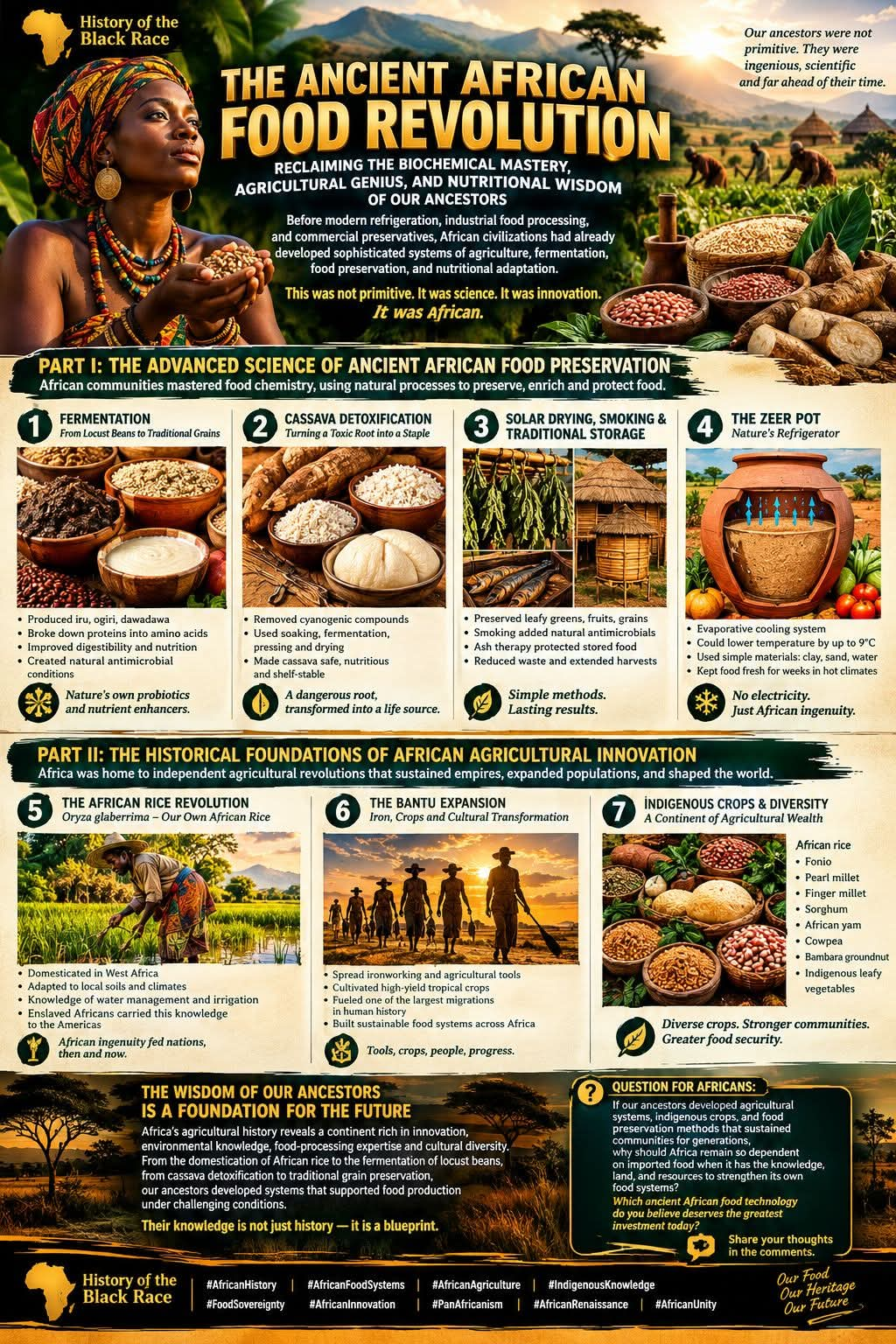
THE ANCIENT AFRICAN FOOD REVOLUTION: RECLAIMING THE BIOCHEMICAL MASTERY, AGRICULTURAL GENIUS, AND NUTRITIONAL WISDOM OF OUR ANCESTORS
THE ANCIENT AFRICAN FOOD REVOLUTION: RECLAIMING THE BIOCHEMICAL MASTERY, AGRICULTURAL GENIUS, AND NUTRITIONAL WISDOM OF OUR ANCESTORS
Before modern refrigeration, industrial food processing, and commercial preservatives, African civilizations had already developed sophisticated systems of agriculture, fermentation, food preservation, and nutritional adaptation.
For centuries, African societies maintained agricultural systems capable of sustaining communities across diverse ecological environments. From the fertile river valleys of West Africa to the highlands of Ethiopia and the agricultural landscapes of Central and Southern Africa, indigenous communities cultivated crops, preserved harvests, and developed food-processing techniques adapted to their environments.
These systems were not primitive survival strategies. They represented generations of accumulated knowledge, experimentation, environmental adaptation, and practical understanding of food chemistry.
African ancestors understood that food was not simply something to consume. It was something to cultivate, transform, preserve, and protect.
Through fermentation, drying, smoking, soaking, and traditional storage, they developed methods that reduced food waste, extended the availability of seasonal harvests, and supported communities through difficult environmental conditions.
Today, rediscovering these achievements is essential for restoring African agricultural identity and understanding the technological intelligence embedded within indigenous food traditions.
PART I: THE ADVANCED SCIENCE OF ANCIENT AFRICAN FOOD PRESERVATION
Long before commercial refrigeration, African communities developed preservation techniques that allowed them to protect food against spoilage and seasonal shortages.
These methods were adapted to tropical heat, dry environments, seasonal rainfall, and the availability of local materials.
- The Chemistry of Fermentation: From Locust Beans to Traditional Grains
One of the most remarkable achievements of African food technology was the development of traditional fermentation.
Across West Africa, communities developed fermented condiments from locust beans, including iru, ogiri, and dawadawa.
These foods are produced through microbial processes that transform the original ingredients.
During fermentation, microorganisms break down complex proteins and other compounds, producing amino acids, peptides, and characteristic flavors.
The process can improve digestibility, modify nutritional properties, and reduce certain undesirable compounds.
Traditional fermentation also creates conditions that discourage some harmful microorganisms, although its effectiveness depends on the specific food, preparation method, and storage conditions.
African grain and tuber fermentation practices demonstrate similar ingenuity.
Foods such as ogi, fermented cassava products, and Ethiopian injera illustrate how communities used microorganisms to transform agricultural ingredients into culturally significant staples.
Fermentation can reduce certain anti-nutritional factors, including phytates, under appropriate conditions. This may improve the availability of minerals such as iron and zinc.
These practices demonstrate that African communities understood the practical value of biological transformation long before modern microbiology explained the underlying mechanisms.
- Cassava Detoxification: Turning a Potentially Toxic Root into a Staple Food
Cassava is one of the most important crops in many African food systems.
However, certain cassava varieties contain cyanogenic compounds that can release hydrogen cyanide during processing and digestion.
Improperly processed cassava can therefore pose serious health risks.
African communities developed traditional processing methods that reduce these compounds and make cassava suitable for consumption.
Depending on the region and the final product, processing may involve:
- Peeling and grating.
- Soaking and fermentation.
- Pressing and dewatering.
- Roasting, boiling, or other heat treatments.
- Drying and sieving.
These methods work through several mechanisms, including the breakdown of cyanogenic compounds, the removal of soluble substances, and the release of volatile hydrogen cyanide.
The preparation of gari, fufu, and other cassava foods demonstrates the importance of understanding how processing changes the chemical properties of agricultural products.
This knowledge was essential to food security in communities where cassava became a major source of energy.
The transformation of cassava demonstrates that indigenous African food processing was not simply about preparing ingredients. It was about making them safer, more stable, and more useful.
- Solar Dehydration, Smoking, and Traditional Storage
African communities also developed preservation systems that relied on environmental conditions and locally available materials.
Solar drying reduced the moisture content of foods, making conditions less favorable for many microorganisms responsible for spoilage.
Leafy vegetables, fruits, grains, fish, and other agricultural products could be dried to extend their storage life.
Smoking provided another preservation method.
When fish and meat were exposed to controlled smoke and heat, the process could reduce moisture, slow microbial growth, and introduce compounds with antimicrobial properties.
The effectiveness of smoking depended on temperature, duration, moisture content, and storage conditions.
Traditional grain storage systems also relied on carefully constructed structures, including granaries, elevated storage facilities, and underground storage in suitable environments.
In some communities, wood ash was used in storage practices to discourage insects and help protect certain agricultural products.
These techniques reveal the ingenuity of African communities in protecting harvests against environmental challenges.
- The Thermodynamics of the Zeer Pot
One of the most remarkable examples of low-energy food preservation is the evaporative cooling system commonly known as the Zeer pot.
The system uses two porous clay pots, with a layer of wet sand between them.
As water evaporates through the outer pot, it absorbs heat from its surroundings.
This process, known as evaporative cooling, lowers the temperature inside the inner pot.
The cooling effect depends on environmental humidity, airflow, the availability of water, and the properties of the clay.
In hot, dry environments, the temperature inside the system can fall significantly below the surrounding air temperature.
Although it cannot replace refrigeration in every situation, this technology demonstrates how African communities and other societies developed practical cooling systems without electricity.
Its continued relevance is especially important in rural areas where access to reliable power remains limited.
Ancient African food technologies offer valuable lessons in energy efficiency, environmental adaptation, and sustainable resource management.
PART II: THE HISTORICAL FOUNDATIONS OF AFRICAN AGRICULTURAL INNOVATION
The history of agriculture cannot be understood through a single region or civilization.
Agricultural development occurred independently in different parts of the world, including Africa, where communities domesticated crops, developed cultivation techniques, and established systems of food production adapted to their environments.
African agricultural history deserves recognition as an important part of humanity’s broader technological development.
- The African Rice Revolution
One of Africa’s most significant agricultural achievements was the independent domestication of African rice, scientifically known as Oryza glaberrima.
This crop was domesticated in West Africa and became an important component of regional agricultural systems.
African rice was adapted to a range of local environmental conditions, including particular floodplain and upland farming environments.
Its cultivation required knowledge of rainfall patterns, soil conditions, water management, and seasonal cycles.
African farmers developed agricultural practices that supported rice production in different landscapes, including environments where managing water was essential.
During the transatlantic slave trade, Europeans forcibly transported millions of Africans from regions with established agricultural traditions.
Historical scholarship has examined the agricultural knowledge carried by enslaved Africans, particularly their expertise in rice cultivation.
In parts of the Americas, African knowledge contributed to the development of rice-growing systems, including practices involving irrigation, drainage, and field management.
However, the history of American rice agriculture also involved the contributions of Indigenous peoples, European settlers, and other groups.
Recognizing African expertise does not require ignoring these other historical contributions.
Instead, it allows us to understand the complex relationship between African agricultural knowledge, forced migration, colonial exploitation, and the development of plantation economies.
- The Bantu Expansion and Agricultural Transformation
The expansion of Bantu-speaking communities across much of Sub-Saharan Africa represents one of the most significant demographic, linguistic, and cultural transformations in African history.
Over many centuries, communities moved into different ecological environments, carrying languages, agricultural practices, and technologies.
Agriculture played an important role in this expansion, although the process also involved pastoralism, hunting, gathering, trade, and interaction with existing populations.
In many regions, ironworking contributed to the production of tools used for farming, woodworking, and other activities.
The availability of suitable agricultural tools supported cultivation in particular environments and helped communities adapt to changing landscapes.
Crop knowledge also mattered.
Communities cultivated different combinations of crops according to rainfall, soil conditions, and regional ecological characteristics.
The movement of people and agricultural knowledge helped reshape the continent’s cultural and economic geography.
This history demonstrates that African societies were active participants in technological innovation, environmental adaptation, and the development of complex agricultural systems.
- Indigenous Crops and Africa’s Agricultural Diversity
Africa’s agricultural heritage includes a remarkable range of indigenous crops.
These include:
- African rice.
- Fonio.
- Pearl millet.
- Finger millet.
- Sorghum.
- African yam.
- Cowpea.
- Bambara groundnut.
- Indigenous leafy vegetables.
Many of these crops are adapted to particular environmental conditions and have played important roles in regional food systems.
Sorghum and millet, for example, are important in areas where rainfall can be unpredictable.
Fonio has a long history of cultivation in parts of West Africa and remains an important traditional grain.
Cowpea provides both food and agricultural benefits, including its role in nitrogen fixation.
These crops represent valuable agricultural resources that can contribute to food diversity, climate adaptation, and local economic development.
Their importance should not be measured only by their historical significance.
They also deserve investment in modern research, improved processing, storage, distribution, and commercial development.
CONCLUSION: THE WISDOM OF OUR ANCESTORS IS A FOUNDATION FOR THE FUTURE
Africa’s agricultural history reveals a continent rich in innovation, environmental knowledge, food-processing expertise, and cultural diversity.
From the domestication of African rice to the fermentation of locust beans, from cassava detoxification to traditional grain preservation, African communities developed systems that supported food production under challenging environmental conditions.
These achievements deserve recognition as part of humanity’s broader history of agricultural science and technological development.
The future of African agriculture should not depend entirely on imported food, externally controlled agricultural inputs, or the continued export of raw commodities.
Africa possesses significant agricultural resources, diverse ecosystems, indigenous crops, and generations of farming knowledge.
The challenge is to transform these resources into sustainable systems that support nutrition, employment, industrial development, and national independence.
The most powerful path forward is one that combines ancestral knowledge with modern scientific understanding.
Africa must preserve the wisdom of its agricultural traditions while developing new technologies capable of meeting the demands of a changing world.
Our ancestors understood the soil. They understood the seasons. They understood how to transform nature into nourishment.
The responsibility of the present generation is to protect that knowledge, improve it through science, and pass it on to future generations.
The soil is part of our history.
The food is part of our culture.
And the ability to feed ourselves is an essential foundation of national sovereignty.
QUESTION FOR AFRICANS:
If our ancestors developed agricultural systems, indigenous crops, and food preservation methods that sustained communities for generations, why should Africa remain so dependent on imported food when it has the knowledge, land, and resources to strengthen its own food systems?


This is a fascinating and insightful exploration of Africa’s rich culinary heritage! 🌍👏 Traditional food preservation, fermentation, and indigenous farming practices demonstrate how generations of knowledge helped communities adapt to their environments and make the most of local resources. These traditions are not merely part of history; they offer valuable lessons for today’s world, especially in sustainable agriculture, reducing food waste, and preserving nutritional diversity. Our ancestors’ wisdom deserves not only to be remembered but also to be studied, respected, and passed on to future generations.
LikeLiked by 1 person