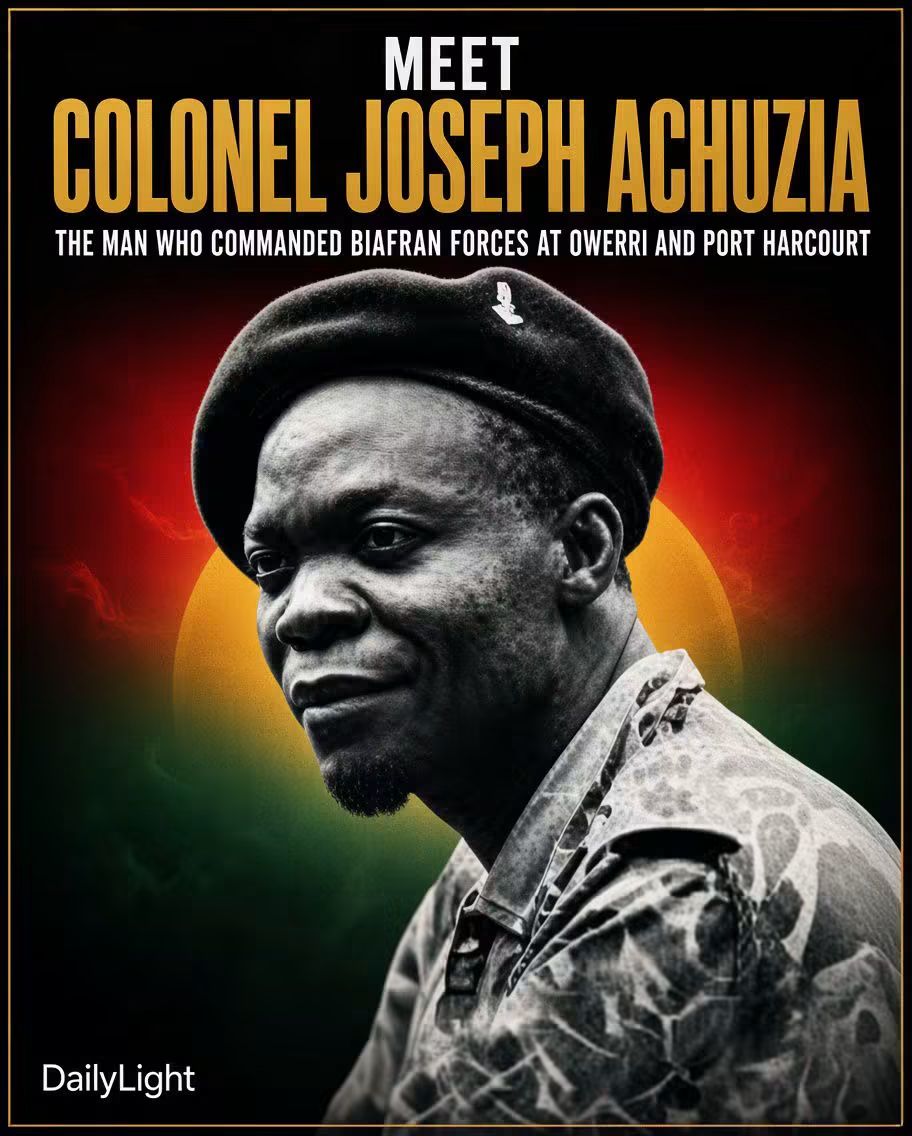
MEET COL. JOSEPH ACHUZIA: THE MAN BIAFRANS CALLED “HANNIBAL” AND “AIR RAID”
MEET COL. JOSEPH ACHUZIA: THE MAN BIAFRANS CALLED “HANNIBAL” AND “AIR RAID”
Before he became one of the most talked-about commanders of the Nigerian Civil War, Joseph Oseloka Governor Achuzia was an engineer, not a conventional career soldier.
Born in 1929, Achuzia hailed from Asaba, in present-day Delta State. He worked in Port Harcourt before the war and became associated with the Biafran cause when the conflict erupted in 1967.
His story is one of battlefield courage, daring operations, military controversy and a commitment to Biafra that continued long after the guns fell silent.
But who exactly was the man behind the nicknames?
FROM ENGINEER TO BIAFRAN COMMANDER
Achuzia’s background was unusual among the men who commanded Biafran troops.
Before the war, he operated an engineering business in Port Harcourt and was associated with engineering work connected to the petroleum industry. Some accounts describe him as British-trained in aeronautical engineering, while others emphasise his electrical engineering background.
There are also accounts that he claimed to have served during the Korean War. However, the details of his alleged British military service have not been conclusively established by the available records.
When the crisis that led to Biafra’s secession intensified, Achuzia became involved in organising a civilian militia in Port Harcourt. He subsequently joined the Biafran Army and rose rapidly through its command structure.
He would eventually become one of the best-known field commanders of the Republic of Biafra.
WHY THEY CALLED HIM “HANNIBAL”
The name “Hannibal” was a reference to Hannibal Barca, the famous Carthaginian general who fought against Rome.
For Achuzia, the nickname became associated with his aggressive battlefield tactics, rapid movements and determination to challenge advancing federal troops.
He commanded the Biafran 11th Battalion, which was initially associated with the defence of the Atani and Ndoni areas.
As the war developed, his name became increasingly associated with the fighting around Onitsha, where Biafran troops resisted repeated attempts by Nigerian federal forces to capture the strategic city.
Achuzia’s reputation grew because he was known for moving close to the fighting and taking an active role in operations rather than remaining distant from the frontline.
His admirers considered him a commander who could be trusted when the situation became desperate.
But there was another nickname that followed him throughout the war.
THE FEARED “AIR RAID”
Achuzia was also known as “Air Raid.”
Accounts differ about the origin of the name. Some connect it to his sudden appearances at battlefronts and the fear his arrival generated among troops. In an account reproduced in Chinua Achebe’s There Was a Country, Achuzia recalled returning from fighting and discovering that people were shouting “Air Raid” and running for cover because they thought an air attack was coming.
Other accounts connect the nickname to the fear he inspired among soldiers who worried about his response to disobedience, retreat or desertion.
His reputation for severe discipline became part of his military identity.
There are also serious allegations about his treatment of soldiers. A published account of his wartime recollections describes him discussing an incident in which he shot four men who refused an order to advance.
Such claims should not be treated lightly. They form part of the difficult history of military discipline during the Nigerian Civil War, when commanders faced desperate circumstances but still bore responsibility for their actions.
To some, Achuzia represented courage and determination. To others, his reputation was inseparable from fear and harsh punishment.
Both aspects deserve examination.
THE BATTLE FOR ONITSHA
Onitsha was one of the most important strategic locations in the war because of its position on the Niger River and its connections to the Biafran interior.
Nigerian forces under Colonel Murtala Mohammed attempted to capture the city, but Biafran troops mounted determined resistance.
Achuzia’s 11th Battalion became a significant part of the defence, working alongside other Biafran formations, including the 18th Battalion associated with Colonel Assam Nsudoh.
Accounts of the fighting describe coordinated counterattacks against Nigerian positions. Biafran narratives credit these operations with inflicting heavy losses on the federal forces.
Some accounts claim that most of a Nigerian division numbering approximately 5,000 men was killed or captured. That specific casualty claim is disputed and should be understood as a reported figure rather than an independently established count.
What is clear is that the struggle for Onitsha involved fierce fighting and substantial losses.
Despite the resistance, federal troops eventually captured the city in March 1968. Biafran forces were forced to withdraw and reorganise.
For Achuzia, the campaign became an important part of his reputation, but it also demonstrated the limits of what even determined field commanders could achieve against a larger military force.
THE ABAGANA AMBUSH OF 31 MARCH 1968
One of the most famous military episodes associated with Achuzia was the Abagana ambush.
On 31 March 1968, Biafran forces attacked a Nigerian military supply convoy near Abagana in present-day Anambra State.
The convoy was associated with the Nigerian 2nd Division under Murtala Mohammed. The attack caused extensive destruction, including the burning of vehicles and supplies.
Major Jonathan Uchendu is widely identified in historical accounts as the officer who led the ambush on the ground. Achuzia is credited in some accounts with a role in the wider planning or operational effort.
Popular accounts give casualty figures running into thousands, but the precise number of soldiers killed, wounded, captured or able to escape remains uncertain.
Nevertheless, Abagana became a powerful symbol of Biafran resistance because it demonstrated that federal troops and their supply lines could suffer serious setbacks.
For Biafrans who had endured repeated military advances, the ambush represented a moment of hope in an increasingly difficult war.
PORT HARCOURT: THE CITY HE COULD NOT HOLD
In May 1968, Achuzia was transferred to the Port Harcourt sector as federal forces advanced on the city.
Port Harcourt was strategically important because of its port, oil infrastructure and economic value.
The fighting was intense. Reports describe heavy bombardment and Achuzia narrowly escaping death during the campaign.
Despite the resistance, Port Harcourt fell to federal troops on 24 May 1968.
Achuzia withdrew to the Igrita area and continued fighting.
This was a major setback for Biafra. The loss of Port Harcourt deprived the secessionist state of a vital economic and logistical centre.
His admirers remember his refusal to give up easily, but the historical record also makes clear that he could not prevent the city’s capture.
THE OWERRI CAMPAIGN AND INTERNAL DISAGREEMENTS
Achuzia continued to participate in military operations as the war moved into 1969.
The struggle for Owerri became one of the major campaigns of the later stages of the conflict. Biafran forces attempted to recover territory from federal troops, and Achuzia was involved in the offensive.
Some accounts say his men advanced to within approximately one kilometre of Owerri before the assault failed to achieve its objective. The precise distance is not firmly established.
There were also disagreements among Biafran commanders over command responsibilities and military strategy.
Accounts describe a dispute involving Achuzia and Major Timothy Onwuatuegwu over control of the S Division. Achuzia briefly assumed command, but the offensive did not result in a lasting recapture of the town.
These events reveal another side of the Biafran military experience: its commanders were operating under severe pressure, with shrinking territory, shortages of supplies and disagreements over how best to defend the remaining territory.
Achuzia remained a prominent commander, but his military career was not a continuous series of victories.
THE END OF BIAFRA
By the closing months of 1969, Biafra’s military position had deteriorated dramatically.
Federal forces controlled increasing amounts of territory, and Biafran troops faced serious shortages of food, ammunition and equipment.
In January 1970, Biafra’s remaining leadership moved toward surrender.
Philip Effiong assumed responsibility for the final stages after Ojukwu left Biafra. Achuzia was among the officers associated with the closing military arrangements and the surrender process.
The war formally ended in January 1970.
For Achuzia, the defeat marked the end of his military career and the collapse of the state for which he had fought.
He had survived several of the war’s major campaigns, but survival came at the end of a conflict that had devastated communities, displaced millions and caused immense suffering.
IMPRISONMENT AND LIFE AFTER THE WAR
After the war, Achuzia was detained by Nigerian authorities and later released. Published accounts differ about the precise length of his detention.
He subsequently returned to civilian life and remained an influential public figure.
He wrote Requiem Biafra, published by Fourth Dimension Publishers in 1986. The book recounts aspects of his wartime experience and provides his perspective on the military operations in which he participated.
Like every participant’s memoir, it is an important historical source that should also be read alongside other accounts of the war.
Achuzia later became involved in Igbo socio-cultural affairs and served as secretary-general of Ohanaeze Ndigbo.
He was also known by the traditional title Ikemba of Asaba Kingdom.
His public life after the war showed that his involvement in Igbo affairs did not end with the surrender of Biafra.
HIS VIEWS ON BIAFRA DID NOT DISAPPEAR
Achuzia continued to speak publicly about the war, the treatment of the Igbo and the political questions that remained unresolved in Nigeria.
He expressed support for the recognition of Biafra’s historical experience and was sympathetic to the aspirations of pro-Biafra movements.
However, his views should not be confused with unquestioning support for every action taken by every separatist organisation. Published accounts indicate that he disagreed with some methods associated with Nnamdi Kanu and IPOB.
He remained a veteran of the war who believed that the experiences and grievances of his people deserved to be acknowledged.
His later political views were part of a much longer public life shaped by the conflict of 1967–1970.
THE DEATH OF COLONEL JOE ACHUZIA
Colonel Joseph Oseloka Governor Achuzia died on 26 February 2018 at the Federal Medical Centre in Asaba, Delta State.
His son, Benedict Onyeka Achuzia, confirmed the death.
He was generally reported to have been 89, although some newspapers described him as 90.
Tributes followed from former associates, political figures and Igbo organisations. Supporters remembered him as a courageous Biafran commander, a defender of his people and a man who continued to speak about their interests long after the war.
Others remembered the controversial side of his military reputation, including the allegations of severe punishment and violence associated with the name “Air Raid.”
His story therefore cannot be reduced to a simple tale of heroism or brutality.
He was a civilian engineer who became a battlefield commander, a man admired by some and feared by others, a participant in a devastating civil war, and a public figure who continued to influence discussions about the Igbo and Biafra after the fighting ended.
His memoir, Requiem Biafra, remains one of the sources through which future generations can examine his own account of that history.
Colonel Joe Achuzia is gone, but the questions surrounding his military career, his conduct and the war he fought in remain part of Nigeria’s difficult history.
His story is a reminder that history must preserve both the courage people remember and the difficult questions their actions leave behind.

