THE NYA-BINGHI CONTROVERSY: HOW EUROPEAN PROPAGANDA, AFRICAN RESISTANCE, AND JAMAICAN RELIGIOUS THOUGHT SHAPED EARLY RASTAFARI
THE NYA-BINGHI CONTROVERSY: HOW EUROPEAN PROPAGANDA, AFRICAN RESISTANCE, AND JAMAICAN RELIGIOUS THOUGHT SHAPED EARLY RASTAFARI
A Historical Examination of Leonard Percival Howell, Emperor Haile Selassie I, and the Origins of Nya-Binghi in Jamaica
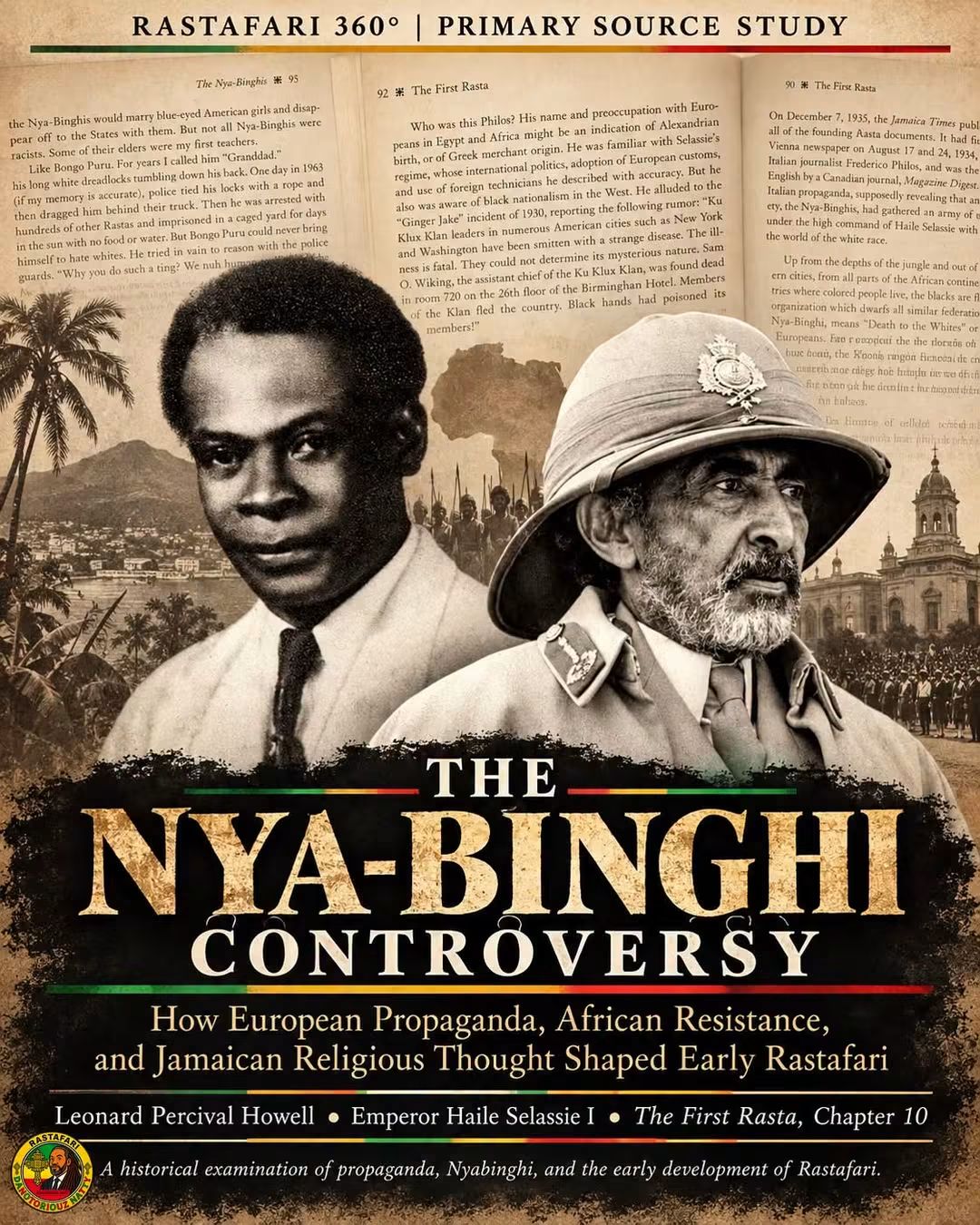
Based on Hélène Lee’s The First Rasta: Leonard Howell and the Rise of Rastafarianism, Chapter 10, pages 89–96, with supporting historical research.
⸻
INTRODUCTION: THE HISTORY MANY RASTAFARI HAVE NEVER EXAMINED
The history of RasTafari is considerably more complex than the popular narratives repeated within the movement today.
Its beginnings involved African liberation, Jamaican colonial oppression, biblical interpretation, Ethiopian sovereignty, religious experimentation, and competing understandings of Emperor Haile Selassie I.
One of the most revealing accounts appears in Hélène Lee’s historical biography The First Rasta: Leonard Howell and the Rise of Rastafarianism.
Chapter 10, titled “The Nya-Binghis,” examines how an extraordinary story circulated through European and Jamaican newspapers during the 1930s, portraying Emperor Haile Selassie I as the supreme commander of a secret African organization supposedly preparing a worldwide racial war.
What makes this account important is not simply the sensational nature of the allegations.
It is the historical question they raise:
How much of what early Jamaican RasTafari adherents believed about Emperor Haile Selassie I came from the Emperor himself, and how much originated in the interpretations, political agendas, and religious imaginations of others?
To answer that question, we must distinguish historical evidence from propaganda, African religious traditions from European representations of them, and the teachings of RasTafari founders from the documented Christian faith of the Ethiopian Emperor.
- ETHIOPIA, ITALIAN AGGRESSION, AND THE RISE OF AFRICAN SOLIDARITY
During the 1930s, Ethiopia occupied an extraordinary position in the consciousness of African-descended people throughout the world.
Although the country had experienced foreign intervention and territorial losses, Ethiopia remained a sovereign African empire that had famously defeated an Italian invasion at the Battle of Adwa in 1896.
For Africans living under colonial domination, Ethiopia represented something powerful: the possibility of African political independence and resistance to European imperialism.
When Benito Mussolini’s Fascist government intensified its expansionist ambitions against Ethiopia, African-descended communities in Jamaica, the United States, the Caribbean, and elsewhere followed the developing crisis closely.
The Walwal confrontation of December 1934 escalated tensions between Italy and Ethiopia.
On October 3, 1935, Italian forces launched their full-scale invasion.
The aggression provoked protests, organized solidarity, fundraising, and demands among some African-descended communities to participate directly in Ethiopia’s defense.
Leonard Percival Howell and his followers interpreted the Ethiopian crisis through their understanding of biblical prophecy and African redemption.
However, Ethiopia’s struggle against Italian colonial aggression must not be confused with an alleged Ethiopian campaign to exterminate Europeans.
Defending Ethiopia’s sovereignty and advocating racial warfare were fundamentally different political objectives.
- THE FEDERICO PHILOS ARTICLE: AN ALLEGED AFRICAN CONSPIRACY
According to Hélène Lee, an article attributed to journalist Federico Philos appeared in a Vienna newspaper on August 17 and 24, 1934.
Lee states that it subsequently appeared in English through the Canadian publication Magazine Digest and was reproduced by the Jamaica Times on December 7, 1935.
The article described an alleged organization called Nya-Binghi, supposedly consisting of millions of Africans secretly organizing to eliminate European influence through violent racial warfare.
It further alleged that Emperor Haile Selassie I had been selected as the organization’s supreme commander.
The article also portrayed the Emperor as a messianic figure whom Africans worshipped as divine.
These were claims made about the Emperor—not statements originating from him.
Lee interprets the article as a deliberate exercise in European racial propaganda.
Its alleged conspiracy transformed African resistance to colonialism into the frightening image of an international racial uprising directed against European civilization.
Such a narrative could serve Fascist interests by portraying Italian aggression against Ethiopia as a defensive response to an imagined African threat.
Nevertheless, a distinction must be maintained between Lee’s interpretation and what has been independently demonstrated.
The chapter provides a specific publication trail that researchers can investigate. The surviving original newspaper articles, their translations, and their editorial circumstances should be examined before the full chain of transmission is treated as conclusively established.
What the reproduced material does not establish is that Haile Selassie accepted command of the alleged organization or endorsed its racial program.
Political propaganda about an emperor cannot be substituted for the emperor’s own words.
- NYABINGHI EXISTED IN AFRICA BEFORE THE EUROPEAN PROPAGANDA
There is another essential historical distinction.
Nyabinghi was not simply a name invented by Italian journalists.
Historical scholarship documents Nyabinghi, also spelled Nyabingi or Nyavingi, as an African spiritual tradition associated with the Great Lakes region, particularly the areas of present-day Rwanda, Uganda, and eastern Democratic Republic of the Congo.
The tradition involved spiritual authority, ritual practice, and, in certain circumstances, resistance to established political and colonial power.
One important historical figure was Muhumuza, a woman associated with Nyabinghi religious authority and resistance to European colonial domination in the early twentieth century.
She mobilized support in the Rwanda-Uganda borderlands and was eventually captured by British colonial forces in 1911.
Her story demonstrates that Nyabinghi had an authentic African history independent of the sensationalized European allegations of the 1930s.
Consequently, three different developments must be distinguished:
- The African Nyabinghi spiritual tradition and its historical connections to political resistance.
- The European newspaper narratives depicting an international African racial conspiracy.
- The subsequent adoption and reinterpretation of Nya-Binghi within Jamaican RasTafari culture.
These developments were related through the movement of names, ideas, and representations, but they were not identical.
Nor can the later Jamaican Nya-Binghi movement be regarded as merely an unchanged continuation of the earlier Great Lakes tradition.
- LEONARD PERCIVAL HOWELL AND THE EARLY THEOLOGY OF RASTAFARI
Leonard Percival Howell was among the earliest and most influential advocates of RasTafari in Jamaica.
Born in 1898, Howell came from an Anglican family background and later encountered a broad range of religious and political ideas.
His experiences included travel outside Jamaica, exposure to Black nationalist thought, and involvement in the intellectual environment from which early RasTafari emerged.
Following the coronation of Ras Tafari Makonnen as Emperor Haile Selassie I on November 2, 1930, Howell became a prominent preacher of the belief that the Ethiopian Emperor possessed messianic significance.
Other early figures, including Joseph Nathaniel Hibbert and Archibald Dunkley, also advanced religious interpretations of Haile Selassie’s kingship.
These preachers did not represent a single, centralized religious institution.
They operated among different communities and sometimes developed competing interpretations.
In Chapter 10, Lee describes how the Nya-Binghi narrative gained prominence among certain Jamaican adherents.
She suggests that the Philos article may have influenced some of these developments.
However, she also acknowledges uncertainty about Howell’s direct contact with the alleged African organization.
This uncertainty is important.
It would be historically irresponsible to claim that Howell belonged to a secret African Nyabinghi society without establishing documentary evidence of such membership.
What can be established more confidently is that early RasTafari theology developed through the interpretations of Jamaican religious figures rather than through theological instructions issued by Emperor Haile Selassie I.
- WAS EARLY RASTAFARI A RELIGION OF RACIAL HATRED?
One of the most revealing parts of Lee’s account appears on pages 94 and 95.
She distinguishes Howell’s teachings from the racial hostility adopted by certain Nya-Binghi adherents.
According to her account, some elders displayed prejudice against lighter-skinned individuals, and she records examples of exclusion based on complexion.
She also describes hostility toward interracial marriage alongside contradictory behavior among individuals who practiced it.
Such accounts challenge the romanticized assumption that every early RasTafari community consistently practiced universal brotherhood.
However, Lee does not portray all Nya-Binghi elders as racists.
She recalls an elder known as Bongo Puru, who reportedly suffered serious mistreatment by Jamaican police yet refused to develop hatred toward white people.
His humanity left a lasting impression on her.
These accounts reveal something fundamental:
RasTafari has never been a movement in which every adherent shared precisely the same attitudes toward race, religion, or humanity.
Some interpreted liberation through racial exclusivism.
Others emphasized dignity, compassion, spiritual renewal, and freedom from oppression.
These competing tendencies belong to the history of RasTafari and should be examined rather than concealed.
The struggle against racism does not become more legitimate when racial hatred is directed toward a different population.
- MARCUS GARVEY, AFRICAN REDEMPTION, AND THE PROBLEM OF CONFLATING IDEOLOGIES
Marcus Mosiah Garvey’s influence on the social and political environment of early RasTafari cannot be overlooked.
Garvey advocated African dignity, self-determination, economic independence, and the rebuilding of political confidence among people of African descent.
His movement provided an important ideological context for the emergence of RasTafari.
Nevertheless, Garvey’s political philosophy, Howell’s religious teachings, and the racial conspiracy presented by Philos must be evaluated separately.
Garvey’s historical positions on race, segregation, and interracial marriage require critical examination in their own right.
They should not be simplified into modern concepts that obscure their historical setting.
Likewise, Howell’s message concerning African redemption must be analyzed through his writings and documented statements rather than through assumptions about what every early Rasta believed.
The same standard applies to Emperor Haile Selassie I.
He was an Ethiopian monarch with his own political responsibilities, Christian faith, diplomatic objectives, and understanding of international affairs.
He cannot be reduced to a theological symbol constructed by observers in Jamaica or elsewhere.
- HAILE SELASSIE I: THE CHRISTIAN EMPEROR VERSUS THE IMAGE CREATED BY OTHERS
This is perhaps the most consequential historical distinction.
Emperor Haile Selassie I was a baptized and practicing member of the Ethiopian Orthodox Tewahedo Church.
His public life included the defense of the Ethiopian Church, engagement with Christian leaders, and repeated expressions of Christian faith.
His imperial title, Defender of the Faith, belonged to this Ethiopian Christian political and religious tradition.
Yet outside Ethiopia, some early RasTafari preachers interpreted his coronation and biblical titles as evidence that he was God incarnate or the returned Messiah.
Those interpretations became foundational within important strands of RasTafari religious thought.
But a belief about a historical person is not automatically a belief held by that historical person.
There is a fundamental difference between:
What Howell proclaimed about Haile Selassie I and what Haile Selassie I proclaimed about Jesus Christ.
The Emperor’s own statements must be examined independently.
In his Christian witness, he identified himself with the faith of the Ethiopian Orthodox Church and upheld the teachings of Jesus Christ.
The fact that certain Jamaican adherents worshipped Haile Selassie does not establish that he taught them to worship him.
Nor does his defense of African sovereignty establish that he endorsed racial separatism or hostility toward Europeans.
For a serious historical study, these distinctions are essential.
- HAILE SELASSIE’S ACTUAL RESPONSE TO EUROPEAN AGGRESSION
The clearest comparison with the alleged secret racial-war narrative can be found in the Emperor’s documented diplomatic activities.
On June 30, 1936, Emperor Haile Selassie I addressed the League of Nations in Geneva after the Italian invasion and occupation of much of Ethiopia.
He appealed for international justice, collective security, and the enforcement of treaty obligations.
His arguments concerned the rights of sovereign nations and the responsibilities of the international community.
He did not present himself as the supreme commander of a secret organization seeking racial extermination.
His appeal rested on the principle that aggression against one nation threatened the security of others.
This address survives as a primary historical document.
The Library of Congress preserves a version containing the Amharic original and French translation.
When the Emperor’s documented international diplomacy is compared with the narrative attributed to Philos, the contrast is striking.
One presents Ethiopia’s sovereign ruler demanding justice through international institutions.
The other portrays him as the leader of an alleged worldwide racial conspiracy.
The historical record demands that these narratives remain separate.
- HOWELL’S RELIGIOUS DEVELOPMENT: CHRISTIAN, HINDU, AND AFRICAN INFLUENCES
Another important passage appears on page 96.
Lee states that Leonard Howell transformed himself into a Hindu mystic, associating this development with the name Gangunguru Maragh.
This passage leads into Chapter 11, “The Hindu Legacy.”
Howell’s use of an Indian religious name and his engagement with Hindu-influenced ideas complicate the assumption that early RasTafari emerged exclusively from one religious tradition.
His background included Anglican Christianity, while his later teaching environment incorporated biblical interpretation, Ethiopianism, African redemption, Black nationalism, and influences encountered across the Caribbean’s multicultural religious landscape.
The Indian religious traditions present in Jamaica formed part of that environment.
However, an author’s description of Howell as a Hindu mystic should not automatically be treated as proof of formal conversion to Hinduism.
It points instead toward a broader process of religious adaptation and reinterpretation that deserves investigation through Howell’s own writings and contemporary testimony.
This is another reason the historical beliefs of Howell must not be confused with those of Haile Selassie.
The Emperor’s religious background was rooted in Ethiopian Orthodox Christianity, while Howell’s religious development occurred in a very different Jamaican and transnational environment.
- IMPORTANT CORRECTIONS TO THE HISTORICAL RECORD
Although Hélène Lee’s work is valuable, it is not beyond criticism.
Page 89 contains two significant chronological errors.
First, the book identifies December 5, 1934, as the date of the Italian invasion of Ethiopia.
The major invasion actually began on October 3, 1935.
The December 1934 confrontation at Walwal was a precursor to the war.
Second, the chapter’s chronology places Haile Selassie’s celebrated League of Nations appeal before August 1935.
The address was delivered on June 30, 1936.
These errors matter because the timing of newspaper reports, political propaganda, and Ethiopian diplomatic events is central to understanding how early RasTafari ideas developed.
Another assertion requiring independent verification is Lee’s characterization of Haile Selassie’s racial self-understanding on page 94.
An author’s interpretation of Ethiopian elite identity is not equivalent to a documented personal statement by the Emperor.
Historians must distinguish between direct evidence, retrospective testimony, and interpretation.
Respect for an important historical work does not require accepting every claim without scrutiny.
- WHY THIS HISTORY MATTERS TO MODERN RASTAFARI
Today, discussions about RasTafari frequently treat the movement as though its beliefs were fixed from the beginning.
The historical evidence suggests otherwise.
Early RasTafari was shaped by several overlapping developments: Ethiopian sovereignty, African nationalism, Jamaican colonial society, biblical prophecy, charismatic preaching, and the circulation of international newspaper reports.
Different communities interpreted those developments in different ways.
Some ideas emerged from legitimate African anticolonial struggles.
Others developed through Jamaican reinterpretations of biblical and political events.
Still others may have been influenced by sensationalized or hostile European representations of African movements.
This does not invalidate the history of RasTafari.
It makes that history more complex—and more deserving of rigorous study.
However, a movement committed to African dignity and historical consciousness should also be willing to examine the documentary origins of its own doctrines.
The central question is not simply what RasTafari adherents believe today.
It is whether those beliefs can be traced to reliable historical sources, and whether statements attributed to Emperor Haile Selassie I reflect what he actually said.
Veneration, religious interpretation, historical documentation, and divine worship are four different categories. They should not be confused.
CONCLUSION: HISTORY MUST TAKE PRECEDENCE OVER MYTHOLOGY
The significance of Chapter 10 of The First Rasta lies in its examination of how an African spiritual name, European racial propaganda, Jamaican anticolonial consciousness, and competing religious interpretations became entangled during the movement’s formative years.
The chapter does not prove that all Nya-Binghi traditions originated in Italian propaganda.
Nor does it establish that every early Rasta embraced racial hatred.
It does, however, challenge the assumption that every idea associated with early RasTafari originated with Emperor Haile Selassie I.
Leonard Percival Howell was a historically important Jamaican religious leader.
Marcus Garvey was a major architect of modern Pan-African political consciousness.
The African Nyabinghi tradition had a history predating both men.
Federico Philos’s reported newspaper narrative belongs to the history of European representations of Africa and the politics of colonial aggression.
And Emperor Haile Selassie I was an Ethiopian sovereign whose own Christian faith, speeches, writings, and actions must be examined on their own terms.
These historical subjects intersected, but they were not identical.
The study of RasTafari is best served by recognizing those distinctions.
Emperor Haile Selassie I should be understood first through his own documented words and actions—not exclusively through the theology that others constructed around his identity.
That is not a rejection of African redemption or RasTafari history.
It is a demand for historical accuracy.
⸻
REFERENCES AND FURTHER READING
- Lee, Hélène. The First Rasta: Leonard Howell and the Rise of Rastafarianism. Translated by Lily Davis. Edited and introduced by Stephen Davis. Chicago: Lawrence Hill Books, 2003. Chapter 10, pp. 89–96.
- Haile Selassie I. Speech at the Assembly of the League of Nations, June 30, 1936. League of Nations Archives; preserved through the Library of Congress, World Digital Library Collection. https://www.loc.gov/item/2021667904/
- Packard, Randall M. “Chiefship and the History of Nyavingi Possession among the Bashu of Eastern Zaire.” Africa. Historical research on the Nyavingi spiritual tradition and the politics of the African Great Lakes region.
- Vokes, Richard. Ghosts of Kanungu: Fertility, Secrecy and Exchange in the Great Lakes of East Africa. Boydell & Brewer, 2009. Discussion of Nyabingi, Muhumuza, and anticolonial religious mobilization.
- “The Suppression of Leonard Howell in Late Colonial Jamaica, 1932–1954.” New West Indian Guide, vol. 87, nos. 1–2. Research examining colonial opposition to Howell and the early RasTafari movement.
- “Rastafari: Alternative Religion and Resistance against ‘White’ Christianity.” Études caribéennes. Research on early RasTafari theology, Jamaican religious culture, and the roles of Howell, Hibbert, Dunkley, and other founders.
Research note: The account of Federico Philos and the reported 1934–1935 newspaper publication sequence is drawn from Lee’s secondary historical study. The original newspaper issues have not been independently examined for this article. They should be consulted before claims about the author’s intentions or the article’s precise transmission are considered definitively established.

