H.I.M. EMPEROR HAILE SELASSIE I: THE 334TH KING OF ETHIOPIA
🇪🇹 H.I.M. EMPEROR HAILE SELASSIE I: THE 334TH KING OF ETHIOPIA
The Ancient Ethiopian Royal Succession — From Ori to Haile Selassie I
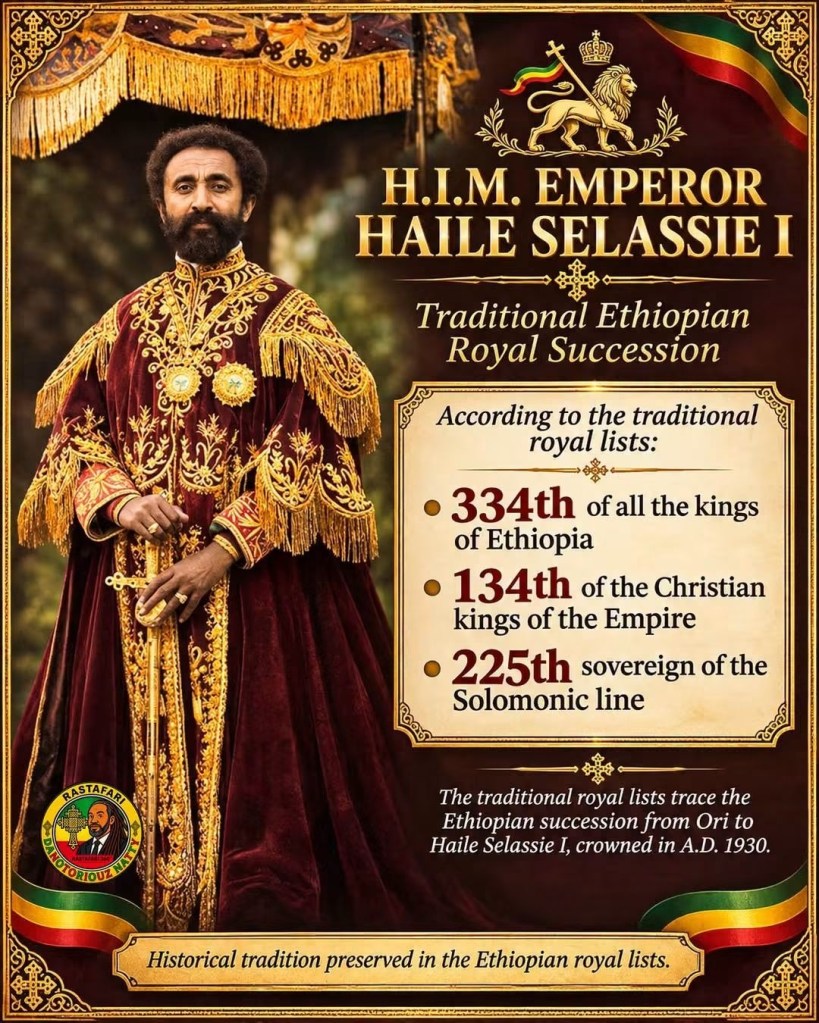
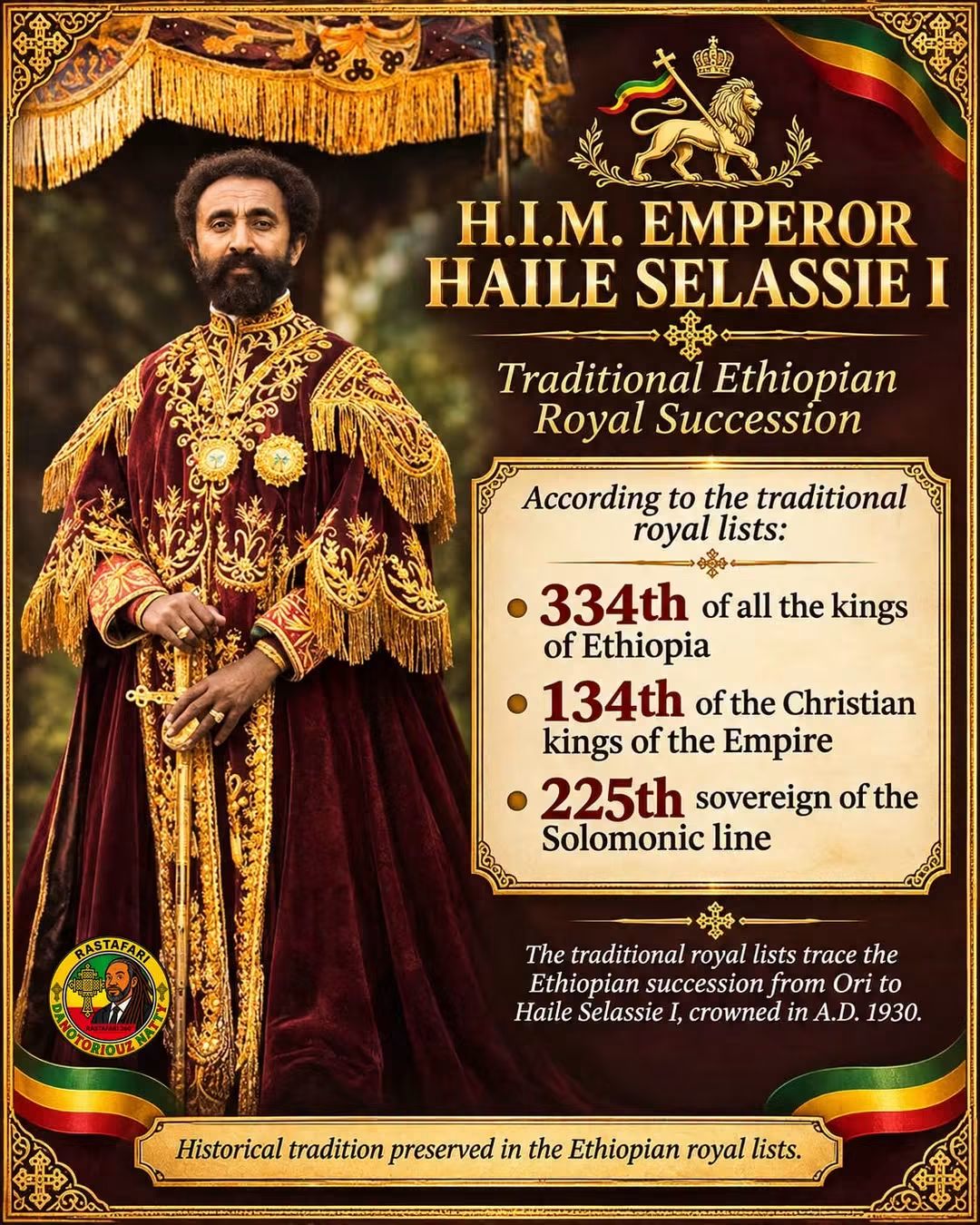
According to Ethiopia’s traditional royal lists, His Imperial Majesty Emperor Haile Selassie I (1892–1975) occupied a distinguished position in one of the world’s most ancient royal traditions.
The Ethiopian royal chronology identifies His Imperial Majesty as:
👑 The 334th King of Ethiopia — Counting the traditional succession of Ethiopian sovereigns beginning with Ori, whose reign is placed in the fifth millennium B.C.
✝️ The 134th Christian King of the Ethiopian Empire — Reflecting the succession of Christian monarchs following the establishment of Christianity as the religion of the Kingdom of Aksum during the fourth century A.D.
🦁 The 225th Sovereign of the Solomonic Line — According to the dynastic tradition tracing Ethiopia’s imperial lineage to Menelik I, traditionally identified as the son of King Solomon of Israel and Queen Makeda, the Queen of Sheba.
📜 THE ROYAL LIST OF 1922
On June 19, 1922, Ras Tafari Makonnen, eight years before his coronation as Emperor Haile Selassie I, provided British author Charles F. Rey with a traditional chronological list of Ethiopian rulers.
Rey subsequently published the material in his 1927 book, In the Country of the Blue Nile.
The chronology extended from the ancient ruler Ori, traditionally dated to approximately 4470 B.C., through successive Ethiopian dynasties. It included a chronological interruption associated with the biblical Deluge and the fall of the Tower of Babel.
This document is particularly significant because it preserves a version of Ethiopia’s royal historical tradition transmitted by the future Emperor himself.
🇪🇹 THE SOLOMONIC DYNASTY
Ethiopian imperial tradition identifies Menelik I as the founder of the Solomonic royal lineage.
The Kebra Nagast (Glory of the Kings), an important Ethiopian literary and religious work, preserves the narrative connecting the Ethiopian monarchy with King Solomon, Queen Makeda, and the Ark of the Covenant.
This tradition became fundamental to the monarchy’s understanding of its sacred history, legitimacy, and continuity.
The 1931 Constitution of the Ethiopian Empire formally recognized Haile Selassie I’s imperial succession through the dynasty traditionally traced to Menelik I.
⚖️ TRADITION AND DOCUMENTED HISTORY
Historical accuracy requires distinguishing traditional royal chronology from independently verified historical evidence.
The earliest rulers recorded in Ethiopia’s traditional royal lists, including those assigned to the fifth millennium B.C., cannot all be substantiated through archaeology or contemporary written records.
Likewise, the claimed genealogical connection between the Ethiopian imperial dynasty and King Solomon belongs to Ethiopia’s longstanding dynastic tradition rather than an independently demonstrated biological genealogy.
Nevertheless, these traditions are essential to understanding how the Ethiopian monarchy preserved and interpreted its historical identity across generations.
👑 THE CORONATION OF 1930
On November 2, 1930, Tafari Makonnen was crowned Emperor Haile Selassie I, King of Kings of Ethiopia, alongside Empress Menen Asfaw.
His coronation took place within the Christian religious traditions of the Ethiopian Orthodox Tewahedo Church.
His Imperial Majesty’s imperial title, Conquering Lion of the Tribe of Judah, Elect of God, King of Kings of Ethiopia, reflected the biblical symbolism and historical traditions associated with the Ethiopian Crown.
Haile Selassie I did not invent Ethiopia’s ancient royal traditions. He inherited a monarchy whose historical identity, Christian faith, and dynastic legitimacy had developed over many centuries.
Understanding His Imperial Majesty requires studying both the documented history of Ethiopia and the royal traditions through which successive generations understood their civilization.
📚 HISTORICAL REFERENCES
- Charles F. Rey, In the Country of the Blue Nile (1927).
- The Kebra Nagast (Glory of the Kings).
- The Constitution of the Empire of Ethiopia (1931), Article 3.
- Traditional Ethiopian Royal Lists, including the chronology supplied by Ras Tafari Makonnen in 1922.