MUAMMAR GADDAFI: WHEN FASHION BECAME A WEAPON OF AFRICAN RESISTANCE AGAINST WESTERN DOMINANCE
MUAMMAR GADDAFI: WHEN FASHION BECAME A WEAPON OF AFRICAN RESISTANCE AGAINST WESTERN DOMINANCE
For more than four decades, Muammar Gaddafi, Libya’s former leader, commanded international attention not only through his political decisions but also through his extraordinary fashion choices. His colourful military uniforms, traditional African and Arab garments, and shirts displaying historical revolutionary figures made him one of the most visually distinctive leaders in modern political history.
However, behind his unusual appearance was something deeper than fashion. Gaddafi understood that clothing could communicate political messages, challenge established narratives, and express resistance against Western cultural and political influence.
HONOURING AFRICA’S REVOLUTIONARY LEADERS
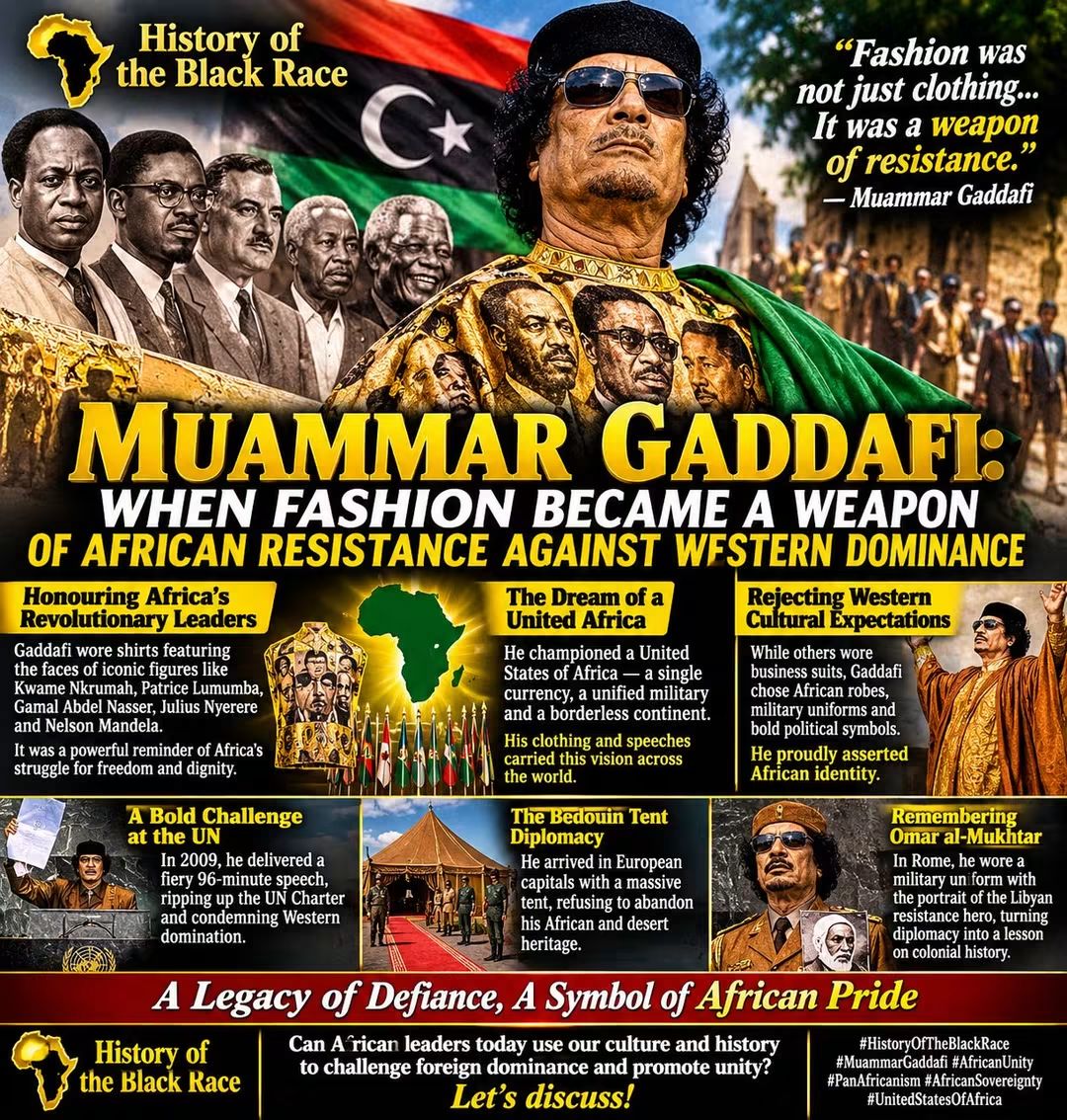
Gaddafi frequently appeared wearing garments displaying portraits of influential African and anti-colonial leaders, including Kwame Nkrumah of Ghana, Patrice Lumumba of the Congo, Gamal Abdel Nasser of Egypt, Julius Nyerere of Tanzania, and Nelson Mandela of South Africa.
These figures represented different struggles for independence, sovereignty, African unity, and resistance against colonial domination.
By displaying their images, Gaddafi publicly associated himself with the legacy of anti-colonial movements. His clothing became a political statement, reminding audiences of Africa’s historical struggles and the leaders who challenged foreign domination.
FASHION AND THE DREAM OF A UNITED AFRICA
One of Gaddafi’s most ambitious political projects was the creation of a United States of Africa.
He advocated for a continent with stronger political integration, a common African currency, greater economic independence, and a unified military structure.
During the 2007 African Union Summit in Ghana, Gaddafi strongly promoted his vision of continental unity.
His clothing, speeches, and public appearances reinforced this message. He wanted Africans to think beyond colonial borders and recognise the strength that could come from political and economic cooperation.
Although his proposed model of African unity was controversial and faced considerable opposition, his campaign brought the question of continental integration back into international political discussions.
REJECTING WESTERN CULTURAL EXPECTATIONS
Gaddafi rarely followed conventional Western diplomatic fashion.
While many world leaders appeared in standard business suits, he frequently chose colourful traditional garments, military uniforms, and specially designed clothing carrying political symbols.
His appearance communicated an image of independence and resistance to cultural conformity.
Whether deliberately or symbolically, he used his clothing to remind the world that African and Arab leaders did not have to abandon their cultural identities to participate in international diplomacy.
THE UNITED NATIONS: A DIRECT CHALLENGE TO WORLD POWER
In September 2009, Gaddafi made his first appearance before the United Nations General Assembly in New York.
Instead of delivering a conventional diplomatic speech, he spoke for approximately 96 minutes, far exceeding the allocated speaking time.
He criticised the structure of the United Nations, particularly the permanent membership and veto powers of the Security Council, arguing that the international system was dominated by a handful of powerful countries.
He also raised questions about colonialism, international inequality, and compensation for historical injustices committed against Africa.
His speech was controversial, dramatic, and widely discussed. But it demonstrated his determination to challenge the existing international order on one of the world’s most prominent diplomatic stages.
THE BEDOUIN TENT: DIPLOMACY WITHOUT CULTURAL SURRENDER
Another distinctive feature of Gaddafi’s international visits was his preference for traditional Bedouin tent accommodation.
During several foreign visits, including trips to European capitals, he arranged for his tent to be erected rather than simply adopting the conventional lifestyle of visiting heads of state.
The tent became part of his international political identity.
It symbolised his connection to desert traditions, Libyan heritage, and his refusal to completely abandon his preferred cultural identity when visiting powerful Western nations.
His diplomatic style was unusual, but it ensured that his presence was rarely forgotten.
REMEMBERING OMAR AL-MUKHTAR IN ROME
One of Gaddafi’s most powerful symbolic gestures occurred during his 2009 visit to Italy.
He arrived wearing a military uniform with a photograph of Omar al-Mukhtar attached to his chest.
Omar al-Mukhtar was the legendary Libyan resistance leader who fought Italian colonial occupation and was executed by Italian authorities in 1931.
By wearing his portrait during an official visit to Italy, Gaddafi brought the memory of colonial violence directly into the diplomatic relationship between the two countries.
The message was unmistakable: historical injustices should not be erased simply because political relationships have changed.
It was a powerful moment of historical symbolism.
THE LEGACY: MORE THAN JUST CLOTHING
Muammar Gaddafi was a controversial leader whose political legacy remains deeply debated. His government was authoritarian, and his record cannot be separated from the serious abuses and conflicts associated with his rule.
Nevertheless, his use of clothing, cultural symbolism, and theatrical diplomacy remains an interesting example of how political leaders can use personal image to communicate ideological messages.
He understood that diplomacy was not always conducted through documents, speeches, and agreements. Sometimes, a uniform, a portrait, a traditional garment, or even a tent could communicate a political message.
Whether people admired him or opposed him, Gaddafi knew how to make the world pay attention.
A QUESTION FOR AFRICANS:
Can you imagine more African leaders today using their cultural identity, historical symbols, and political influence to challenge foreign dominance and promote genuine African unity?
Or has Africa become too comfortable adopting the political and cultural expectations of others?
Let’s discuss.

