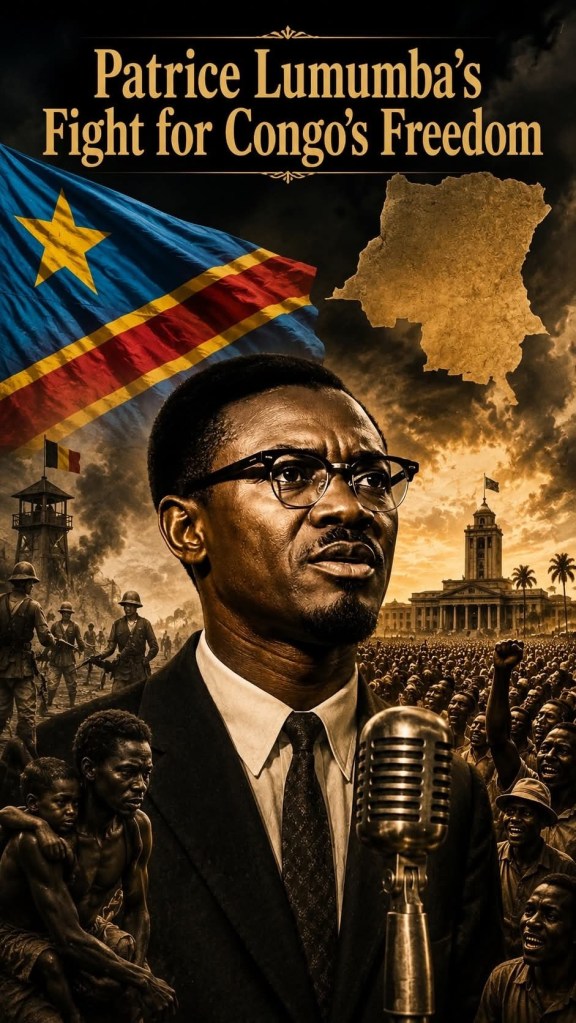
The Man They Feared: Patrice Lumumba’s Fight for Congo’s Freedom”
The Man They Feared: Patrice Lumumba’s Fight for Congo’s Freedom”
They called it civilization.
But for the people of the Congo… it felt more like a prison.
For nearly 80 years, the vast land of the Congo was controlled by Belgium — one of the most brutal colonial powers in African history.
The Congo was rich beyond imagination.
Rubber. Gold. Copper. Diamonds. Uranium.
The land had everything.
Yet the Congolese people had nothing.
Villages were burned. Families were torn apart. Men were forced into labor camps. Women were humiliated. Children grew up under fear. Millions died during colonial exploitation while Europe grew wealthy from Congo’s suffering.
And in the middle of that darkness… a young man named Patrice Lumumba was watching.
Listening.
Learning.
He was born in 1925 in a small village in the Kasai region. Unlike many Congolese children at the time, Lumumba received some formal education under the colonial system. The Belgians trained a tiny group of Africans called the “évolués” — Africans considered “civilized” enough to work low-level jobs for the colonial administration.
But there was a trap hidden inside that system.
No matter how educated an African became…
he would never truly be equal to a European.
Lumumba saw it clearly.
He worked as a postal clerk. He read books endlessly. He studied politics, history, and the growing independence movements spreading across Africa. Everywhere he looked, Africans were beginning to ask dangerous questions.
Why should Europeans rule us?
Why should Africans remain poor on their own land?
Why should freedom belong to everyone except us?
Those questions changed Lumumba forever.
By the 1950s, anger was boiling across the Congo. The colonial government treated Congolese people like strangers in their own country. Africans had almost no political power. Most were denied quality education. They could not freely control businesses, wealth, or government.
And while Congolese workers suffered in mines and plantations… Belgium continued getting rich.
Lumumba refused to stay silent.
He became a speaker unlike anyone the Congo had ever seen.
His words were powerful. Emotional. Fearless.
When he spoke, ordinary people felt hope for the first time. He didn’t speak only for one tribe or region. He spoke about unity — one Congo, one people, one future.
That was revolutionary.
Because colonial powers often used tribal divisions to weaken Africans and keep control. But Lumumba wanted to destroy those divisions completely.
In 1958, he founded the Mouvement National Congolais — the MNC.
Its mission was simple:
Freedom.
Unity.
Independence.
And suddenly, Belgium realized something terrifying.
The Congolese people were beginning to believe in themselves.
Lumumba traveled across cities and villages speaking to massive crowds. Workers, students, farmers, and young Africans gathered to hear him. His speeches spread like wildfire.
But the more popular he became…
the more dangerous he looked to the colonial government.
Then came 1959.
Riots and protests exploded across the Congo as people demanded independence. Colonial authorities responded with violence. Protesters were beaten, arrested, and killed.
Lumumba himself was arrested and thrown into prison.
Belgium believed prison would silence him.
Instead… it turned him into a symbol.
Across the Congo, people began chanting his name. To many Congolese, Lumumba represented courage — a man willing to risk everything for freedom.
At the same time, the entire African continent was changing. Ghana had already gained independence under Kwame Nkrumah. Anti-colonial movements were rising everywhere.
Belgium realized it could no longer hold the Congo forever.
So in 1960, Belgian officials organized negotiations in Brussels to discuss independence. Even though Lumumba was in prison, his influence was too strong to ignore.
He was released and brought to the talks.
And there, he demanded immediate independence.
Not in twenty years.
Not slowly.
Not under Belgian control.
Immediately.
Many Europeans believed Africans were not “ready” to govern themselves. But Lumumba rejected that racist idea completely.
Finally, Belgium agreed.
June 30, 1960.
The day the Congo became independent.
Crowds filled the streets. Music played. Flags waved everywhere. After generations of colonial rule, the Congolese people finally believed freedom had arrived.
At the independence ceremony in Kinshasa, Belgium’s King Baudouin gave a speech praising Belgium’s role in the Congo. He described colonialism as a “civilizing mission.”
To many Congolese listening… it was insulting.
Because they remembered the beatings.
The forced labor.
The killings.
The humiliation.
Most leaders at the ceremony stayed diplomatic and polite.
But Lumumba did something nobody expected.
He stood up.
Without permission.
And delivered one of the most powerful anti-colonial speeches in African history.
He spoke directly about the suffering of the Congolese people. He spoke about whips, insults, racism, exploitation, and oppression. He declared that independence was not a gift from Belgium.
It had been won through struggle.
Through sacrifice.
Through blood.
Across Africa, people celebrated his courage.
But in Western capitals… fear began spreading.
Because this was the Cold War era.
The United States and its allies feared the spread of Soviet influence around the world. Lumumba’s strong nationalism and anti-colonial stance made Western governments suspicious of him.
At the same time, powerful foreign companies wanted continued access to Congo’s enormous mineral wealth — especially uranium and copper from the Katanga region.
Then chaos began.
Only days after independence, the Congolese army mutinied. Belgian troops intervened again. The mineral-rich Katanga province tried to break away from the Congo with Belgian support.
The new nation was collapsing almost immediately.
Lumumba desperately sought international help to keep the Congo united. When Western nations refused to fully support him, he turned toward the Soviet Union for assistance.
That decision changed everything.
To the West, Lumumba was no longer just an African nationalist.
He became a threat.
Soon, political enemies inside the Congo turned against him. President Joseph Kasa-Vubu removed him from office. Then army chief Mobutu Sese Seko seized power.
Lumumba was arrested.
Humiliated.
Beaten.
But even in captivity, many Congolese still saw him as the true leader of the nation.
His enemies feared that as long as he lived… he could return.
So they decided to eliminate him permanently.
On January 17, 1961, Patrice Lumumba was executed in secret in Katanga.
He was only 35 years old.
The men responsible tried to erase all evidence. His body was destroyed to prevent his grave from becoming a symbol of resistance.
But they failed.
Because ideas are harder to kill than people.
News of Lumumba’s death shocked Africa and the world. To millions, he became a martyr — a man who gave his life fighting for African dignity and true independence.
Even today, decades later, his name still carries power.
To some, he represents the dream of a united and independent Africa free from foreign control.
To others, he is a warning about what can happen when powerful nations fear a leader who refuses to obey.
And perhaps that is why Patrice Lumumba remains unforgettable.
Because he did not simply ask for freedom.
He demanded it.
 Hi welcome to my website