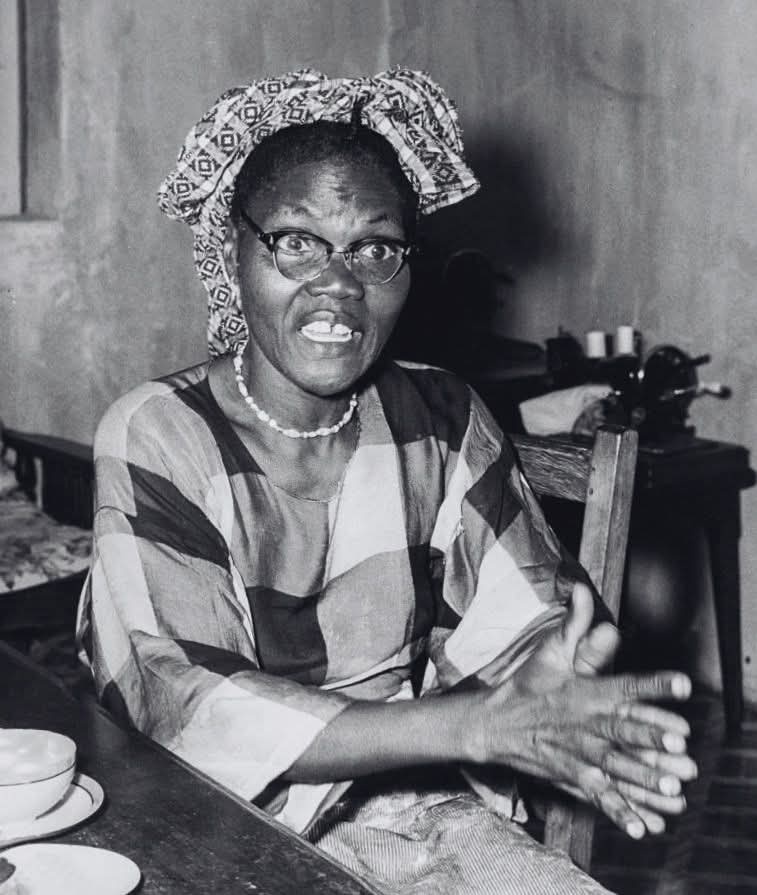
Chief Mrs. Olufunmilayo Ransome-Kuti, educator, nationalist leader and President of the Abeokuta Women’s Union, is interviewed at her residence in Abeokuta, Western Nigeria, in 1959.
Chief Mrs. Olufunmilayo Ransome-Kuti, educator, nationalist leader and President of the Abeokuta Women’s Union, is interviewed at her residence in Abeokuta, Western Nigeria, in 1959.
Olufunmilayo was born in Abeokuta in 1900, and was among the earliest Nigerian women to receive a formal Western education. After attending Abeokuta Grammar School, she proceeded to Britain for further studies before returning home as a teacher. But the classroom would prove only the beginning of a public life that would span more than four decades and place her at the centre of some of the most consequential political struggles in colonial and post-colonial Nigeria.
Her progressive public work was deeply intertwined with her family life. In 1925, she married Rev. Israel Oludotun Ransome-Kuti, an Anglican clergyman, prominent educator, and co-founder of the Nigeria Union of Teachers. Together, they established a household anchored in egalitarian values, shared responsibilities, and fierce commitment to social justice. This environment profoundly shaped their children, who would all grow up to become foundational figures in modern Nigerian history.
Among her children, her eldest son, Prof. Olikoye Ransome-Kuti, became a distinguished pediatrician and a globally respected Minister of Health who revolutionized Nigeria’s primary healthcare system. Her youngest son, Dr. Beko Ransome-Kuti, was a prominent medical doctor and human rights champion who spent decades leading pro-democracy movements against repressive military regimes. Her middle son, Fela Anikulapo-Kuti, went on to achieve global fame as the pioneer of Afrobeat music and an unyielding political dissident whose art challenged systemic corruption. Fela’s embrace of African identity inspired his mother to drop her colonial name and adopt the surname Anikulapo-Kuti in her later years.
The turning of her life toward mass politics came in Abeokuta during the 1940s. What began as efforts to improve educational opportunities for women evolved into a much broader challenge to colonial rule and traditional authority. Under her leadership, the Abeokuta Women’s Union grew from a local association into a formidable political movement whose membership eventually numbered in the tens of thousands. Market women, traders, artisans and farmers became an organised political force capable of confronting both the Native Authority administration and the British colonial government.
The dispute centred on taxation, representation and accountability. Women were being taxed through structures over which they exercised virtually no political influence. Ransome-Kuti argued that taxation without representation was unacceptable and demanded sweeping reforms. Her meetings drew enormous crowds. Delegations of women marched, petitioned and organised boycotts. The movement became so effective that colonial officials in Lagos and London followed developments in Abeokuta with growing concern.
At the centre of the storm stood Alake Sir Ladapo Ademola II, the powerful traditional ruler of Abeokuta. Ransome-Kuti and her supporters accused the Native Authority administration of arbitrary taxation, corruption and exclusion of women from decision-making. The confrontation culminated in one of the most dramatic episodes in Nigerian political history. In 1948, following sustained pressure from the women’s movement, the Alake was compelled to abdicate and leave Abeokuta. Few political activists anywhere in colonial Africa could claim such a victory against an entrenched alliance of traditional and colonial authority.
Her influence soon extended beyond Abeokuta. Through the National Council of Nigeria and the Cameroons (NCNC), she became involved in the wider nationalist movement led by figures such as Dr. Nnamdi Azikiwe, Herbert Macaulay and other advocates of self-government. She campaigned for constitutional reform, universal suffrage and greater African participation in government. At a time when political leadership across much of Africa remained overwhelmingly male, she insisted that women had an equal stake in the future of the nation and an equal right to shape it.
Colonial intelligence files reveal the extent to which British authorities regarded her as a political force. Her speeches, travels and meetings were closely monitored. Reports frequently described her as influential, uncompromising and capable of mobilising large numbers of people at short notice. Such attention was unusual for any African politician of the period and even more remarkable for a woman operating in a political environment still dominated by men.
Her reputation travelled far beyond Nigeria. During the late 1940s and 1950s she established links with anti-colonial movements, trade unionists, Pan-Africanists and women’s organisations across Africa, Europe and Asia. She visited Britain, the Soviet Union, China and several other countries, speaking about colonialism, racial equality, women’s rights and African self-determination. In international circles she became one of the most visible African women of her generation, long before African independence movements became global headlines.