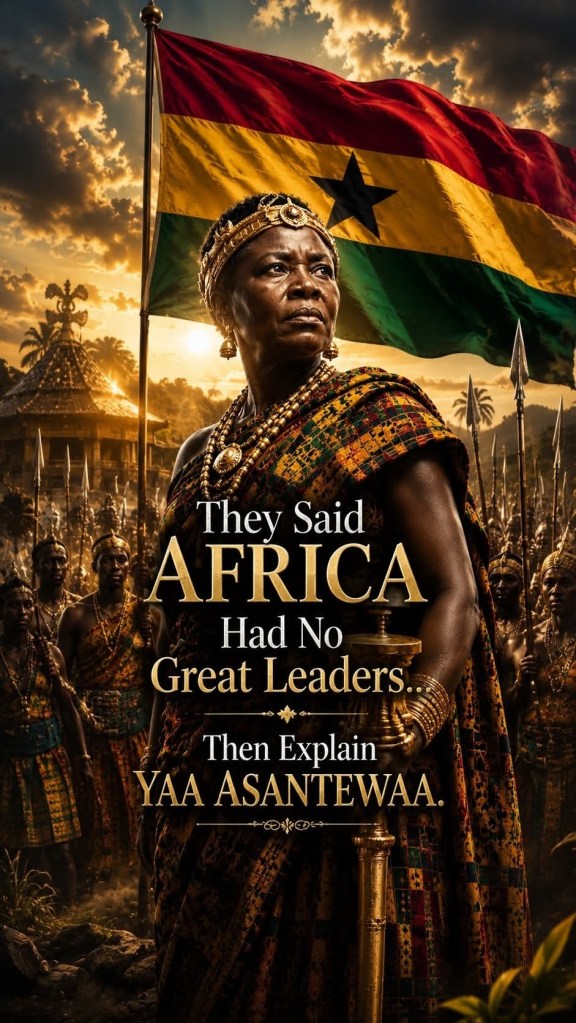
They Say Africa Had No Great Leaders… Then Explain Yaa Asantewaa.
They Say Africa Had No Great Leaders… Then Explain Yaa Asantewaa.
History has a way of exposing comfortable lies.
One of the biggest myths ever told is that Africans simply accepted colonial rule without resistance.
Really?
Then who was Yaa Asantewaa?
She wasn’t a queen hiding behind palace walls.
She wasn’t waiting for another nation to save her people.
She was a leader who looked one of the most powerful empires in the world in the eye and chose resistance over surrender.
Around 1840, Yaa Asantewaa was born into the Ashanti Kingdom—one of Africa’s most organized and prosperous states. This was not a society without government, law, military strategy, or diplomacy. The Ashanti had a functioning political system, international trade, skilled craftsmen, and immense wealth from gold long before European colonial rule reached its peak.
So if Africa had no civilization, why was Britain so determined to conquer Ashanti?
Was it charity?
Or was it because wealth attracts power?
By the late nineteenth century, Britain had fought multiple wars against the Ashanti. Yet despite superior weapons, defeating them was far from easy.
Then came the moment that changed history.
In 1900, the British governor demanded possession of the Golden Stool.
To someone unfamiliar with Ashanti culture, it may have looked like an ordinary royal chair.
It wasn’t.
The Golden Stool represented the soul of the Ashanti nation. It symbolized their unity, identity, and sovereignty. No king sat on it because it belonged to the people—not to one individual.
Now imagine a foreign governor demanding the flag of your country, your constitution, your national identity, and your history—all wrapped into one sacred symbol.
Would you call that peace?
Or domination?
Many Ashanti chiefs hesitated. They had already witnessed the devastation of previous wars.
Then one woman stood up.
Yaa Asantewaa.
She challenged the silence of the men around her with words that history has never forgotten.
“If you, the men of Ashanti, will not go forward, then we will. We, the women, will fight until the last of us falls.”
Read that again.
This was around 1900.
An African woman in her sixties became the military leader of a national resistance against the British Empire.
Does that sound like a continent without leadership?
She organized warriors, coordinated strategy, and led the uprising now known as the War of the Golden Stool. For months, British forces struggled against determined Ashanti resistance.
Yes, Britain eventually won the military campaign after sending overwhelming reinforcements with superior firepower.
But here’s the part many people never mention.
The British never captured the Golden Stool.
The very object they came for remained hidden.
They occupied territory.
They did not possess the soul of the Ashanti people.
Yaa Asantewaa was captured and exiled to the Seychelles, where she died in 1921.
She never returned home.
But her sacrifice did not disappear with her.
The Ashanti identity survived.
Their monarchy survived.
Their traditions survived.
And decades later, Ghana became the first country in sub-Saharan Africa to gain independence from British colonial rule.
So before anyone says Africans accepted colonialism without a fight…
Before anyone claims Africa produced no great military leaders…
Before anyone argues that African women had no political power…
Study Yaa Asantewaa.
History doesn’t ask us to romanticize the past.
It asks us to tell it honestly.
And honestly…
If one woman could inspire an entire nation to defend its identity against the most powerful empire of her time…
Maybe the real question isn’t whether Africa had heroes.
Maybe the real question is why so many of their stories were left out of the history we were taught.