The First Supreme Military Council Meeting After the January 1966 Coup
The First Supreme Military Council Meeting After the January 1966 Coup
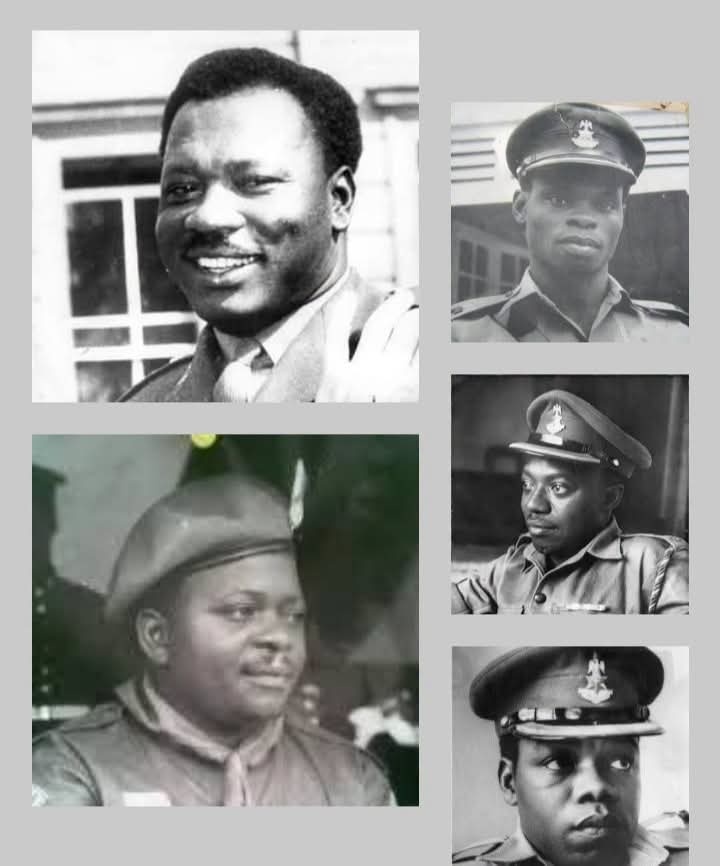
Following the January 15, 1966 coup, the first meeting of the Supreme Military Council was held at the old Government House in Lagos under the leadership of Major General Johnson Thomas Umunnakwe Aguiyi-Ironsi, who had become Nigeria’s new Head of State at the age of 42.
Also in attendance were:
- Lieutenant Colonel Hassan Usman Katsina, 33, Military Governor of the Northern Region.
- Lieutenant Colonel Adekunle Fajuyi, 40, Military Governor of the Western Region.
- Lieutenant Colonel Chukwuemeka Odumegwu Ojukwu, 33, Military Governor of the Eastern Region.
- Lieutenant Colonel David Akpode Ejoor, 34, Military Governor of the Mid-Western Region.
According to Frederick Forsyth’s biographies of Ojukwu, much of the meeting was spent with each officer recounting where they had been during the January coup, what they had witnessed, and how they had responded. Once everyone had spoken, Aguiyi-Ironsi instructed the governors to return to their respective regions and resume administration.
Before the meeting ended, however, Ojukwu asked a question. He wanted guidance on the policy framework the new military government should adopt in governing the country. Hassan Katsina reportedly made a light-hearted remark in Hausa, roughly translating to, “The Englishman with his long words,” prompting laughter around the room.
Aguiyi-Ironsi, however, remained serious. Looking directly at Ojukwu, he replied:
Ironsi: “You are an army officer?”
Ojukwu: “Yes, sir.”
Ironsi: “You know your duty?”
Ojukwu: “Yes, sir.”
Ironsi: “Then go to Enugu and do it.”
The brief exchange effectively served as Aguiyi-Ironsi’s instruction to all the military governors: return to your regions and govern.
It was an extraordinary moment in Nigeria’s history. Five career soldiers, trained in the British military tradition and aged between 33 and 42, suddenly found themselves responsible for governing a nation despite having little or no prior political or civil administrative experience.
After arriving in Enugu, Ojukwu sought to broaden his administration by consulting representatives from across the Eastern Region. He established an Advisory Committee and a Council of Chiefs and Elders to provide guidance on governance at a time when political parties and political gatherings had been banned.
The episode illustrates the immense challenges faced by Nigeria’s first generation of military administrators as they transitioned from commanding troops to governing millions of citizens during one of the country’s most turbulent periods.
Sources:
- Emeka: The Biography of Chukwuemeka Odumegwu Ojukwu by Frederick Forsyth.
- The Making of an African Legend: The Biafra Story by Frederick Forsyth.
 Hi welcome to my website