THE BIRTH OF MANDEN: BEFORE THE EMPIRE, THERE WERE THE KAKORO.
THE BIRTH OF MANDEN: BEFORE THE EMPIRE, THERE WERE THE KAKORO.
Most people know the names Ghana (Wagadou) and Mali (Manden).
Far fewer understand how Manden itself came into being.
History did not begin with the Mali Empire.
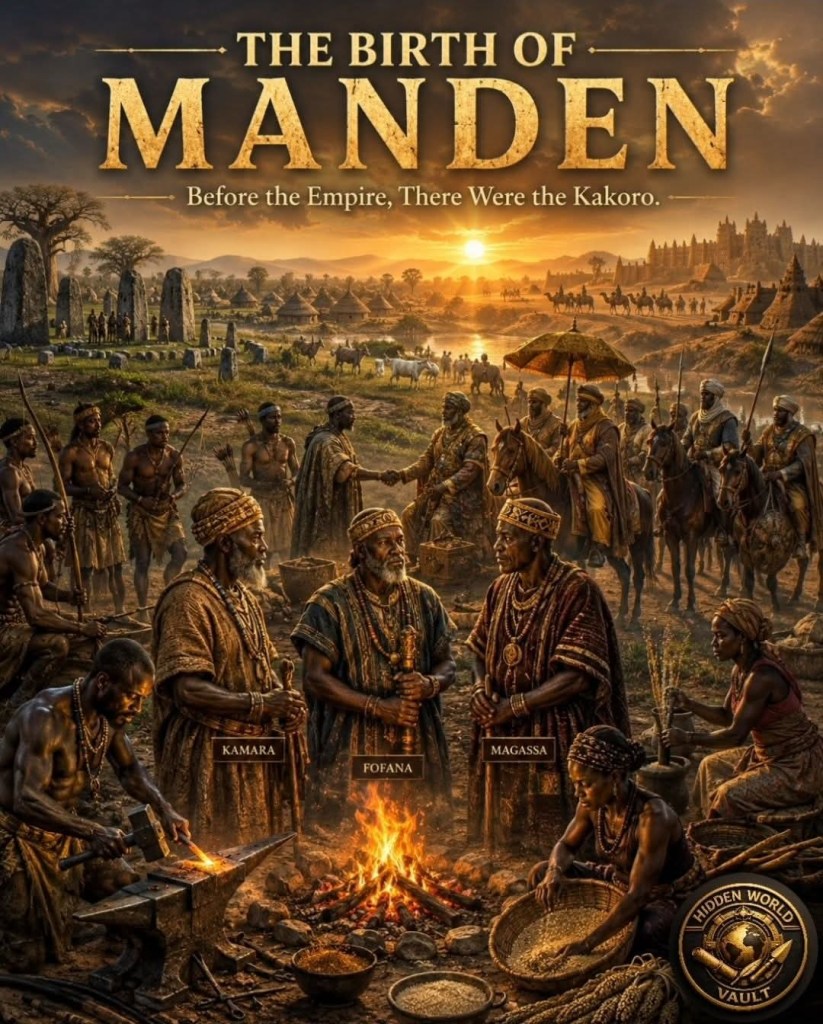
Long before Sundiata Keita united Manden, and long before the Kingdom of Wagadou (Ancient Ghana) emerged as one of Africa’s greatest powers, Manding oral traditions preserve the memory of an ancient people known as the Kakoro (Kakolo).
These traditions describe the Kakoro as among the earliest inhabitants of the western Sahel, hunters, farmers, metallurgists, ritual specialists, and founders of many of the lineages that would later shape the Mandé world.
According to these oral traditions, the Kakoro spoke Kakorokan, remembered as the earliest form of the Manding language from which later Manding languages gradually evolved. While this linguistic reconstruction belongs to oral tradition rather than established historical linguistics, it remains one of the most important historical memories preserved by Manding Jalis (Griots).
According to the genealogist Djeli-Baba Cissoko, the Kakolo originally comprised three families, from which all others descended. These were: The Kamara, Fofana, and Magassa as the three original Kakoro families. From these founding lineages emerged many of the great Mandé surnames known today, including Konaté, Kouyaté, Kanté, Mariko, Koita, Bamba, Konaré, Kané, Kanouté, Kamissoko, Nomoko, Timité, Koté, Nyakaté, Danté, Sinyaté, and many others.
This tradition presents the Kakoro not simply as another ethnic group, but as one of the deepest ancestral foundations of the Mandé world.
Centuries later, Soninké-speaking populations established the Kingdom of Wagadou, known to the outside world as the Ghana Empire.
Modern historical scholarship broadly agrees that Wagadou emerged as a Soninké kingdom whose wealth rested upon trans-Saharan commerce, gold production, military organization, and political centralization.
However, Wagadou did not emerge in an empty land.
According to Manding oral traditions, the Soninké encountered populations already living throughout the western Sahel, among them the Kakoro. Over many generations these communities did not simply replace one another. They traded, intermarried, forged political alliances, exchanged technologies, shared religious traditions, and gradually created a broader historical community.
Rather than viewing West African history as a succession of isolated ethnic groups, these traditions remember a long process of cultural interaction and assimilation.
From this historical process emerged what some Manding traditions remember as the Wangaran; not originally as a single ethnic group, but as a broader political, commercial, and cultural community linking Wagadou with the civilization that would later become Manden.
Mainstream scholarship often describes the Wangara as long-distance Muslim merchant networks active throughout the Ghana, Mali, and Songhai periods. Manding oral traditions preserve an additional perspective, remembering the Wangaran as a wider historical community that emerged from centuries of interaction between Soninké and older Manding populations.
These two perspectives need not necessarily contradict one another. They may illuminate different dimensions of the same historical process.
Understanding this helps explain one of the most remarkable features of West African history.
Ancient surnames such as Cissé (Ceesay/Sesay), Sylla (Sillah), Kamara, Fofana, Sakho, Gassama, Kanté, Konaté, Kouyaté, Mariko, Magassa, Koita, Touré, Traoré, Diabaté, Condé, Koroma, and many others are found across numerous Mandé-speaking communities today.
Their widespread distribution reflects centuries of migration, assimilation, Islamic scholarship, commerce, diplomacy, political alliances, and state formation—not the rigid ethnic categories that many people often project backward into the distant past.
The birth of Manden was therefore not the work of one family, one clan, or one people alone.
It was the result of generations of interaction among ancient populations whose descendants collectively shaped one of Africa’s greatest civilizations.
At Hidden World Vault, we distinguish clearly between:
Mainstream historical scholarships — conclusions widely supported by historians, archaeologists, linguists, and written sources.
Oral traditions — historical memories preserved across generations by Manding, Soninké, and other West African communities.
Historical synthesis — careful attempts to compare both traditions while remaining transparent about where evidence is strongest and where interpretations remain debated.
Recovering Africa’s past requires intellectual honesty.
It also requires respecting both written history and oral memory.
Our history is deeper than many of us were taught.
And we are only beginning to uncover it.
REFERENCES
- Cissé, Youssouf Tata. La Grande Geste du Mali: Des Origines à la Fondation de l’Empire. Paris: Karthala. (Based on the Yéréré oral traditions and the testimony of the Kakolo genealogist Djeli-Baba Cissoko.)
- Cissé, Youssouf Tata. Studies on the Yéréré traditions and Kakolo (Kakoro) oral history, documenting the genealogies of the ancient Kakolo clans and their relationship to later Mandé lineages.
- Delafosse, Maurice. Haut-Sénégal-Niger. Paris: Émile Larose, 1912. (Discussion of ancient Sudanese populations, including references to Kagoro/Kakolo traditions.)
- Lucas, A. J. (1901). Early studies on West African historical traditions concerning ancient Sahelian populations.
- Proceedings of the International Seminar on the Peopling of the Sahel. Niamey, 1981. (Comparative discussions on early populations of the western Sudan.)
- Manding Jali (Griot) oral traditions preserved across Mali, Guinea, Senegal, The Gambia, Sierra Leone, Liberia, and Côte d’Ivoire.