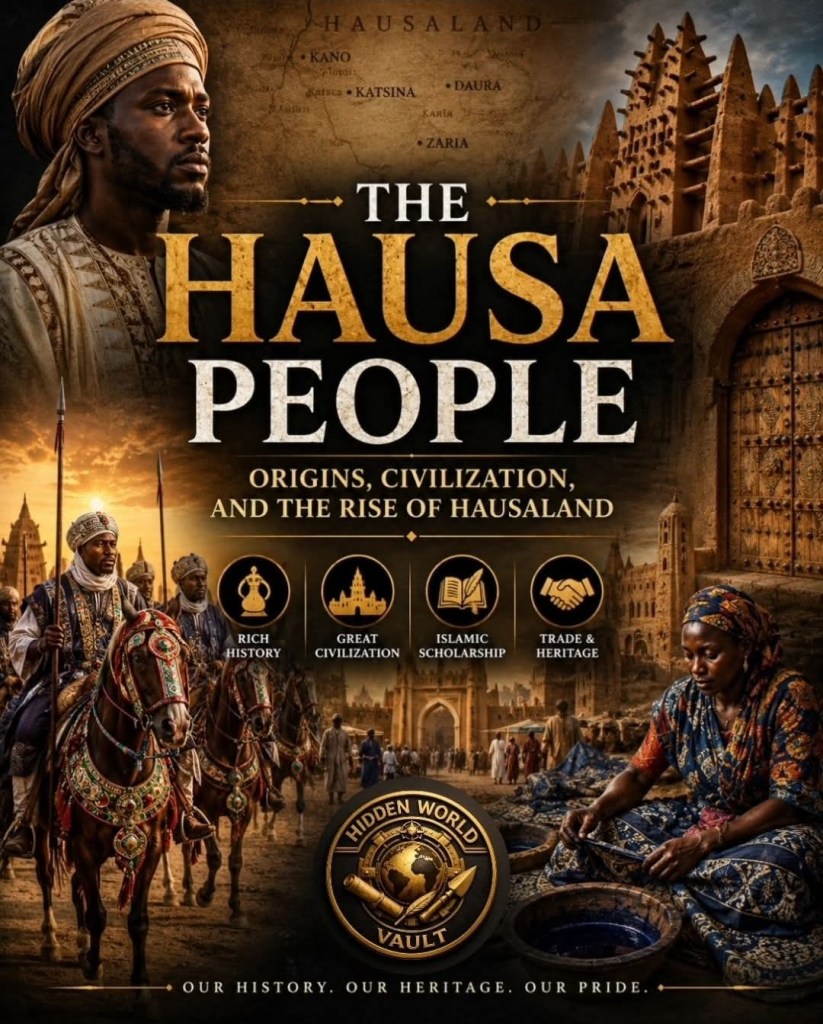
THE HAUSA PEOPLE: ORIGINS, CIVILIZATION, AND THE RISE OF HAUSALAND
THE HAUSA PEOPLE: ORIGINS, CIVILIZATION, AND THE RISE OF HAUSALAND
The Hausa people are among the largest and most influential ethnic groups in Africa. Today, they are found primarily in northern Nigeria and southern Niger, with significant communities across Ghana, Cameroon, Chad, Benin, Togo, Côte d’Ivoire, Sudan, and other parts of West and Central Africa. Through centuries of migration, trade, Islamic scholarship, and commerce, Hausa-speaking communities have spread far beyond the borders of Hausaland.
The Hausa language is one of Africa’s most widely spoken languages and serves as a major lingua franca across much of West Africa. It belongs to the Chadic branch of the Afro-Asiatic language family and has developed through centuries of interaction with neighbouring peoples and cultures. While Arabic has contributed many religious and scholarly terms following the spread of Islam, Hausa remains an indigenous African language with a long and rich history.
One important distinction should be made from the beginning.
Being Hausa and speaking Hausa are not always the same thing.
Millions of people speak Hausa as a second language for trade, education, administration, and everyday communication without identifying ethnically as Hausa. This reflects the historical importance of Hausaland as one of West Africa’s great commercial and cultural centres.
- The Origins of the Hausa
The exact origins of the Hausa people remain a subject of historical research.
Mainstream scholarship suggests that the Hausa gradually emerged within the central Sudan region through the interaction of local populations over many centuries. Archaeological evidence indicates that urban settlements were already developing in parts of Hausaland by the first millennium CE, eventually giving rise to organized kingdoms.
Alongside academic research, Hausa oral tradition preserves the famous story of Bayajidda, a legendary figure associated with the founding of several Hausa kingdoms. According to tradition, Bayajidda arrived in Daura, slew the serpent that prevented people from drawing water, married the queen, and became the ancestor of the rulers of the seven classic Hausa states (Hausa Bakwai).
Whether understood as history, symbolic memory, or political tradition, the Bayajidda narrative remains one of the most important cultural foundations of Hausa identity.
- The Rise of Hausaland
By approximately the 11th–14th centuries, several independent Hausa city-states had become major centres of commerce, governance, scholarship, and craftsmanship.
Among the most famous were:
- Kano
- Katsina
- Daura
- Zazzau (Zaria)
- Gobir
- Rano
- Biram
Each kingdom possessed its own ruler, administration, military, and commercial networks while sharing a common language, many cultural traditions, and long-standing diplomatic relationships.
Unlike centralized empires such as Mali or Songhai, Hausaland consisted of multiple independent kingdoms connected through trade, kinship, diplomacy, and shared civilization.
- Commerce and Urban Civilization
Hausaland became one of the great commercial crossroads of Africa.
Its merchants traded gold, leather, textiles, salt, grains, livestock, iron, and later kola nuts across the Sahara into North Africa and throughout West Africa.
Cities such as Kano developed into internationally recognized centres of manufacturing and commerce. Hausa leatherwork, indigo-dyed textiles, metalworking, architecture, and market systems became famous throughout the region.
- Islam and Cultural Transformation
Islam gradually entered Hausaland between the 11th and 14th centuries through merchants, scholars, and trans-Saharan trade.
Rather than immediately replacing older beliefs, Islam spread gradually alongside existing religious practices. Over time it became deeply rooted in Hausa society, influencing education, governance, law, architecture, literature, and scholarship.
Even after the spread of Islam, some communities continued to preserve older religious traditions, including the Bori spiritual tradition, demonstrating the complex religious history of Hausaland.
- The Fulani Jihad and the Sokoto Caliphate
In the early nineteenth century, the Fulani scholar Usman dan Fodio launched a reform movement that developed into a jihad.
Between 1804 and 1808, many Hausa kingdoms came under the authority of the newly established Sokoto Caliphate.
This period transformed the political organization of Hausaland but did not erase Hausa identity.
Instead, Hausa language, urban culture, administration, and commercial traditions continued to flourish within the Sokoto Caliphate. Over time, many Fulani rulers adopted Hausa language and aspects of Hausa culture, while Islamic scholarship expanded across the region.
For this reason, historians distinguish between the Hausa as an ethnic group and the Hausa-Fulani political and historical relationship that developed during and after the Sokoto Caliphate.
- Hausa and Fulani
A common misconception is that Hausa and Fulani are the same people.
They are not.
The Hausa and Fulani are distinct ethnic groups with different historical origins and languages.
The Hausa speak Hausa, a Chadic language.
The Fulani speak Fulfulde, an Atlantic language within the Niger-Congo family.
Centuries of coexistence, intermarriage, political alliances, and Islamic scholarship created close historical connections between the two peoples, but they remain distinct communities with their own historical identities.
- The Hausa Today
Today the Hausa remain one of Africa’s most influential peoples.
Their language serves as a major regional lingua franca.
Their commercial traditions continue to shape West African markets.
Their scholars have contributed significantly to Islamic learning.
Their music, architecture, literature, clothing, festivals, and artistic traditions remain among the richest on the African continent.
The story of the Hausa people is therefore not simply the history of one ethnic group.
It is the story of one of Africa’s greatest civilizations.
- Hidden World Vault Research Note
At Hidden World Vault, we distinguish between:
Mainstream historical scholarship — conclusions supported by historians, archaeologists, linguists, and written historical sources.
Oral traditions — historical memories preserved across generations within Hausa communities.
Historical synthesis — careful comparison of both traditions while remaining transparent about where scholarly consensus exists and where interpretations continue to evolve.
Understanding Africa’s past requires respect for both documented history and the invaluable oral traditions that have preserved historical memory for centuries.
Our history is deeper than many of us were taught.
And the journey to recover it continues.
REFERENCES
Mainstream Historical Scholarship
- Paul Newman, A History of the Hausa Language: Reconstruction and Pathways to the Present (Cambridge University Press, 2022).
- Frank A. Salamone, The Hausa of Nigeria (University Press of America, 2010).
- Philip J. Jaggar, Hausa (John Benjamins Publishing, 2001).
- G. P. Bargery, A Hausa-English Dictionary (Oxford University Press, 1934).
- M. G. Smith, The Affairs of Daura (University of California Press, 1978).
- Murray Last, The Sokoto Caliphate (Longman, 1967).
- Nehemia Levtzion & J. F. P. Hopkins (eds.), Corpus of Early Arabic Sources for West African History (Markus Wiener Publishers).
- Encyclopedia Britannica, “Hausa” and “Hausa Language.”
- Dziak, Mark. Hausa People (Research Starter, 2023).
- Saidou Barmo Zaiya, “Origin, Language, Culture, History and Beliefs of the Hausa People,” Right for Education Foundation (2024).
Oral Traditions
- Hausa oral traditions concerning Bayajidda and the Hausa Bakwai (Seven Hausa States).
- Oral traditions preserved by Hausa royal courts, traditional historians, and praise singers.
- Islamic scholarly traditions preserved in Kano, Katsina, Daura, Zaria, and Sokoto.
Historical Sources
- Tarikh al-Fattash.
- Tarikh al-Sudan.
- Kano Chronicle (Tarihin Kano).